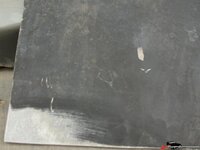
I just mix my own filler from epoxy or build it up enough not to need any.
A lot of people get hung up on this SMC stuff.
All corvettes, except I think the first experimental display car (hand laid up) had panels made by
press moulding. In the C2 era, the 2 halves were sprayed with release agent, then mat was laid in the mold, then closed and resin injected and heated to cure.
To speed up the cycling time and produce a more uniform panel, SMC (Sheet Molded Compound) was used, a few panels in the late C2's but almost exclusively in C3's and later. the chopped glass strands and resin and release agent (in the case of C3s) was manufactured between paper layers (sort of a soft clay like texture) and placed in the mold and press formed the same as the earlier panels. It was quicker, better quality and cheaper. The resin compounds and glass ratios were changed almost every year due to advances in composite chemistry.
Fast forward to 2003, the Dodge Viper was the first car to use carbon fiber that is SMC (which means it is also press molded) in the windshield frame and door supports and front fender mountings. The Viper used a modified vinyl ester matrix as a resin. Don't know what the new Corvettes use. It's really a moot point because epoxy is the best to use, period. BTW there are over 2800 variations of epoxy commercially available and more can still be specially formulated for a particular use.
General Dynamics uses SMC of carbon fiber and epoxy resin to make guideing tubes for aircraft born missles. There is
NO release agent mixed into the resin, the mold halves are sprayed with PTFE for release.
So SMC doesn't mean that release agent is automatically in the mix.
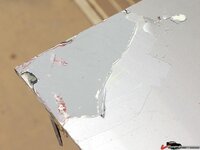
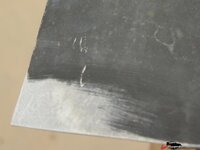
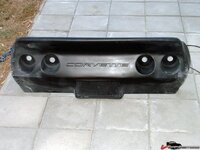
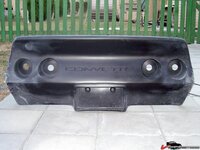
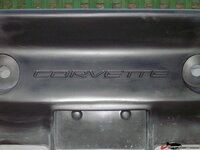
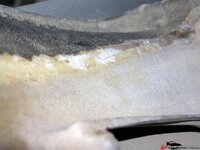
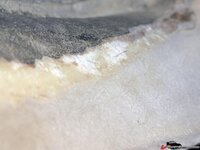
Here are a couple of pics of a inner fender that is "press molded" and just happens to be "SMC" too. Note it is smooth on both sides. I scuff sanded them with 220 to prep for paint, easier off the car than installed.
Ones Side
Other Side
They are both very smooth on each side.
Compare that with your fender backside.

If you have any fiberglass boats in Sandland you can match your finish. Not press molded. Compare with the fingernail test.
To make this even more boring, a self proclaimed vette expert saw my DD at a store one day, and after saying "nice car" nit picked it apart for the duration of his lecture. He saw the inner fender that someone had cut out to get at the ac/heater box and told me that was a costly major repair that took a real expert like his buddy to replace the inner fender. I told him that the seller had given me the pieces. He said it was impossible to repair that way. :huh:
I just smiled and said Oh.
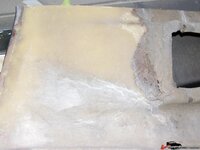
Here is the damage
Here are the pieces stuck on with a/c duct foil tape (the heavy stuff, not Homey Depot junk). The engine side is not taper ground, so as to make a flush fit.
The wheel side has all the mating joints ground with 30 grit to a next to nothing taper.
The foil tape holds these pieces well enough that I could mount the recovery bottle back in it's place and drive at highway speeds with no fear of it coming loose. The more layers you add the stronger it becomes. You must use a squeegee to stick it down well.
Once the wheel side is galssed and built up enough to be flush after sanding, then the other side will be "v" ground with the 30 untill touching the new glass in the center of the grind and built up to be flush. There should be no need for any kind of filler. Just grinding and sanding carefully from 80to about 220 and then some black paint.
Hope you can use the foil tape trick sometime, saves a lot of fussing around.
BTW, I really hate glass work, done too much of it and am over it.
SMC





![Pampers Sensitive Baby Wipes, Clinically Proven, Fragrance Free, Unscented, Water Based, Hypoallergenic, Multi-Use, Hand Wipes 336 Wipes Total (6X Flip-Top Packs) [Packaging May Vary]](https://m.media-amazon.com/images/I/41KLBHu9CAL._SL500_.jpg)





 :friends:


 prrtt: