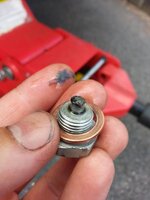
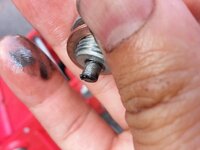
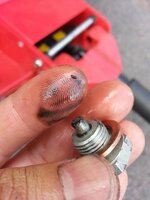
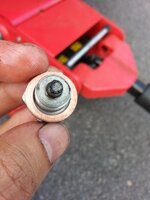
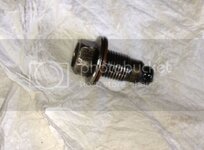
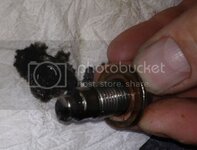
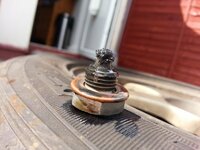
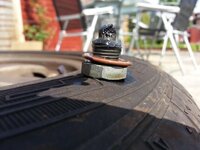
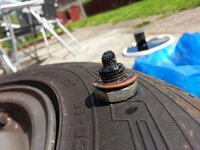
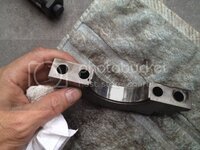
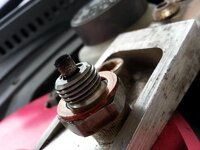
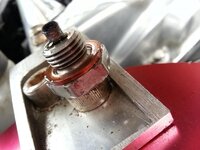
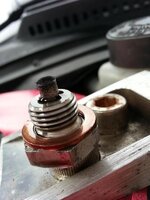
Metal shavings on magnetic oil drain plug

VetteMod - Corvette Restoration, Modding & Performance Forum

Help Support VetteMod Forum:

Something writen above reminded me, I noticed a DRAMATIC reduction in sludge on the magnetic plugs when I started sealing the inside of the blocks with Glyptol. Not chips mind you, just ferrous sludge. I believe the pores of cast iron blocks are filled with crap that is sealed in by the paint.

Obviously this has to be done just after the block is well boiled...

I'll agree on that. Cast is just that- cast. All those pits and valleys have junk in them that will get washed out sooner or later.

and Gene- YES, analysis CAN tell the difference between bearing material and iron, right down to how much silicone,manganese,bronze,copper,tin,or whatever else you might find in there. My diesel pickup is starting to trend high on bronze- up to .03 parts per million. So I've moved the oil change intervals from 12,000 to 10,000 miles.
 
I know the oil test can tell between metals, the question was more concerning if it could tell WHAT was wearing?? say the timing chains are made of one type steel call it ABC, and the cams are made of XYZ steel or some such, and the block is !@# type iron.....

is there any way to correlate that with a oil test???

the above is a curiosity type question as I think it's much easier to just tear the SOB down....

:huh:
 
I know the oil test can tell between metals, the question was more concerning if it could tell WHAT was wearing?? say the timing chains are made of one type steel call it ABC, and the cams are made of XYZ steel or some such, and the block is !@# type iron.....

is there any way to correlate that with a oil test???

the above is a curiosity type question as I think it's much easier to just tear the SOB down....

:huh:
A SOAP test certainly can. Spectrometric Oil Analysis (Program) can tell you how many ppm of what metals are present in your oil. If you know what all your components are made from, you can tell what's wearing. You start a trend graph from new build and plot all your samples. The SOAP results will be high for a little while with build wear debris and the engine "bedding in". Once it settles down, you sample regularly and watch your trend, when something starts climbing and veering away from the trend, you know something's on it's way out - whichever metal is veering away from the trend will tell you what component is failing. With aero engines, manufacturer info will dictate what time to replace the component, they may even reduce the time between samples so they can monitor the item more closely before rejecting it.

That what you mean?
 
Cute, so they CAN tell the diff between cam/chain/pump/gear/cyl wall wear, or even CRANK surfaces, somehow I doubt a huge variation in the metal needed for a particular application...

more applicable to major machinery than a mear car engine, I suppose, really....

:crutches::flash:
 
Gene,

Thanks for stopping by yesterday!

I know you'd rather just tear it down, cause you'd have to if it's broke to fix it anyway, and that makes sense.....if it's actually broke. The SOA is simply an early warning tool, if it isn't quite broke yet, or if it's just getting started, you may not even see it physically (depending on where the failure is) unless you pulled the entire engine down right? But you can see it with a SOA, it can help you see things before they've actually failed. If you pull it apart, depending on how far (if at all) some thing is near failure, you may not find it anyway unless you measure everything if it isn't obivous to the most casual observer! And if you don't find anything, you still have the time, parts, oil, etc., that cost way more than the silly SOA. The big plus on the SOA is that if it's normal wear in, or residual gunk in the engine, the SOA will show that, a tear down won't. Just do the SOA to start out with.....
 
Fun seeing your project there man, need to figger out what to do today, raining like hard today....wonder if I should work on the vette in the garage, or play lazy retarred guy ....

:crap::bonkers:
 
After I get some of the work stuff done today, it's back to cleaning parts!!! Good day for it, since it's a day for ducks outside!!!
 
Hi guys,

Apologies for bumping a really old thread, but alas I'm a fellow car enthusiast and Google brought me here, so I was wondering if I could find some advise.

I have recently had my engine rebuilt. It lasted two hours of very light load on the highway at 70mph. It ended up getting rod knock and when I checked the oil, I had a similar 'fluff' on the magnetic plug, but not so bad as the OP of this thread. The oil was however littered with metal specs. I took the car back to my engine builder and upon teardown the crank and bearings were all shot.

They rebuilt the motor by way of having the crank ground down and using their own choice of bearings (they didn't like the ACL bearings that I used on the first build). The rods were inspected for roundness and so was the engine girdle.

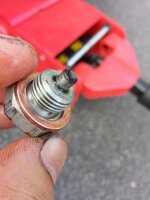
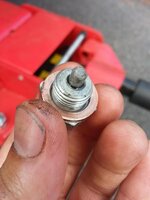
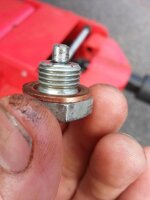
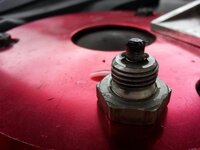
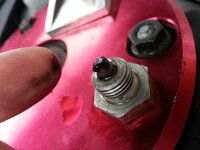
Anyway, so I've had the car for a month now. I've had some electrical gremlins and other issues meaning that I'm yet to take the car on the main road and give it some miles - it's only really idled on my driveway (While I tune the fuelling/ignition/vvt etc) and I've done a grand total of 1 mile just driving around my block. I changed the oil last week and it had the same amount of fluff or filings as the first time the engine failed. I changed the oil and filter, ran the motor for 2 hours, then drained again...it came out clean. I've given it a week of more tuning and some light driving around my block, drained the oil today and found some more (albeit very light) filings/black gunk on the drain plug. There was also a very small 'chip' (please see pics below) also. The motor runs like a champ at the moment, but then it also ran great last time until it spun a bearing. Graphogen assembly lube was used on the second build to act as a added security against failure.
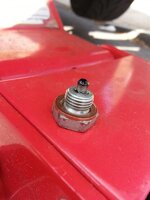
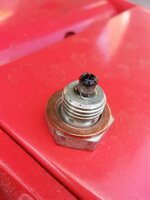
20130907_164544_zpsd15325eb.jpg

20130907_164554_zpsb5efa1e4.jpg

20130907_164634_zps3b04228e.jpg

This chip is what bothers me most alarmingly...
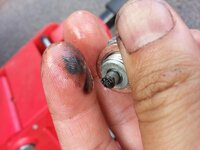
20130907_164718_zpsca9cb421.jpg

20130907_164725_zps844bb687.jpg

20130907_164738_zps51579eb3.jpg

20130907_164755_zpsa5815420.jpg

20130907_1648010_zps086a4df1.jpg

20130907_164836_zps222bd24b.jpg

20130907_164839_zpsba791117.jpg

My main question goes to the OP I guess.....how did this turn out for you? Did it all work out well with the motor that had the filings, or did it end in tears?

Failing that, any good advice would be great. I know it's not a Vette (my car is a 2zz-ge powered Celica) but the concept is the same I guess :)
 
My engine is now at 3900 miles, runs fine, no problems. 2000 miles in 4 years is not much, maybe I should drive it more ....
I am going to change the oil soon and I'm going to update this thread then
 
Last edited:
Thank you for your feedback sir.

Well, 3900 miles is 3700 miles more than what my motor held up to so I can take some heart from your positive experience.

Have you not changed the oil then for a good while?
 
Well, I try to remember to change the oil every 12 months or so even though that's usually less than 1000 miles. I have been putting off this oil change because I have a new 7qt pan that I want to install. Obviously, dropping the oil pan is not going to be fun .... I am however curious what I'm going to find in there .....
 
Thank you for your feedback sir.

Well, 3900 miles is 3700 miles more than what my motor held up to so I can take some heart from your positive experience.

Have you not changed the oil then for a good while?

That fluff on your drain plug could be just that- fluff. Unless your builder pulled ALL of the oil galley plugs and washed and swabbed the galleys, (most don't), it could very well be just some trash that was trapped and then washed out later.
 
Drained the oil today, had some more "fluff" on the magnetic plug.... I'm not too concerned but I'm pulling the pan to swap the oil pump and the pan, going to post a few photos once the pan is down.....
 
Of course not wanting to thread hi-jack, I'm just contributing to this thread as it seems interesting that mybad79 is documenting the same thing here, so it's interesting to see it from another cars perspective - here are some pics of my magnetic sump plug too - this was after 150 steady miles on the highway and it developed rod knock:

magneticsumpfilings3_zpsc2392afc.jpg

magneticsumpfilings2_zps78f9d352.jpg

magneticsumpfilings1_zps3aadae5d.jpg

This weekend, I changed the oil and although the micro particles are significantly reduced, I saw a couple of bigger ones. 5th oil change in a month. Miles covered is around 50. Freshly built motor.

20130914_125735_zps092ca633.jpg

20130914_125813_zpsbbdd71f7.jpg

Hopefully this is 'normal' for breaking in a new motor.

Mybad79, i'll be keeping a close eye on your progress with this :)
 
The first three photos you posted show the particles before the second engine rebuild????

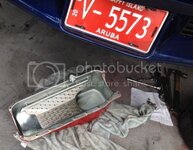
I dropped the oilpan today, there was a "sludge" at the bottom of the pan. I am convinced it's assembly lube - at least I hope that's what it is.... That sludge seems to hold the particles in the pan and it seems the sludge does not get flushed out with an oil change.

******* me ... Didn't take a photo before wiping the pan .....

photo_zps93990acb.jpg

You can see some of the sludge/crud at the front of the sump....

I suggest you pull your pan and clean it, then see if the oil stays clean....
 
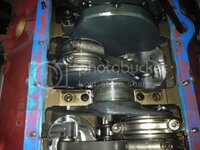
Pulled a main cap to inspect the bearing, fortunately it seems to be in good shape.... The engine runs fine without any strange noises so I had really no reason to believe the bearings are bad but just for piece of mind I pulled one ....

photo_zps876a7ae8.jpg
.
photo_zps1f76fa1c.jpg
.
 
first the magnetic drain plug is doing what it should....

I just did and oil change on my 502... 5200 miles total and about 1200 since that oil change in the spring.. same kinda deal the end of drain plug had some cruft on it... same as my harleys... it always does... it is very fine... a collection of particulate matter smaller than what 6-10 microns or some such what ever the filter cant get. a high percentage of usually dropping off under 25 microns or so ..

If its not filings or chips... forget about it...

Oil analysis is good thing more data is always better.

My guess is that it is normal wear and tear and qualitative analysis will show that it is cast iron and molybdenum and lots of other gunk.. If your worried about wear switch to mobil 1 and run it hard...
or a semi-synthetic if you let it set alot... can you say non-hygroscopic. full synthetics are hydrophobic to some extent in that they dont absorb water... Read up on why Mobil pulled out of the Piston Engine Aviation market

IMHO
 
The first three photos you posted show the particles before the second engine rebuild????

Apologies for the delay, I don't visit here too much.

Yes those first pictures (the ones in this page) are from the first drive on the rebuilt engine (which has loads of assembly lube btw) and then the pictures with a lot less fluff are from a few weeks ago effectively on the 'newer' version of the engine (bearings replaced because that fist motor with the filings wiped all of it's bearings on the highway within 100 miles)

I did an oil change yesterday and it's looking pretty good now (touch wood!) - very light fluffy microparticles which I can only assume are 'normal'

20131005_130544_zpsdef3ca49.jpg

20131005_130601_zps48aec17d.jpg

20131005_130619_zps8d795594.jpg

Looks like your motor is doing good too bro, which is always good to know :)
 
I've been running magnetic plugs since the early 70s.
You will always get that fluff on the magnet, the stuff that does not feel gritty. It's a good thing.

FYI, way back I had several bikes that had roller bearings at the crank, rods and wrist pins and still had the fluff. Nothing to worry about at all.
 
that's good to know, thanks for sharing.

out of curiosity, is there any reason why you say it's a good thing to have the soft stuff, or did you mean that it's just totally harmless?
 
Hey guys, for what it's worth, I'll post up my findings here in case if helps anybody in the future.

I kind of always had an oil consumption issue on this motor since I had it running last autumn. This spring however, it had gotten worse and I was getting wet plugs. Clutching at straws, I replaced the valve seals...no improvement.

Tore down the block and sure enough the piston rings weren't fitted properly. My motor has a special support/spacer ring that sits amongst the oil control rings (only Lord knows why) and the builder didn't know what to do with them, so he didn't fit them.

My bores were chewed up from the wayward piston rings and in some places down low, you can still see where the rings dug into the bores due to the excess clearance.

That's where my filings were coming from - just thought I'd share.
 
Years ago I tried to help a buddy who insisted on assembling his own short block.....a royal failure.....

never again.....heads taken to shops also....I can put heads on the block, slip the cam/chain home, bolt on pans....all the simple ****, but pretending I am a machinist NO!!!!


:eek::surrender:
 
So far so good .... My engine is still running fine, next oil change we will see if there are still some shavings.....
I used syntetic at the last oil change and they say it's good for either 10000 miles or one year..... I drive maybe 2000 miles a year, actually less now that I work on my new house all the time...
My '79 is probably going to ne moved over to the new house around the end of the year, then oil change and hopefully a few winter/spring trips along the coast....
Until then I'll try to forget about this oil sludge/shavings issue.....

..... Might find myself in a LSx swap next year ....lol.....
 
Back
Top