Rear spoilers

VetteMod - Corvette Restoration, Modding & Performance Forum

Help Support VetteMod Forum:

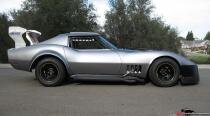
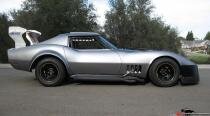
Critique this rear.
My hypothesis is it doesn't work at all
vemp_0603_07_z+black_1969_corvette_coupe+rear_view.jpg

Here's my amateur view:
the spoiler is mounted too low to be effective. Where it's at the air would be tumbling off the rear window and play all sorts of havoc with clean air flow

the deck spoiler is for nothing but show, and would create huge turbulence behind the car

there's no belly pan or defusers

the mirrors are useless (okay, not spoiler related but curious if you could see around the widebody kit)


That said, I do like the look of that rear profile - reminds me of the Shelby Daytona coupes....
 
It is really, really PURDY!
Seriously - it looks nice.

The wing does appear low - as you've commented. But it would be coupled with the rear oversized Gurney-style "flap," and yes a diffuser would - REALLY benefit here too. So, there is some flow change and appears to be in the correct direction for increasing Downforce.

Rear turbulence is not necessarily a BAD Thing. You can reduce overall Drag - with a bit of that - note the KAMM-effect:
If a body is not properly conditioning flow on exit - cut it off and end the skin friction and Boundary build up and pay the penalty elsewhere. (my version)​

Some folks can't get over "Mud-Flap" flares - but I'm pretty sure they would be useful for flow considerations as well. - For BOTH front and rear -- at least that's where I'm heading on my mods.

Any more pics or a reference for this car? It would be nice to see the front end treatments too.

Cheers - Jim
 
Custom Front End?

Anyone know about the exotic front end?
Except for the wing, that is almost perfect!

The tucked in rear w/spoiler is nice, the stick out behind is
not.

Since my 74 body is very rough. It might be easier in the long run to graft on some new custom glass? Any thoughts on this?

That big plastic spoiler on the 76 might do some good, if it was doubled?

Since I don't have a wind tunnel handy, coast down testing and yarn action is about all we can do. Hopefully someone, somewhere is curious and has too much time on their hands.

R
 

Super BG,

Check out the APR gallery pages. The lotus on pg 1 is somewhat C3 like. Also, nearly every install has the wing at roof level or slightly below. They may have tech recommendations, I'll check.

If you are real serious make you car a hardtop convertible.

I did briefly consider filling the space with plexiglass (or whatever), but decided that would be the point that I go to a Miata :wink:
 
As an Amazon Associate we earn from qualifying purchases. Product prices and availability are accurate as of the date/time indicated and are subject to change.
Back to the issue at hand...
What about a high mounted rear foil on a C3?
I offer the following:
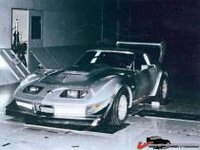
thum_1269509176b22d479.jpg

This image was lifted from a VetteWeb article on 1980s Kevlar bodys for Greg Picket. This particular image was identified as being one of, "A wide variety of "aero" devices were evaluated in order to determine the optimum shape for the 1980 race car. Courtesy of Dr. Kevin Cooper, NRC."

It appears not to be fastback (mirrors don't look right, not a 78 escutchion - so maybe a 76?) - so if it is a 'notch-back - it answers the original postings.
Unfortunately I find no details (lift/drag/downforce/velocity/etc)- but what you see. Kevin Cooper has done a lot of research in aero devices, he is an award winner at SAE, and has worked on "near surface (ground) flow." Most recent work appears to be in the area of rear diffusers.

Nice splitter too.

Cheers - Jim

My wife used to work with Kevin Cooper, wonder if he's still around the nrc

Sent from my Transformer Prime TF201 using Tapatalk 2
 
SBG: Someone on CF has done some yarn testing. I believe it was to do some Mythbuster type testing on a hood/windshield. They were trying to prove or dis the low pressure area at the base of the windshield being of benifit to performance.

The evidence was interesting, but by no means conclusive.

If your testing can really prove the wing is significantly better for downforce w/o big increase in cda, I'm happy to consider it.
I'm waiting for George to jump in.

R

See my photo album, "Stringray." Page 2, starting toward the bottom and page 3.
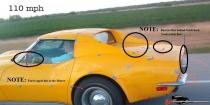
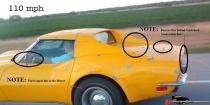
Along with just general air flow patterns info, I was looking to prove the high pressure at the base of the windshield, why a back facing cowl scoop works so well for carb induction. And to verify the gills do extract air from the engine compartment, thus relieving under car turbulence & air pressure a bit. The pics won't help with wing or spoiler design, but they are interesting to study.
(Oh, and that's my friend Wes driving, not me. I was behind the camera.)
 
Last edited:
very helpful
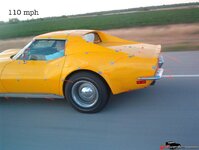
66481b8b2855b98.jpg

the low pressure behind the window and the rear spoiler are pretty amazing. I'll have to see what the airflow looks like with mine (75) since it's a different angle
 
Don't assume that airflow, pressures, turbulence, airfoil dynamics, etc are all so simple. Yarn tests vs. turbulence vs. magnahelic(?) guages vs. all the rest of it are only contributing factors. Which in the end, I have decided, don't really matter on a street car where .10 second lap time differences aren't critical.
Fun to play with, but of no real importance in the real world.
But fun to think about and play with, yes!
 
Testing is always useful.
Gene has done some tuft testing as I recall, and another member was working testing on velocity change through a radiator.

Another approach; base a design on sound theory, set out a hypothesis, and then do some experimentation. Analyze results and repeat as necessary. (I'm sure someone can Google that series of steps and point out a few missed steps - BFD, you'll get the idea.)

If you are interested in some theory, I'll offer the following invaluable texts for low speed aerodynamics, theory and application - depending on the text:
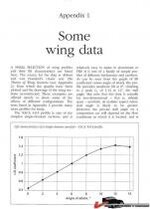
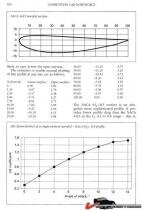
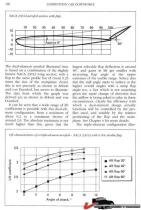
Ing S.F. Hoerner - Fluid Dynamic Drag, and the companion book Fluid Dynamic Lift. Abbot and Doenhoff, Theory of Wing Sections; Geoffrey Howard, Automobile Aerodynamics; a translated Japanese text published by Car Styling, Automotive Aerodynamics, SAE Papers - Vehicle Aerodynamics (a collection of papers), New Directions in Race Car Aerodynamics: Designing for Speed by Joseph Katz, and Simon MacBeath, Competition Car Downforce: A Practical Handbook. These are all part of my growing Low Speed/Aero Library. I'm going to post a section from Simon MacBeath's Competition Car Downforce in the downloads - for those interested. It's a nice piece and useful for some of what you're looking for - if I read and understand your stated needs correctly.
Hopefully you'll find it interesting. It is a pdf and requires TT or BBShark to upload - so it will be a bit. Meanwhile, I offer a few jpgs of the appendix on WINGS (the correct name is WINGS, after all - spoilers are there to KILL lift! -- these WINGS just generate lift DOWN.):


thum_12695091ab92eb347.jpgthum_12695091aba107d25.jpgthum_12695091abb0dc5a4.jpgthum_12695091abbd9e0dd.jpgthum_12695091abcc0d3a2.jpg

Another approach you see more these days is the Cellular Wing -- witness the posted A-Mod Autocross/Hillclimb car (which is so cool I want to build one next.) I did MS work using Cellular Wing Theory it and a presentation at AIAA regionals - back in the very early 70s. It was also a key to our Uni study for a Man Powered Aircraft. No, we didn't build it - but would have been a player! McCreedy had the funds - we were poor students - and could only afford to build a HG instead - 50 bucks - and it flew.


Hope you enjoy.

Cheers - Jim
Class adjourned.

Resurrect this thread, a bit, I bought Competition Car Aerodynamics, A practical handbook by Simon McBeath (2nd edition)... I can only read one section at a time so it will be awhile before it's done because it has a lot of information - with that said - thank you for the recommendation, it starts with the basics (which had a couple things I knew intuitively, but wasn't 100% correct in my thinking), then quickly builds to stuff that takes some time to digest... in short, I'd recommend this book too
 
Glad you like the book!
Katz is a good one too. But at one chapter at a time - finish Simon McBeath's first!

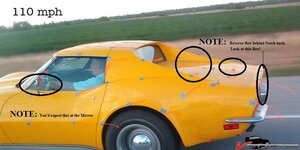
Here are a couple of areas to look at on the Tuft Test above - interesting - eh?thum_126950abb3a798379.jpg

Cheers - Jim
 
New to this thread, so back to the beginning. The Chrysler winged cars, wing was that tall so the trunk would open,it was also very effective. There were braces installed so at high speeds the downforce would not collapse the quarter panels.
 
New to this thread, so back to the beginning. The Chrysler winged cars, wing was that tall so the trunk would open,it was also very effective. There were braces installed so at high speeds the downforce would not collapse the quarter panels.

You are correct. :thumbs:

Depending on which source you believe, the downforce numbers I've seen for those cars (Dodge Daytona and Plymouth Superbird) were 350 to 500 pounds. Not bad for a wing with such modest dimensions.
 
Glad you like the book!
Katz is a good one too. But at one chapter at a time - finish Simon McBeath's first!

Here are a couple of areas to look at on the Tuft Test above - interesting - eh?thum_126950abb3a798379.jpg

Cheers - Jim

it'd look Bubba, but the best place for the spoiler would be on the targa panel. From reading the book, it wouldn't even necessarily need to be a spoiler, remove the rear window and put a lip on the back edge (with the t-tops removed, obviously) - might even satisfy the purists if it were made (the lip) removeable
 
Awww. Now look what you made me do - find a C3 "notch back" with a Wing:
thum_126950b1572778558.jpg

Note the strakes on the T-Tops. :thumbs:
More pics and Specs over here:
http://www.race-cars.com/carsales/chevy/1166804889/1166804889ss.htm


Cheers - Jim

Corvette notch.... I like it :)

I admit it - that's the first time I've seen strakes on a t-top Corvette

I also like how he used the front bumper bolt holes to mount the skirt on the front - looks like it'd easily be reversible....

Notice how he took the expensive wheels off the Corvette (the race picture) and put on steelies for the sale?
Still, I like the car, not $47,000 like, but like nonetheless
 
Anyone know how much an original style Pacecar front -and rear spoiler are worth in terms of downforce.

I know that for the front it helps airflow for cooling the engine a lot, don't know about down force however.
 
Anyone know how much an original style Pacecar front -and rear spoiler are worth in terms of downforce.

I know that for the front it helps airflow for cooling the engine a lot, don't know about down force however.

Interesting coincidence. I'm reading the aerodynamic book recommended above; and I'm to that chapter which talks about that.... the answer is yes, by removing the air from under the car (creates low air pressure under the car, thereby giving it more force down - or probably more correct way of saying, less force resisting the downward pull of gravity)... unfortunately, I'm not to the end of the chapter yet, so I don't know how it ends (or how much it provides) :)
 
Anyone know how much an original style Pacecar front -and rear spoiler are worth in terms of downforce.

I know that for the front it helps airflow for cooling the engine a lot, don't know about down force however.

Interesting coincidence. I'm reading the aerodynamic book recommended above; and I'm to that chapter which talks about that.... the answer is yes, by removing the air from under the car (creates low air pressure under the car, thereby giving it more force down - or probably more correct way of saying, less force resisting the downward pull of gravity)... unfortunately, I'm not to the end of the chapter yet, so I don't know how it ends (or how much it provides) :)

Not my field of expertise, but isn't it so that when the air below is less, that the air above gets to exert more downward force on the vehicle in question ?
 
Anyone know how much an original style Pacecar front -and rear spoiler are worth in terms of downforce.

I know that for the front it helps airflow for cooling the engine a lot, don't know about down force however.

Interesting coincidence. I'm reading the aerodynamic book recommended above; and I'm to that chapter which talks about that.... the answer is yes, by removing the air from under the car (creates low air pressure under the car, thereby giving it more force down - or probably more correct way of saying, less force resisting the downward pull of gravity)... unfortunately, I'm not to the end of the chapter yet, so I don't know how it ends (or how much it provides) :)

Not my field of expertise, but isn't it so that when the air below is less, that the air above gets to exert more downward force on the vehicle in question ?

mine either (which is why I said "read in a book" numerous times).... but I suppose, technically speaking, the air squishes better under the car when there's less of it

(I can just hear the true aero experts admiring my technical expertise and quick grasp of the complexities) :rofl:
 
So we are all finding ways to occupy our time, Ive been on the SR getting it ready for a few final races before passing it on to another person.

Meanwhile, I've been revisiting some interesting Aero books I've added to my collection. Turns out I have 2 of these [AIAA SECOND SYMPOSIUM AERODYNAMICS AND RACING CARS, May 1974]

Some real good info there and I'll offer one of them for sale. But meanwhile I'll address this slide:

126950abb3a798379.jpg

One of the papers addressed this very problem! Title - TRAPPED VORTEX FLOW CONTROL FOR AUTOMOBILES. I've lifted 6 images and posted in the Downloads section for those interested.

At about 100 mph, you'd need around 4000 cfm fan for the suction - but should be doable with 12 volts. I can scan the maths if desired too.


It will be in DOWNLOADS once approved (Chassis and Suspension - Title; C3 Rear Deck Aero.)


Cheers - Jim
 
Last edited:
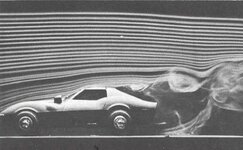
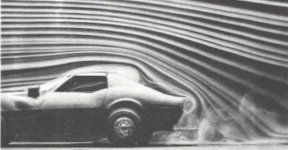
I'll add 2 images from the pdf as a teaser. The first shows the "baseline" of flow which is not too unlike the tuft test shown previously.

12695eb91f86acec0.jpg

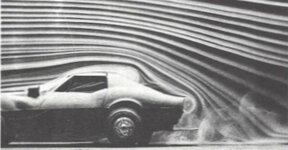
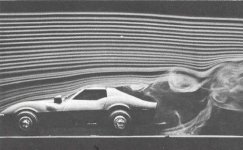
The second shows the flow "modified" using the techniques presented in the pdf.

12695eb91f86bc14e.jpg
You'll note the flow aft of the car is very streamlined, and an added bonus is the air over the rear deck provides much needed downforce. No spoiler, no wing. Just some suction.

If anyone is interested in the book - let me know via pm.

Cheers - Jim
 

Attachments

  • fig 23A.jpg
    fig 23A.jpg
    31.3 KB
  • fig 18A.jpg
    fig 18A.jpg
    51.5 KB
Jim- very interesting method, especially applied specifically to our cars!

Does the book go into more detail than what you posted in the downloads section?

I also wonder at what speeds that is valid until?

Thanks for posting!
 
Chris -

They used a model in the tunnel (typical approach), and they tested the effort at 100 feet per second. Just over 68 mph. So, the effectiveness is a good speed range. The article in the book includes the calculations for amount of suction needed and I ran it to about 100 mph to estimate the 4000 cfm requirement. Go faster, might need more suck. Once the vortex is "trapped" it would need to be sustained.

The book (if interested) includes 18 similar topics; land speed design, Can-AM cars and aero, effect of aero downforce on handling, coast-down testing discussion, some high speed motorcycles an even one article on drag reduction on trucks! I'll load the TOC and cover in the classifieds in a bit.

Unfortunately, the author of the article passed in 2012, and would have been a fantastically interesting man to spend some time with. https://www.legacy.com/obituaries/atlanta/obituary.aspx?n=joseph-cornish&pid=155461905

No, it wasn't CCP-Virus!

Cheers - Jim
 
Last edited:
This seemed like the right place to add this.


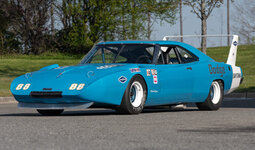
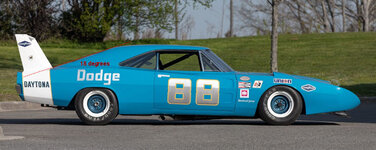
I was looking at wings on cars, following SBG's addition and did a "dive. Came up with some interesting notes to pass along. Most notable (stock car - not Can-Am/F-1) was theh Daytona Dodge and Super-Bird series wing cars.

The first problem area was the Charger’s recessed grill, which was creating a tremendous amount of drag and lift at the front end. The other problem was the rear window area, which appeared from the side to be an aerodynamically efficient fastback design, but was in fact two hollow C-pillars flowing to the back with a near-vertical back window nested in the center.
Aero Warrior—1969 Dodge Charger Daytona https://vintageracecar.com/aero-warrior-1969-dodge-charger-daytona/4/

Sound like a '68-78 C3?

daytona.jpg

...John Pointer began sketching cures for the aerodynamic deficiencies. These cures included a narrowed-and-sealed grill insert to deflect air around the car’s nose, as well as a sheet metal cover over the C-pillars to create a true fastback design at the rear. These changes were tested at the Wichita State University wind tunnel and proved to be a significant improvement over the previous design.

So who was this guy, John Pointer?
The man who first conceived of the wing—and the nosecone as well—was John Pointer. Pointer was a rocket scientist who came over from Chrysler's missile division and was asked to make the 1968 Dodge Charger "go faster."

When told he could do anything he wanted, he drew a crude outline of a car and plastered a nosecone on the front. Over the decklid, he placed a giant wing—the top of which was roughly at the roofline of the car.- Steve Lehto Road & Track Jun 2016

daytona side.jpg

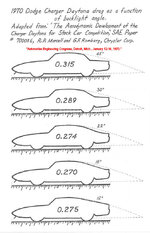
So given rules set by the several racing associations, the size and height of a rear wing may be limited. Other modifications could "fit" under some classes. For a "stock 68-78 C3, a suitible rear "filler could be fabricated (fiberglass and lexan) to fasten and potentially get similar reductions in drag as shown here:

C3 REAR DECK.jpg

The above image was part of a paper presented at the Automotive Engineering Congress, Detroit, Mich., January 12-16, 1970.. WHy didn't GM/CHevy incorporate this information into the C3? Most likely because of they're "Not in Racing" policy? Doesn't mean we cant "VetteMod" today!

Cheers - Jim​
 
Last edited:
Back
Top