
You are using an out of date browser. It may not display this or other websites correctly.
You should upgrade or use an alternative browser.
You should upgrade or use an alternative browser.
Internal Body Aerodynamics
- Thread starter vette427sbc
- Start date

Help Support VetteMod Forum:


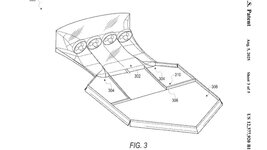
That is very clever. Colin Chapman was on a roll back then. Looks like they had the body pulled down onto rubber strips to seal the underside. I think one of the new regulations outlawed moving aero components from touching the track. I think this is the same era as the Chapparal 2J vacuum cleaner cars (also outlawed).

rtj
Well-known member
- Joined
- Nov 5, 2011
- Messages
- 3,598
- Reaction score
- 211
rtj
Well-known member
- Joined
- Nov 5, 2011
- Messages
- 3,598
- Reaction score
- 211
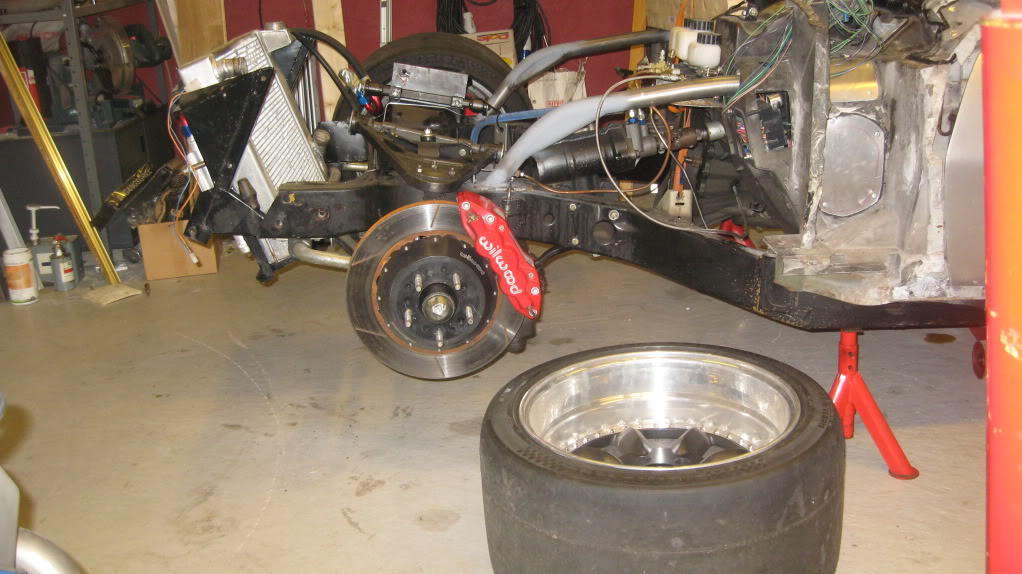
A guy over at CF made some front wheel brake brackets to mount the front brake calipers for anti-dive. He flipped the brackets left to right and did some cutting and welding. Since Duntov wants $2K for these brackets, I think I’ll try this on the spare spindle assemblies I have.
It also facilitates brake cooling, hence the post here.
It also facilitates brake cooling, hence the post here.

phantomjock
Well-known member
Looking forward to the post and any details.
Link?
I missed the Duntov brackets - I'll go have a peek.
Cheers - Jim
Link?
I missed the Duntov brackets - I'll go have a peek.
Cheers - Jim


![Pampers Sensitive Baby Wipes, Clinically Proven, Fragrance Free, Unscented, Water Based, Hypoallergenic, Multi-Use, Hand Wipes 336 Wipes Total (6X Flip-Top Packs) [Packaging May Vary]](https://m.media-amazon.com/images/I/41KLBHu9CAL._SL500_.jpg)







As an Amazon Associate we earn from qualifying purchases. Product prices and availability are accurate as of the date/time indicated and are subject to change.

69427
The Artist formerly known as Turbo84
- Joined
- Mar 30, 2008
- Messages
- 3,080
- Reaction score
- 42
- City & State/Province
- Clinging to my guns and religion in KCMO.
A guy over at CF made some front wheel brake brackets to mount the front brake calipers for anti-dive. He flipped the brackets left to right and did some cutting and welding. Since Duntov wants $2K for these brackets, I think I’ll try this on the spare spindle assemblies I have.
It also facilitates brake cooling, hence the post here.
You lost me on the connection between those calipers brackets and anti-dive. Can you clue me in?
Thanks.

rtj
Well-known member
- Joined
- Nov 5, 2011
- Messages
- 3,598
- Reaction score
- 211
You lost me on the connection between those calipers brackets and anti-dive. Can you clue me in?
Thanks.
On the front wheels with double an arms, mounting the caliper behind the spindle gives anti-dive. A simple free body diagram will show it, but probably isn’t accurate. Modern corvettes are like this. I’ll see if I can find better info.
rtj
Well-known member
- Joined
- Nov 5, 2011
- Messages
- 3,598
- Reaction score
- 211
“Load transfer:
When the brakes are applied, the braking force pushes down on the front suspension.”
I ran through the free body diagram once and rear mounted gave most downforce. I’ll keep looking.
The fact that modern C6’s and Vipers have front calipers rear mounted always seemed to prove it to me.
Duntov is claiming easier to route cooling.
When the brakes are applied, the braking force pushes down on the front suspension.”
I ran through the free body diagram once and rear mounted gave most downforce. I’ll keep looking.
The fact that modern C6’s and Vipers have front calipers rear mounted always seemed to prove it to me.
Duntov is claiming easier to route cooling.
rtj
Well-known member
- Joined
- Nov 5, 2011
- Messages
- 3,598
- Reaction score
- 211
AI gave this, but I will try to find the full article.
“
The position of the front brake affects anti-dive because it changes the
braking force vector's interaction with the suspension geometry, specifically the location of the instantaneous center (IC) of the front suspension.”
That silver vet from Europe had this mod.
“
The position of the front brake affects anti-dive because it changes the
braking force vector's interaction with the suspension geometry, specifically the location of the instantaneous center (IC) of the front suspension.”
That silver vet from Europe had this mod.
phantomjock
Well-known member
rtj - Once again - "You made me look!"
You'll have to bring the receipts. I can't find a credible reference.
I did a dive on TOO many links to be convinced. - As we'd say: Prove me wrong!/Change my Mind!*
EXCEPT for one case. That would be; INBOARD brakes mounted to the CHASSIS.
In that circumstance the load would be transferred directly to the chassis and would have some impact.
Front brakes are largely located for chassis weight distribution (aft location better), cooling (a plumbing issue) and front/rear steer (the rack and spacing).
Now, I do have inboard brakes on the rear CV axles, so would like to see the analysis and be happy - or sad.
But for the front - I'm happy to have the calipers FINALLY mounted. Now to work the steering... It is currently rear steer and front mounted calipers.
So any dive/anti-dive is from the double-A Arms mounted to the chassis.
Cheers - Jim
*RIP: Charlie
You'll have to bring the receipts. I can't find a credible reference.
I did a dive on TOO many links to be convinced. - As we'd say: Prove me wrong!/Change my Mind!*
EXCEPT for one case. That would be; INBOARD brakes mounted to the CHASSIS.
In that circumstance the load would be transferred directly to the chassis and would have some impact.
Front brakes are largely located for chassis weight distribution (aft location better), cooling (a plumbing issue) and front/rear steer (the rack and spacing).
Now, I do have inboard brakes on the rear CV axles, so would like to see the analysis and be happy - or sad.
But for the front - I'm happy to have the calipers FINALLY mounted. Now to work the steering... It is currently rear steer and front mounted calipers.
So any dive/anti-dive is from the double-A Arms mounted to the chassis.
Cheers - Jim
*RIP: Charlie
I'm not sure how the rotational forces due to braking would result in a linear force acting on the A-arms. My guess is that it's the same regardless of the position of the caliper.AI gave this, but I will try to find the full article.
“
The position of the front brake affects anti-dive because it changes the
braking force vector's interaction with the suspension geometry, specifically the location of the instantaneous center (IC) of the front suspension.”
That silver vet from Europe had this mod.
If you think about the caliper as a coupling mechanism, the tire/wheel, rotor, caliper, spindle are one body, with rotational forces (during braking) countered by the upper and lower ball joints.
rtj
Well-known member
- Joined
- Nov 5, 2011
- Messages
- 3,598
- Reaction score
- 211
The disk has a force exerted on it opposite rotation, so the force on the caliper is opposite. This has a vertical and horizontal component. The vertical component depends whether the caliper is front or rear mounted.
I was hoping to find a paper on it, but haven’t so far. But, did find this.
“
berkeman said: Summary: Does the placement of the calipers make a difference for braking performance in sports cars? (like anti-dive characteristics under braking Would that be it? Front braking tends to lower the front (raise the rear ). Putting the calipers on the advance side of the disk for the front wheels seems to me that the situation would be aggravated, with the braking torque driving the frame downwards. Similar argument for rear braking.
Source: https://www.physicsforums.com/threads/placement-of-disc-brake-calipers-for-best-performance.979033/”
Seems to be a lot of different theories. Actually, AI gives opposing answers.
I had found a better physics discussion thread, and will keep looking for it. An SAE paper or other refereed publication would be best.
I was hoping to find a paper on it, but haven’t so far. But, did find this.
“
berkeman said: Summary: Does the placement of the calipers make a difference for braking performance in sports cars? (like anti-dive characteristics under braking Would that be it? Front braking tends to lower the front (raise the rear ). Putting the calipers on the advance side of the disk for the front wheels seems to me that the situation would be aggravated, with the braking torque driving the frame downwards. Similar argument for rear braking.
Source: https://www.physicsforums.com/threads/placement-of-disc-brake-calipers-for-best-performance.979033/”
Seems to be a lot of different theories. Actually, AI gives opposing answers.
I had found a better physics discussion thread, and will keep looking for it. An SAE paper or other refereed publication would be best.
Last edited:
rtj
Well-known member
- Joined
- Nov 5, 2011
- Messages
- 3,598
- Reaction score
- 211
I’ve found numerous claims that the caliper placement impacts bearing load when braking, so they are positioned to reduce bearing load in high performance applications. But, this was posted on discussion boards, so again, may be speculation.
I went to the Physics forum - no answer
I went to the site that was supposed to give a definitive answer - no answer
https://www.team-bhp.com/forum/tech...on-how-do-engineers-decide-its-placement.html
PICTURES FROM THE SITE:

I went to the site that was supposed to give a definitive answer - no answer
https://www.team-bhp.com/forum/tech...on-how-do-engineers-decide-its-placement.html
PICTURES FROM THE SITE:
phantomjock
Well-known member
Yeah, I just finished a 2 day experience with ChatGpt. It was useful and saved me a bunch of research time.
But, it seems like the tagline: "AI responses may include mistakes. " is often appropriate.
Cheers - Jim
But, it seems like the tagline: "AI responses may include mistakes. " is often appropriate.
Cheers - Jim
Last edited:
rtj
Well-known member
- Joined
- Nov 5, 2011
- Messages
- 3,598
- Reaction score
- 211
Yes, AI contradictions seem inevitable.
I’ll do a bit more digging, and start a new thread. Basically, the vertical component of the caliper reaction force changes sign when position is flipped front to back.
I’m pretty sure when the older Vipers with more of a trailing arm suspension went to double a-arm on newer models the brake caliper on the rear went from front to rear.
I’ll do a bit more digging, and start a new thread. Basically, the vertical component of the caliper reaction force changes sign when position is flipped front to back.
I’m pretty sure when the older Vipers with more of a trailing arm suspension went to double a-arm on newer models the brake caliper on the rear went from front to rear.

mfain
Well-known member
Yes, the rear calipers are on the rear on a Gen V Viper. But, they are on the front in the C8 Z06.
69427
The Artist formerly known as Turbo84
- Joined
- Mar 30, 2008
- Messages
- 3,080
- Reaction score
- 42
- City & State/Province
- Clinging to my guns and religion in KCMO.
First, let me admit these are just my opinions and observations. I welcome any clarification or corrections.
My understanding is that the (front axle) caliper location is heavily influenced by whether it is front or rear steer/rack positioning. (As everyone here knows) the old Corvettes were rear steer, and packaging and bleeding constraints required putting the calipers in front of the wheel. C4 and later models are front steer, and the calipers are then packaged behind the wheel.
My understanding of front anti-dive is that during braking the caliper (through the caliper bracket) puts a rotational twist force on the knuckle/upright, and through the virtual front swing arm of the control arms angles, anti dive is created. It's not readily apparent to me that this rotational twisting effect on the knuckle is significantly different if the caliper is mounted ahead or behind the axle centerline.
Locating the caliper behind the axle centerline is certainly directionally correct when considering vehicle weight balance and moment of inertia.
I'm still trying to figure out any secondary effects from the caliper bracket force vectors.
My understanding is that the (front axle) caliper location is heavily influenced by whether it is front or rear steer/rack positioning. (As everyone here knows) the old Corvettes were rear steer, and packaging and bleeding constraints required putting the calipers in front of the wheel. C4 and later models are front steer, and the calipers are then packaged behind the wheel.
My understanding of front anti-dive is that during braking the caliper (through the caliper bracket) puts a rotational twist force on the knuckle/upright, and through the virtual front swing arm of the control arms angles, anti dive is created. It's not readily apparent to me that this rotational twisting effect on the knuckle is significantly different if the caliper is mounted ahead or behind the axle centerline.
Locating the caliper behind the axle centerline is certainly directionally correct when considering vehicle weight balance and moment of inertia.
I'm still trying to figure out any secondary effects from the caliper bracket force vectors.
phantomjock
Well-known member
So - OK. I had to have a think about it...
Maybe. And - It Depends...
Here is a quick and dirty diagram:
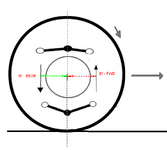
Notes - The Calipers are rigidly attached to the Upright - neither shown for clarity.
The Clamping Force vectors are shown as Bf - FWD and Bf - REAR, with the force vector direction shown.
The Bf (Brake force) will create a roll moment (aka a Couple) about the center of the mounting point on the upright.
That moment will be transmitted through the upper and lower Double Wishbone A-Arms to the chassis.
But in both cases, the direction would resolve to the same for either location - Front or Rear mount Caliper.
Think of it this way. Hands on the wheel. Entering the corner. Bang - You Hit a Bump.! ARGHH BUMP Steer!
Does the steering react any differently if you use your RIGHT - or LEFT Hand to regain control?
NO. Same force, same result. Simplistic model.
Just Hang on and get back on line take the corner...
Hope that helps.
Cheers - Jim
Maybe. And - It Depends...
Here is a quick and dirty diagram:
Notes - The Calipers are rigidly attached to the Upright - neither shown for clarity.
The Clamping Force vectors are shown as Bf - FWD and Bf - REAR, with the force vector direction shown.
The Bf (Brake force) will create a roll moment (aka a Couple) about the center of the mounting point on the upright.
That moment will be transmitted through the upper and lower Double Wishbone A-Arms to the chassis.
But in both cases, the direction would resolve to the same for either location - Front or Rear mount Caliper.
Think of it this way. Hands on the wheel. Entering the corner. Bang - You Hit a Bump.! ARGHH BUMP Steer!
Does the steering react any differently if you use your RIGHT - or LEFT Hand to regain control?
NO. Same force, same result. Simplistic model.
Just Hang on and get back on line take the corner...
Hope that helps.
Cheers - Jim
phantomjock
Well-known member
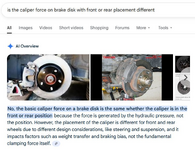
Some Google-foo:
rtj
Well-known member
- Joined
- Nov 5, 2011
- Messages
- 3,598
- Reaction score
- 211
Yeah, the brake force magnitude is the same regardless of position (every thing being equal) but the tangential force on the disc changes direction when brake position changes.
I’ll try to sketch something, and keep digging for a technical reference.
I found several references that talked about reducing spindle bearing load, so will find them again.
I’ll try to sketch something, and keep digging for a technical reference.
I found several references that talked about reducing spindle bearing load, so will find them again.
phantomjock
Well-known member
Where's That HORSE?
My purpose in using the steering wheel analogy was to demonstrate; it means little whether force is applied to the left or right side, up or down tangentially, the result is the same. That result is at the steering shaft (think point of rotation). And the direction of the tangential force – up or down - does not change the result.
The point of rotation with the brake calipers and rotors is the center of the rotor. But the brake rotor- rotates. A brake caliper in either front or rear mount, is fixed to the upright. The upright transmits forces through the ball joints (or rod ends) to the A-Arms. The A-Arms are secured to the chassis. The rotational force (Torque) generated by the caliper on the rotor is in the same direction and magnitude, regardless of caliper mount location. This rotational force is applied to the upright, through the A-Arms, and then to the chassis.
The force will be the same regardless of brake caliper mounting location.
This revised drawing may show better (and - I fixed the notations):
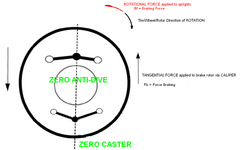
Or a short 4 minute video:
But I am open to reviewing the other case when you find it.
Cheers - Jim
My purpose in using the steering wheel analogy was to demonstrate; it means little whether force is applied to the left or right side, up or down tangentially, the result is the same. That result is at the steering shaft (think point of rotation). And the direction of the tangential force – up or down - does not change the result.
The point of rotation with the brake calipers and rotors is the center of the rotor. But the brake rotor- rotates. A brake caliper in either front or rear mount, is fixed to the upright. The upright transmits forces through the ball joints (or rod ends) to the A-Arms. The A-Arms are secured to the chassis. The rotational force (Torque) generated by the caliper on the rotor is in the same direction and magnitude, regardless of caliper mount location. This rotational force is applied to the upright, through the A-Arms, and then to the chassis.
The force will be the same regardless of brake caliper mounting location.
This revised drawing may show better (and - I fixed the notations):
Or a short 4 minute video:
But I am open to reviewing the other case when you find it.
Cheers - Jim

rtj
Well-known member
- Joined
- Nov 5, 2011
- Messages
- 3,598
- Reaction score
- 211
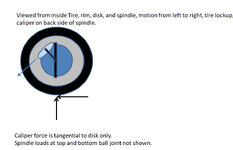 And this addresses the anti-dive.
Not saying it’s right, but a lot of discussion was done. I think the Front an arms were parallel. There was no dive on braking, but if I remember right the suspension was stiff.
Last edited:
rtj
Well-known member
- Joined
- Nov 5, 2011
- Messages
- 3,598
- Reaction score
- 211
Anyway, I’ll go back later and read the earlier posts. Like I said, I could be wrong, but it did stimulate some discussion, which is what these forums are for.
One comment on AI, I think all the big scientific sites locked AI out unless they pay. A lot of reference were from discussion forums.
One comment on AI, I think all the big scientific sites locked AI out unless they pay. A lot of reference were from discussion forums.
Last edited:

phantomjock
Well-known member
Cool.
Air cooled? LSR or sport vehicle?
Cheers - Jim
Air cooled? LSR or sport vehicle?
Cheers - Jim
Similar threads


- Replies
- 3
- Views
- 1K

- Replies
- 93
- Views
- 22K
- Replies
- 31
- Views
- 10K

