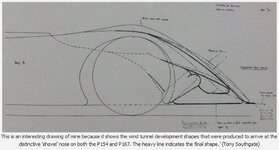
Internal Body Aerodynamics

VetteMod - Corvette Restoration, Modding & Performance Forum

Help Support VetteMod Forum:

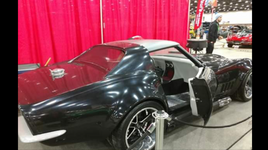
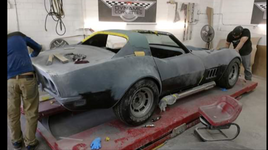
Through the top/hood.
Same builder -- very different livery:

12695be80cac34bfe.jpg
If you look real close as he exits the pit you can see what appear as open exits on either side of the streamlined "blister."

A lot to see here in side view too:

12695be80cac484c8.jpg

Something they have played around with more than one it seems:

12695be80cac5abc1.jpg

12695be80fe4110e1.jpg

A lot of work here in his gallery:
http://www.frankiesgarage.com/pr01.htm


vette427sbc - There are some clear plastic VGs you could mount with clear double stick. A bit "unobtrusive," but workable.

I have some and if I find could send a few if you'd be willing to do a Tuft Study and share the pics.

Cheers - Jim
 
Last edited:
Through the top/hood.
Same builder -- very different livery:
12695be80cac34bfe.jpg
If you look real close as he exits the pit you can see what appear as open exits on either side of the streamlined "blister”.

Cheers - Jim

Agreed on this one, with the raised gills on either side of the hood. Not so sure on the first one in the vid. But, fans make anything possible.

But, I’m sure he’s done his homework. Looks awesome.

Great discussion, chances are I’m wrong on all accounts! :)
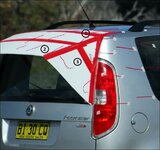
Edit: okay I went back and zoomed. You are right. It is really hard to see on the blacked out car. There appears to be an intake way down low like above.
 
Last edited:
rtj - Yeah that video lacked enough defination to really see the intake - and nearly impossible to make out the hood exits zoomed way in!


Here are the specs on "Frankie's" vettes:
Technical Data:

Engine:
6.4 L - Chevy based V8, built by Frankie´s Garage. 600 hp @ 6600 rpm, 720 Nm (530ft#) @ 4800 rpm, electronic racing fuel injection, programmed by Frankie´s Garage​

Transmission:
ZF, manual 6-speed​

Body:
Carbon fiber​

Chassis:
modified C4 space frame​

Brakes:
Carbon disks, Brembo calipers​

Weight:
1280 kg 2822#​

Top speed:
310 km/h 192 mph​

Wheels:
front and rear 10 x 17​

Tires:
275/40 ZR-17​

Cheers - Jim
 
Jim- Once I get my car together Id love to do some yarn tuft testing and hopefully some highway smoke testing too. If all goes as planned that should be possible this summer! And the clear VGs are a pretty cool idea... Ive been trying to figure out how to make them look good on the roof. The pre-79 coupes need them badly.
 
I can imagine the flow on the back of an "early C3" is not good.
I wonder how Denis' (aka denpo) rear window mod flows.

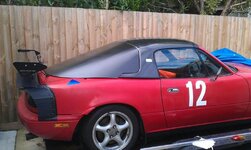
I wouldn't be too ashamed of stealing this idea from the Miata crowd:
12695be85ea42e19d.jpg

I understand it is CF and laid up over stretched cloth, kinda like the audio speaker box folks do. Could be hot wired foam and laid up too. Or -- what about heating and forming some lexan. May need a frame then too.

Ahh, winter projects.

Cheers - Jim
 
Smoke wands,

https://ntrs.nasa.gov/archive/nasa/casi.ntrs.nasa.gov/19710000335.pdf

This is an earlier version of what I’ve used (above).

The link below is very similar to what I’ve used and easy to make yourself. NASA Published a “how to” but I can’t find it.

https://www.aerolab.com/products/smoke-generator/

Basically pump kerosene or propylene glycol down a stainless needle tube held inside a larger steel tube. Create an electric circuit and the needle tube becomes a heater. Kind of dangerous if you aren’t careful (use at own risk).

https://www.aerolab.com/products/smoke-generator/

I wonder if you’d get fined using these in public?
 
Last edited:
As an Amazon Associate we earn from qualifying purchases. Product prices and availability are accurate as of the date/time indicated and are subject to change.
I do really like Denpo's rear window mod... Theres a fiberglass company called dynamic corvettes that grafted a hardtop onto a coupe body... It looked very cool. Ill have to try and find a picture.

RTJ- Thanks for the links Ill have to look into one of those when Im ready... As far as legality... I cant imagine doing smoke testing on a public highway will go over well with the state troopers :withstupid:
 
I do really like Denpo's rear window mod... Theres a fiberglass company called dynamic corvettes that grafted a hardtop onto a coupe body... It looked very cool. Ill have to try and find a picture.

I’d like to see the grafted hard top photos. I hacked off the roof and added a vert top years ago, only cost other than the HT was vert windows. Your car is too nice for a hack job in my opinion.

Another, less controversial smoke generator is a cigar smoker. Basically a pipe you throw a lit cigar in, cap, and pump compressed air in. Smoke exits tube on other end. Just as toxic, just socially acceptable.
 
[ame]https://www.youtube.com/watch?v=QVRCqLRgZRQ&app=desktop[/ame]
 
Not internal, but ......

[ame]https://www.youtube.com/watch?v=jOoS6FBoQZM&app=desktop[/ame]

It would be cool if cars had active crash mode aero devices. Lock up the brakes and drag doubles or quadruples. Yes, I slid around in the first snow dump.
 
Last edited:
It would be cool if cars had active crash mode aero devices. Lock up the brakes and drag doubles or quadruples. Yes, I slid around in the first snow dump.

Well, I bet you then remembered, that when the front wheels lock - you don't steer - the car just goes where it was last pointed! With that device and increased drag, you'd hit whatever is in front of you with less force!

Every winter in Fargo, I'd take my buddies out for a little "(Out-of)Control Theory" class on the slick university lots. It wasn't ice racing, but close.

Cheers - Jim

PS; I've got some interesting info to add in a bit on radiator intake/duct/exit. Will post soon. I need to scan some images first.
 
As promiced...

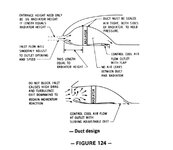
Here are a couple of images to review. The first is Walter Korff's take on duct design - for radiators. Key points:
1. The duct must seal the radiator--air tight.
2. The placement is related to the radiator height
3. The inlet is also related to the placement of the radiator.​
12695bec75bac2fc8.jpg
He shows (but doesn't discuss size, etc) controlling the airflow with the exit "flap" like on the P-51 Mustang. Also, with no plan view, I assume the duct is rectangular when viewed from above, i.e., no converging to the radiator, and no diverging on exit.

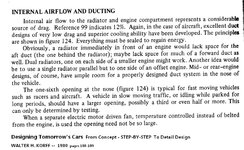
The second is his text.
12695bec75bae55bb.jpg
The reference #99 is to a 1963 SAE paper I have not been able to source. I do note that his book is Really good and surprising some of the topics covered -- including Hybrid Vehicles!

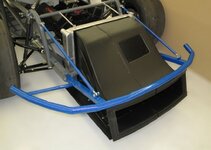
This is an example of Walter's ideas being used today:
12695bec98ead7e51.jpg

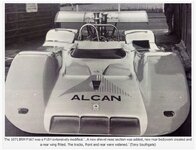
Here is a Can-AM from showing duct design in cross-section:
12695bec75bb06101.jpg

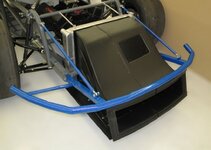
and here in execution:
12695bec75bb1d00f.jpg

Cheers - Jim
 
Last edited:
I’d like to see the grafted hard top photos. I hacked off the roof and added a vert top years ago, only cost other than the HT was vert windows. Your car is too nice for a hack job in my opinion.

Another, less controversial smoke generator is a cigar smoker. Basically a pipe you throw a lit cigar in, cap, and pump compressed air in. Smoke exits tube on other end. Just as toxic, just socially acceptable.


Thanks :2nd:
It was on dynamic corvettes facebook page but I cant seem to find it... In 40 years when I go through all this again I think Ill do the hardtop graft :lol:


Jim- this is close to what I have envisioned for the rad ducting:
12695bec98ead7e51.jpg

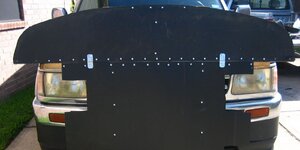
Im keeping the pop-up headlights so the grilles up front are useless to me (they'll be blocked off like 69427 did on his car). Im going to keep the car a "bottom feeder" and seal off the openings to only the rad duct and brake ducts. Hopefully I can devise something that still allows the hood to open all the way.

Another find today from Improved Racing... They have an oil cooler with some bold claims. If this is lighter, creates less drag and cools as good or better than the Setrab 25 row I was looking at then I think I may have to try it out...

Improved Racing's Motorsport Heat Exchanger (MHX) series oil coolers are the result of several years of development and testing to create a highly efficient oil cooler. These coolers were perfected through extensive testing on our in-house heat exchanger test system and wind tunnel.

The MHX-514 oil cooler is a dual-pass oil cooler that matches heat rejection rates to larger, heavier stacked-plate coolers made by brands such as Setrab, Mocal, and Earl's. Compared to a typical 25-row stacked plate cooler, this cooler is 17% smaller overall and 20% lighter, yet holds 36% more oil volume capacity. The core is 23% thinner and has a lower row and fin density, allowing more air to flow through the cooler to other heat exchangers (such as a radiator) behind it.

http://www.improvedracing.com/impro...mhx-514-high-efficiency-oil-cooler-p-885.html
 
Thanks :2nd:
It was on dynamic corvettes facebook page but I cant seem to find it... In 40 years when I go through all this again I think Ill do the hardtop.

I found a couple of photos of a black hardtop vert. No lines on the rear deck for a hatch. And, the grainy photo appears that the “buttresses” are cut. Looks like HT windows.

21945bed832a613ec.png

21945bed832a5040c.png
 
Last edited:
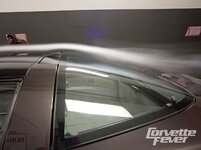
Apolgies to rtj if he's posted this in the video section. So many videos -- so little time! C3 starts @ 1:52
[ame]https://www.youtube.com/watch?v=FjwyUOq_goI[/ame]
This is from the A2 Wind Tunnel. You can hire time and the Blue and White racer I posted earlier spend a day there. He can certify that that car has downforce greater than its weight. So at speed, like an F1 can race on the ceiling!

I wish they had shot video from the side views. Would get to see the advantage of a "fastback" mod for the earlier C3s.
OOPS - Just found a "still":
12695bedb82411040.jpg

Here is a real life example:
126950abb3a798379.jpg

and here is a C4 looking a lot like a C3 mod/fastback version:
12695bedb8242428d.jpg


Cheers - Jim
 
Last edited:
Apolgies to rtj if he's posted this in the video section.

Cheers - Jim

Don’t worry about me, I’m just sharing vids I see as interesting. Plus, bookkeeping them for reference.

Interesting stuff on the air intakes, Jim.

I previously had Cd numbers for C3 coupe and convertible, can’t find them now. Convertibles have lower Cd, hence more popular with road racers.
 
Last edited:
Another sales pitch, but interesting. They employ a venturi effect (high speed jet ) under the car at high speed.

[ame]https://www.youtube.com/watch?v=8B8ElNX-nRw&app=desktop&spfreload=10[/ame]
 
... They employ a venturi effect (high speed jet ) under the car at high speed.

Conservation of Mass: High speed flow (makes) Low Pressure

Pressure Differential: High on Top + Low Below (makes) DOWNFORCE

The nice thing is it is nearly free (low drag), and limits porpoising as speed changes. Would be nice if they showed some more underbody aero in the advert, but that wasn't their purpose.
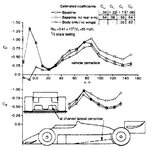
Here is an example on an F1:
12695beeee2e5c1e4.jpg
"Baseline" means both front and rear wing. Note the Cp (coefficient of pressure) is only slightly lower in the no-wing configuration - but a huge difference in the Drag coefficient (Cd) of the all-up round.
Locating the venturi so the Cp is close to the CG is useful to decrease pitching moments too.

No doubt Mercedes has done extensive tunnel testing and design. Wouldn't it be fun to see details?

Cheers - Jim
 
As Long As We Are Talking About Bottoms...

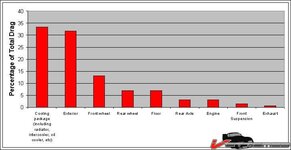
If you wanted to reduce the overall drag as easily as possible, you could start with this:
12694d212d7813bda.jpg
Which would you tackle first?
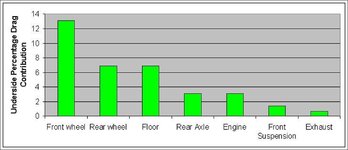
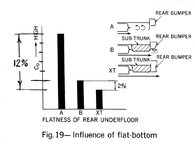
Well, if you add up everything other than the first 2 columns on the left -- all those items would see significant reduction in their contribution by adding a full belly pan. Now, full disclosure, all those bits from the first table, are not just the underbelly contribution - wheels, tires, etc. But, this shows the contribution of each to just the underside drag.
12695beef92b8a0bf.jpg
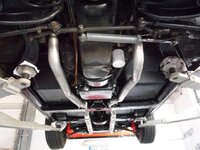
No easy task:
12695bedc418b4e88.jpg
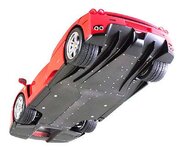
You'd have to add material to the side rails to be level wth the rear cross member. But you gain the opportunity then to include a diffuser in the rear!
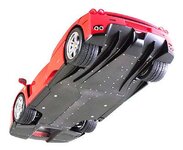
Not a 'vette, but you get the idea:
12695bedc4ec18971.jpg
[NOTE they are exhausting the Radiator to the underside of the vehicle]

If you want to build one - here are 19 pages of a build:
https://www.toyotanation.com/forum/60-t-100-forum/325836-under-belly-pan.html
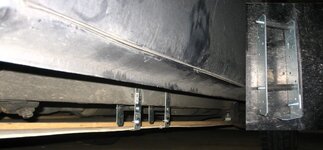
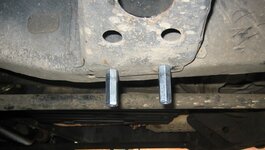
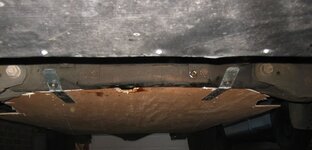
And a few images lifted to pique your interest: [Note I think he used "bendy-ply/doorskin as a prototype.]
How to mount to the frame rails and get below the rear crossmember. Here is a novel idea:
12695beef92bdc992.jpg
use Rivetnuts/nutserts then threaded rod or standoffs:
12695beef92bf1bf8.jpg
Simple joins between panels"
12695beef92c25e8e.jpg
Now would be a goodtime to include a splitter:
12695beef92c39bbd.jpg
We have all remarked about the rear end being a "Prachute" -- here are some details of possible improvement potential:
12695beef92c87fc3.jpg
So from the mid/rear crossmember aft something like this:
12695bedc4ec18971.jpg
Just a few notes on bellypan improvements I've seen in researching:
Walter Korff, suggested 15.38 % reduction in drag with a full bellypan.
NASA achieved a 15% drag reduction on a Ford Econoline van. A BOX!
The late 1970s Audi 100 scores a 15% drag reduction with a full bellypan.
1980, a 1970 VW bus a 8.726 % reduction in drag. A "classic" BOX.​

So, What is that like?

At 3000 pounds - sort of a Corvette, 20 sqft Frontal Area (Wild Ass Guess), Cd of 0.45 (another WAG), It would take 509 HP to reach 200mph. Reducing the Cd by 15%, with no increase in frontal area, and minimal increase in weight, you can get to 200mph with 436HP!
I used the calculator over at http://www.apexgarage.com/tech/horsepower_calc.shtml

Cheers - Jim
 
No doubt Mercedes has done extensive tunnel testing and design. Wouldn't it be fun to see details?

Cheers - Jim

In the old days, when the underbody was a mess on production cars, the rule was a low front spoiler. They’ve definitely done some work.
 
In the old days, when the underbody was a mess on production cars, the rule was a low front spoiler. They’ve definitely done some work.

That is what I'd like to see. It is "easy" to add panels to the underside - when in the design stage, we have to (get to) make up the difference on a classic, yet dated vehicle. But, there are some significant gains to be made!

My previous was a long post - but should have enough detail that might push someone over to the "Dark Side" of Drag Reduction. Rabbit hole- ANYONE?


12695bef4b85292ea.jpg

Cheers - Jim
 
A674CD55-0478-415C-B1FF-EF838E747E4E_zpscwb411xr.jpg

Besides the transmission, the rest of the underside can be smoothed pretty easily if the crossmembers are "flushed"
I'll work on the belly pan once I've got some miles on the car and my bank account recovers but I made sure the major frame mods were done in preparation. I took the red pill a few years ago!
 
Last edited:
A few years back I made a bunch of aluminum panels to smooth the underside of my '69. The first thing I noticed was it's a PITA to retrofit this stuff to our antiques. It's difficult/impossible to hide the undercar exhaust system, so that gummed up the works. In addition, the stock transmission crossmember is an inch or two lower than the rest of the frame. This means either having a semi-circle shaped bellypan (bad), or a much lower pan in front of the crossmember, with an upswept portion behind the crossmember (potentially good), or removing the crossmember and replacing it with a new/modified piece that packages at the same plane as the rest of the frame (my choice at the time).

I eventually removed the panels behind the engine for multiple reasons. I couldn't quantify how much (if any) lift/drag reduction there was after these efforts, the assorted aluminum sheets weighed in the 20-30 pound range (I hate adding weight to my car), and it made driveline maintenace even more difficult/time-consuming than it already is on our antiques.

I do still try to run a pan of sorts under the front portion of the car, as that's where I have some confidence that the air hasn't already gone turbulent, and I'm searching for more front grip (less lift) wherever possible.

Regarding the transmission crossmember, I always disliked the visual nature of it hanging down below the level of the rocker panels. Several years back I kicked around the idea of buying an extra set of panels and slicing them lengthwise, and then adding 2-3" of material in the slice area to hide the crossmember. To see if the thicker look was "acceptable" I cut out some panels from some Lexan I had laying around, and then painted them black. I personally like this look better than the stock rocker look, and, when time permits, I'd like to do some wool tuft measurements to see if this lower panel (skirt) helps reduce air entering under the car from outside.

Just my thoughts and experiences at the moment. I am enjoying this thread. It's a welcome change from the "what thermostat temperature should I run" found too often at other sites.
 
Regarding the transmission crossmember, I always disliked the visual nature of it hanging down below the level of the rocker panels. Several years back I kicked around the idea of buying an extra set of panels and slicing them lengthwise, and then adding 2-3" of material in the slice area to hide the crossmember. To see if the thicker look was "acceptable" I cut out some panels from some Lexan I had laying around, and then painted them black. I personally like this look better than the stock rocker look, and, when time permits, I'd like to do some wool tuft measurements to see if this lower panel (skirt) helps reduce air entering under the car from outside.

I don't like the look of the crossmember hanging down either. At the very least GM could have angled it up so that it was flush with the bottom of the frame side rails.

Do you have any pictures of what you did?
 
Another over-the-top example of what the ultra high end cars are doing. The “tail” is like the Prius picture (posted earlier) but on steroids.

[ame]https://www.youtube.com/watch?v=wWNjRYOHZts&app=desktop[/ame]

I wasn’t going to post, but the wheels are reminiscent of the old bbs fans. Two bbs fans on eBay for 1000$ right now.
 
As far as the c3 trans crossmember, couldn’t you just cut the bottom off, reduce the height and reweld. Better yet just a chrome moly tube crossmember. The first would still allow factory exhaust.
 
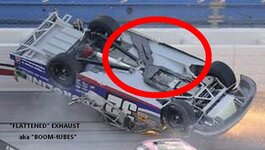
Not a happy situation;
12695bf1602cb3dab.jpg

But the image shows another clever approach - Boom-Tubes - Totally flat. Make the crossmember the mod rtj suggested - and go side exit! Not so "neighborly" at 3 am I suppose.

The belly pan could be "sculpted" around the exhaust, with little loss in efficiency - and good cooling too.

Cheers - Jim
 
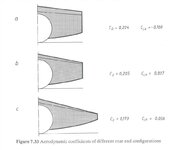
Following up on the Mercedes testing, here are relative comparisons of several "tail mods":
12695bf1635571ef4.jpg

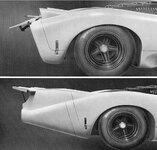
Porsche went down this route with the 917s; Can-Am, Le Mans, etc:
12695bf16355b4a23.jpg

This has caused me to rethink the rear Kamm approach I was building on Elvira. Ahh too much thinking...

Cheers - Jim
 
vette427sbc -

... Id love to do some yarn tuft testing and hopefully some highway smoke testing too. If all goes as planned that should be possible this summer! And the clear VGs are a pretty cool idea... Ive been trying to figure out how to make them look good on the roof. The pre-79 coupes need them badly.

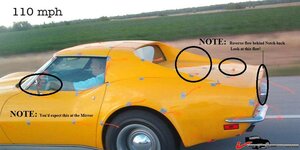
The pre-fastback C3s have a number of ways to work the "drag/turbulence-bubble." The fastback mod I showed on a Miata is one way. I think there is some goodness to be had with VGs too. But I came across another idea or two, you could put in your test plan for next summer.

First comes from Chevy. The 2019 Chevy Silverado did some mods starting at the back of the truck. They realized they had smooth flow over the top the cab, but was then being disturbed by the cargo bed, just like a "notch-back" C3 coupe. This was causing significant drag. Their design-nerds came up with this.

12695bf16355905b8.jpg

They were working to beat the typical turbulence-bubble formed on a pick-up:

12695bf16355a44ae.jpg

A lot like the sort of bubble that forms on rear deck of the early C3 'vettes. They added two small spoilers. The first is at the back edge of the cab. It directs air up and lengthens the air stream so it then hits the second spoiler on the top of the tailgate. I've looked for close up pics of these, but no luck. Chevrolet found that this and other changes increased aerodynamic efficiency on the new Silverado by 7%.

Vortex generators on the trailing edge might do the same thing. It would be useful to test alone, then with the trailing edge spoiler on the deck.

The second approach uses coroplast and tape:

12695bf16355d9e37.jpg

This cut-and-paste would be cheap, fast, and easy (Yeah - I know - pick only 2). These approaches might be as - or nearly - as effective as the fastback mod. At least you'd most likely see some significant improvement.

Looking forward to your testing!

Cheers - Jim
 
Back
Top