Another exhaust tweak

VetteMod - Corvette Restoration, Modding & Performance Forum

Help Support VetteMod Forum:

Chambered mufflers work because the different chambers have different standing wavelenghts. It looks like you really have only one chamber, so you won't have a lot of different frequencies covered.

There is lots of information in acoustics books on the subject.

Yeah, I'm still on the steep part of the acoustics learning curve. I've got an old engineering book with a chapter on acoustics, but a lot of it is pretty dry reading.
 
Chambered mufflers work because the different chambers have different standing wavelenghts. It looks like you really have only one chamber, so you won't have a lot of different frequencies covered.

There is lots of information in acoustics books on the subject.

Yeah, I'm still on the steep part of the acoustics learning curve. I've got an old engineering book with a chapter on acoustics, but a lot of it is pretty dry reading.

OLD Helmholtz resonators, Corner horns, Folded horns, Acoustic suspension, all them terms back when I played with stereo speaker designs....

Used to have a HUGE McIntosh stereo system....stacked ML2c's in each channel...make that FOUR 12" woofers per channel, and 400 watts RMS per channel pushing them....the amp had it's own 20 amp breaker feeding it....the system was tuned to the room resonances.....

sold it maybe 4 years ago, never listened much anymore....

:nuts::clobbered::tomato:
 
Summit racing on YouTube has some good video on corsa and flowmaster mufflers.
 
I e-mailed the tech guys at Dynomax to request some flow information on a couple of their 3" turbo style mufflers. I picked two models that would probably package decently, and asked about the flow rates (and at what pressure drop), and why one of the models was twice the price of the other. I got a short reply saying that both models flow 430 CFM. It frustrates the hell out of me trying to figure out wth is the purpose of a tech line if they won't answer simple technical questions. A flow rate number without the pressure drop or head pressure number is meaningless. I could take a guess that Dynomax flows their mufflers at the same pressure drop as Holley flows their carbs, but I'm not inclined to spend hundreds of dollars (in mufflers and my time) installing these things, and finding out I guessed wrong. I see that they have a phone number to their tech area, so I'll give a call this week to see if I can get some complete answers this time.

If I can definitively reduce the backpressure significantly with some new mufflers I'll do it. If the answer is fuzzy my backup plan is to retain the current mufflers and make a simple tap in the underspring Y pipe to be able to hook up an additional pipe and muffler/glasspack and dump some of the exhaust out under the license plate area during track days. I could install/remove this extra exhaust shunt in five minutes. I would prefer not to carry the additional ten pounds of this system (although I could weld up an aluminum glasspack), but as I mentioned earlier, I'm also not interested in spending money and time installing a new set of mufflers that don't "pay for themselves" in performance.
 
Mike, Chances are the "tech" guy does not know much. Thats been my experience with this. Dynomax does have a PDF that describes the test perameters

MODEL (Flow Rate- @ 20.3" H2O) Muffler Inlet Size

http://www.dynomax.com/assets/2008catalog_pdf/superturbo.pdf

Damn, Larry, that's the exact info I was looking for! Don't know where you found it, but I greatly appreciate it. For whatever reason I was never able to find this type info on their website, and the tech guy's reply also neglected to say that one of the 3" mufflers I was asking about is actually 2.5" tubing inside. The chart also contradicts his claim that the two part number mufflers flowed the same.

Looking at the chart gives me the indication that it's doubtful I can package a pair of sufficient-flow mufflers back there. The pressure drop numbers are also darn close to what I currently have at my "rule of thumb" flow number, so the performance improvement per dollar ratio is pretty slim.

Again, thanks a bunch. It's probably saved me from a lot of wasted time talking to the "tech" guys.
 
A while back, I was searching for info on induction tuning. What I came up with was very little info on induction and a lot of questions about exahust (flow rates etc.). The Dynomax info was a result of that. It would be really good if that was a third party test that included other brands but I haven't seen that yet.

This is another example of when marketing people sell a product. The bigger, better, faster hype starts and the science is forgotten. For automotive, there is probably no more abused term than CFM. From radiator fans, to carbs, to pumps, to exhaust, it's all the same.
 
Titanium muffler (temporarily)

Been going a couple different directions in the exhaust mods. With the info Larry provided I was able to make a comparison with what (muffler flow) I currently have and what better flow units are available from Dynomax. I ordered a pair for the car.


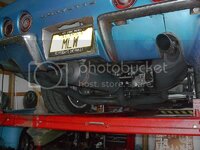
The muffler on the top is a spare like I've had on the car for several years (2 1/2 inch), while the bottom is one of the replacements (3 inch). The flow rate numbers are 410 CFM for the 2 1/2" part, while the 3" muffler is rated at 554 CFM, for a 35% improvement at the same pressure drop. The down side is the new mufflers are 8 pounds (per pair) heavier than the current mufflers.

I was trying to get ready for a track weekend in Indiana but I knew I couldn't get the new mufflers installed in time so I did a quick modification of the current setup to reduce the backpressure a little. I was going to buy a glasspack from the local parts store but I happened to remember the titanium muffler on my lawnmower. (Okay, it used to be on my Yamaha R1 but recently it's been a quiet replacement for the cheap & loud muffler that B&S puts on their engines.) A little bit of cutting and welding:

IM002285_zps89606b6b.jpg

Didn't get a chance to test out the system at speed as the track event sold out pretty quickly. I had held out for a few extra days while I kept checking the weather forecasts. I wasn't in the mood to pay multiple hundreds of dollars for the entry fee, and pay the fuel to haul the car 1100 miles (roundtrip), only to be standing around in the rain for two days. Oh well, I'll pull the extra muffler off and put it back on the mower, and weld up the new ones.

I'm hoping the new mufflers don't end up being louder than the current ones.
 
How Does The 3Rd Muffler Effect The Sound? Looks Interesting!

Unfortunately I didn't get the opportunity to put any track miles on this, just a couple throttle blips in the garage. No significant difference with that modest test.

I'm just going to unbolt everything after the exhaust termination box and put the stuff on the shelf. In the event I'm not happy with the new mufflers (I believe Dynomax has a 30 day return policy) I'll throw the old setup back on.
 
Working on the new setup, and an issue pops into my head. It's damn tight trying to squeeze in the spare tire bucket.

IM002293_zps7fa9ec31.jpg

The C4 tire bucket (lighter and more easily packaged) I'd planned to eventually use, and the stock tires are about 26 1/2 inches , but the mufflers are only 24 inches apart when the outlets are centered in the bodywork cutouts. If these mufflers were similar to the old ones (with the outlets in the middle rather than the outter sides) I might have had enough room. I considered moving the mufflers over an inch or so on each side but then I would have had to add an "S" bend to get back to the cutout and the baloney tips. I'm not happy with that option at the moment, so I'm just going to proceed with this configuration. In the mean time it looks like I can fit a tire behind the seats when I need to have a spare along.

Got the replacement Y pipe underneath tacked together. Took a bit of sneaking up on it to get the two 3" pipes to fit the slightly squashed 4" pipe and at the angles to point to the muffler inlets. Now I just gotta figure out where to put the sleeve/coupler between there and the mufflers so I can wiggle the assembly apart when needed.

These things better flow decently for the extra PITA that they're causing me.
 
I wuz going to make a comment about your car blowing away in the breeze, but I won't.....temping the devil, now that you live in the plains.....


:shocking::beer::drink: a chrome shark with a 80+ diffy.....interesting.....
 
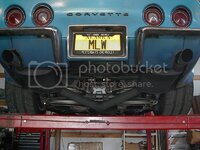
Got the mufflers all welded up, along with the hanger brackets and put a couple of small beads on the SS tips to hold them in. I like the appearance of the 3" size tips better than the 2 1/2" ones I had on there.

IM002296_zps94f63d2b.jpg

Fired up the engine on the lift and the system is reasonably quiet. I'm trying to do a track day in about a week and a half, and I'm curious to find out what the WOT noise volume is and the backpressure levels.
 
Did you end up using the larger mufflers (on the bottom of the picture)?


Yep. Those are the mufflers I chose from the chart you supplied. (Thanks again!) I just put a coat of flat black BBQ paint on them. No particular reason but I've always painted my exhaust systems flat black.

For the expense and hassle installing them they better flow better (ie: less backpressure). I have the pressure gauge hooked up again so I'm hoping to find out at the next track day in a week or two.
 
Spent the day at Heartland Park Topeka. Cooler temps this time (92*F vs 99*F last time :wink:). Hooked the pressure gauge up again to the EPTBox. The backpressure reading with the 3" rear pipes and new mufflers was 10" H20 versus the 24" H2O with the previous 2 1/2" pipes and mufflers.

Things were going well during the second session when I got a damn loud exhaust backfire after lifting at the end of the fastest straight. (I'm speculating I got a misfire due to the spark advance being over advanced at high RPM and high vacuum. I might consider running ported vacuum advance at the next track day to prevent that situation, and see what happens.) I'm going to have to take a look under the car this weekend to see if the backfire damaged any muffler seams or header gaskets.
 
The backpressure reading with the 3" rear pipes and new mufflers was 10" H20 versus the 24" H2O with the previous 2 1/2" pipes and mufflers.

Pretty impressive reduction.

Were they loud?
 
thnks for sharing. I am a little surprised that you had 10" with the larger exhaust. I don't have any comparative info to base that on; just thought it would be in the single digits... Could you "feel" any difference?
 
The backpressure reading with the 3" rear pipes and new mufflers was 10" H20 versus the 24" H2O with the previous 2 1/2" pipes and mufflers.

Pretty impressive reduction.

Were they loud?

They were a little louder than the 2 1/2 inch mufflers. I believe a significant part of that was a leak in the crossover pipe behind the headers. I bottomed out somewhere and dislodged the clamps on the crossover. I fixed it yesterday after putting it on the lift to check out if anything in the exhaust ballooned out from the backfire. Other than the dislodged clamps everything looked fine. I'll note the noise level now that the leak is fixed.

I finally (after nine years) have the car running and licensed (thanks to Tim and Kevin for old car licensing advice), so I'm looking forward to driving it again on the streets. I've hardly driven this car any speed or distance in years without a helmet on.
 
thnks for sharing. I am a little surprised that you had 10" with the larger exhaust. I don't have any comparative info to base that on; just thought it would be in the single digits... Could you "feel" any difference?

Well, the reading could have been 9" H20, but with the angle I was looking at the gauge (parallax, IIRC) I just rounded it up to 10".

The car ran well, and I was pretty happy with it, but I don't know how accurate my buttometer is when comparing changes to the car. :amused:
 
High temp sound insulation for exhaust?

Ran the '69 at a Porsche club track day last Friday. Car ran great, with no major handling issues or breakdowns. It did have a bit more interior exhaust noise than desired (even when wearing a helmet). I assumed that the new mufflers were just too loud under WOT, but on the weekend autocross I noticed something when I loaned the car to a young guy who I have "Big Brothered" for a bunch of years. (He recently bought his first Corvette (an '89), but lost the clutch last week when the hydraulic line between the cylinders split open.) Well, I noticed that while he was driving my car on the autocross course that the exhaust volume was very quiet (I revised my opinion upward right there about the quality of the Dynomax mufflers), even in the areas where the engine was at near WOT condition. I've kinda come to the conclusion that a good share of the interior noise was coming up through the floor from the EPTB under the seats. I'd like to try (if it exists) a thin sheet of high temperature heat/sound deadening material on the top side of the EPTB itself to dampen the vibrations. Can anyone recommend a material that might do the job? I'm thinking the surface temps are about 3-4 hundred degrees F at times in that area.

Thanks.

 
Exhaust crossover Part Deux

Decided to try a different version of the crossover. The first iteration worked well but it was a bit of an annoyance getting the center D shaped section to seal well without using some hi-temp gasket sealer. So, I decided to try something else. After a couple of minor setbacks getting the shape right so I could get the damn thing back out after tack-welding it I finally got something to work.

IM002332_zps3628b405.jpg

It slips up into the leftside pipe reducer nipple, then I rotate the pipe to buttup with the rightside nipple, and then slide the sleeve over the rightside interface. I then put a couple hose clamps on the sleeve to make a tight (hopefully leak-free) fit.

Took some time off from working on the car to fix my lawn tractor muffler. The original muffler was rusting out and getting too damn loud, and I wasn't in the mood to spend the money buying another overpriced part at the dealer. I looked around for material in the garage and decided to use some 4" tubing for the housing, and some smaller pipes for the inlet and outlet. I made three expansion chambers in it along with some SS wool for some dampening. Fired up the tractor and the noise level is damn decent. It took a few hours of my time, of course, but I've probably got less than ten bucks in material cost in it.

 
Last edited:
that looks nice. getting those damn things to be leak free can be royal PITA. i like the lawn mower exhaust too nice improvization (sp?)
 
Have you tried V-band clamps or whatever these things are called? I bought one and I am really impressed- it does not leak and is super easy to tighten/loosen .... No gasket .... Not cheap though .... Think I bought OTX brand on ebay , $40 a pop .....
 
Have you tried V-band clamps or whatever these things are called? I bought one and I am really impressed- it does not leak and is super easy to tighten/loosen .... No gasket .... Not cheap though .... Think I bought OTX brand on ebay , $40 a pop .....

Haven't tried any band clamps yet (I'm too damn cheap ;) ). This arrangement (the sleeve and worm-drive clamps) was the lightest (and cheapest) configuration I could come up with.
 
I dunno guys, 6 bolts and my entire exhaust system flops on the ground, except the headers, of course....I don't have loops under the pipes on my cross support, and utilize those band clamps, I suppose to call them, about 6" of metal and two bolts, wrapped around the pipes and tightened snug....

:crutches:
 
Ran the '69 at a Porsche club track day last Friday. Car ran great, with no major handling issues or breakdowns. It did have a bit more interior exhaust noise than desired (even when wearing a helmet). I assumed that the new mufflers were just too loud under WOT, but on the weekend autocross I noticed something when I loaned the car to a young guy who I have "Big Brothered" for a bunch of years. (He recently bought his first Corvette (an '89), but lost the clutch last week when the hydraulic line between the cylinders split open.) Well, I noticed that while he was driving my car on the autocross course that the exhaust volume was very quiet (I revised my opinion upward right there about the quality of the Dynomax mufflers), even in the areas where the engine was at near WOT condition. I've kinda come to the conclusion that a good share of the interior noise was coming up through the floor from the EPTB under the seats. I'd like to try (if it exists) a thin sheet of high temperature heat/sound deadening material on the top side of the EPTB itself to dampen the vibrations. Can anyone recommend a material that might do the job? I'm thinking the surface temps are about 3-4 hundred degrees F at times in that area.

Thanks.

Well, my initial premise that the noise was coming from the EPTB was correct, but for the wrong reason. I pulled it out today to weld in some additional inner vertical walls to tie the top and bottom surfaces together to keep the box from acting/vibrating like a big bass drum (my initial guess as the reason for the box noise). Once I got it out I got a good look at the top (floorboard side) of the box.


It's a two inch tear in the top wall. I had a significant backfire at the end of the main stretch at Topeka last summer. The top of the box was oil canned pretty well, and the rip was right by the single internal stiffening wall. I peened the shape back down and welded a patch over the area. I'm anxious to see how much quieter the car will be inside after this repair.
 
Back
Top