Aero improvement, or roadhugging weight?

VetteMod - Corvette Restoration, Modding & Performance Forum

Help Support VetteMod Forum:

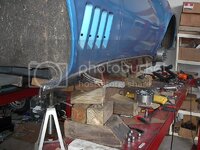
Got the undertray and brackets pretty much done. Just need to get some correct length bolts to tidy things up a touch. I'd like to put some end-fences on it, but I think I'll make a few pressure measurements on it first. Had a few minutes to kill today so I cut out a replacement rocker panel out of the scrap plastic sheet to see what it would look like. It's two inches deeper than the stock rocker.
IM001989.jpg

If it doesn't look too out of place once the car is back on the wheels I'll sand the panels down and put a coat of black paint on them. I like to keep the mods unnoticeable if possible but I don't know if this one will be.
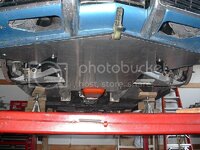
 
Got a couple more things done. The tray is installed other than three bolts through the leading edge to secure it to the spoiler. While I was fastening things I thought I'd try diverting a little of the air to help cool the brakes, and reduce the amount of air that goes under the car. The front wheels do get noticeably dirty with brake dust under hard use, so I'm assuming that the front spoiler kicks out enough side air to cause a low pressure area outside the wheels. Hopefully this will allow an increase in the volume of air exiting the wheel well area. I just took a couple pieces of scrap aluminum angle stock (1 1/2 x 1 1/2) and bolted it to the bottom of the tray. I painted them black so they wouldn't be noticable from the front view (when the car is on the ground).

IM001993.jpg

I also quick sanded the rocker material and put a coat of semi-gloss black on it. It doesn't look too out of place, so I think I'll cut one out for the passenger side. (Please pardon the mess.)

IM001995.jpg

The two pieces of aluminum angle at the back of the wheelwell are for a small air dam to inhibit air from being trapped in the area between the frame and the rocker.

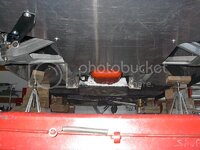
I'm also playing around with a flat panel under the transmission. Right now it's just clamped up there, and I still need to get some of the shape figured out.

IM001994.jpg

I'm trying to get this finished so I can do another track day in the next couple weeks.
 
Greenwood's Spirit of 76 car had a nicely done front end and air dam. He used the rubber strips to get the spoiler as low as possible.

I think my car would overheat in FL with that aluminum panel under the front end. But, if it works for you that is all that matters.

I found the rubber/vinyl baseboard trim works really well for side skirts and front air dams. It comes in long rolls, many colors, and is pretty tough. You only have to trim off the rolled edge that is intended to blend to the floor when used as a baseboard trim.
 
Last edited:
What about the rear of the car? It's like a cookie cutter upside down for aerodynamics. I'd don't have spare tire carrier. I've thought about an aluminum floor pan extending from the rear axles back to the end of the car.

Looks like you've a Richmond tranny or maybe the Doug Nash predecessor. Five speed or six speed?

Thanks

Nash 5spd. Swapped out the original 3.70 rear and have been bouncing back and forth between 3.08s and 2.73s.

I'm still trying to figure out what can be done at the rear. Most of the airflow at that point is probably going to be pretty turbulent. Right now I'm just concentrating on trying to minimize the quantity of air that makes it back that far.

Couple of comments: I've heard that the Doug Nash 5 speed is much stronger than the Richmond 5 speed. (For people that don't know, Nash went bankrupt and his tranny design and patents were bought out by Richmond Gear. One patent they particularly wanted, or so I've been told, is the split case design of the Nash. Richmond now sells this tranny under their own name.) However the story goes, that in order to keep the price of the "Nash now know as Richmond" tranny down, they downgraded the gear strength quality. I was able to read some internet blogs saying the Richmond wouldn't withstand high horsepower Big Blocks. The owners manual for the Richmond states that its torque limits are 450 ft-lbs. This seems to substantiate a claim that the Nash has been downgraded. It's marketing was targeted to competition cars. For my 70, I was going to use a Richmond 5 speed and a 3.08:1 rear end. As a result of the realization that the Richmond was only a 450 foot pound tranny, I bought a TKO600 5 speed, 650 foot pounds rated, and also switched to a 3.73:1 differential ratio. The TKO's 5th gear is a 0.64 overdrive so I won't have to be spinning the engine excessively on the freeway. The TKO 600 is THE perfect tranny for a C3 in that it's first four gear ratios closely mimic the Muncie 4 speed. What's not so great for the TKO 600 is that in kit form for a C3, it's got a price tag of $3500. I've never shifted the Richmond 5 speed under power. I have a lot of experience shifting the Doug Nash. A new Doug Nash (circa 1975) is an absolute bear to shift , mine loosened up a little as I drove it. The TKO 600, now in my 68, is just so nice to shift. Very short throws, almost just wrist motion, and the gear patterns, repeat.. are nice for me. A 3.55:1 in my 68 means stock Muncie response in the lower four gears, and then at highway cruising ...5th gear..bam. 2.27:1 cruise.


second comment: I have the spare tire tubs out of my 68 and 70. I'm driving the 68 with a giant upside down cookie cutter in the rear for aerodynamics. (The 70 is not drivable). I'm thinking a flat surface would be great for aerodynamics.

I read you're concerned with turbulent airflow under the front of the car. I'd think the turbulent airflow under the rear might be just as important. Also, if achieve some nice laminar airflow under the front of the car, will that aerodynamically unstabilize the front end? Seems like turbulent airflow under the nose of the car would help prevent the nose lifting.

Sometime around 1980, Gale Banks set a Bonneville speed record for a stock bodied automobile. (Gale Banks is alive and well today selling turbo kits for trucks). The stock bodied automobile was a 1968 Corvette Convertible with a hard top. The body was pristinely stock. What was underneath was not. He had a twin turbo charged 427 engine producing 1200 hp. The front radiator was removed an in it's place was a 50 gallon water ballast tank (400 pounds). The front end of the car was dropped to about an inch (2 inches?) above the pavement (i.e. salt). I forget, but he went something like 240 mph. I saw the car and talked to Gale about it. I have always been impressed about the 400 pounds of weight up front. Keeps the nose down, and the center of gravity of the car way in front of the aerodynamic center of pressure.
 
Last edited:
As an Amazon Associate we earn from qualifying purchases. Product prices and availability are accurate as of the date/time indicated and are subject to change.
What about the rear of the car? It's like a cookie cutter upside down for aerodynamics. I'd don't have spare tire carrier. I've thought about an aluminum floor pan extending from the rear axles back to the end of the car.

Looks like you've a Richmond tranny or maybe the Doug Nash predecessor. Five speed or six speed?

Thanks

Nash 5spd. Swapped out the original 3.70 rear and have been bouncing back and forth between 3.08s and 2.73s.

I'm still trying to figure out what can be done at the rear. Most of the airflow at that point is probably going to be pretty turbulent. Right now I'm just concentrating on trying to minimize the quantity of air that makes it back that far.

Couple of comments: I've heard that the Doug Nash 5 speed is much stronger than the Richmond 5 speed. ........................

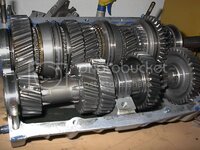
Here's a picture of the Nash when I had it apart. I mismatched the RPM during a 4-3 downshift with sticky tires and sheared a few teeth off the third gear set when the rear tires chirped.

IM000754.jpg

I don't know anything concrete about the strength issue. All I can offer is that this transmission shifts like a truck tranny, while my Richmond 6spd in my '84 is much smoother. Can't really explain the reasons.

second comment: I have the spare tire tubs out of my 68 and 70. I'm driving the 68 with a giant upside down cookie cutter in the rear for aerodynamics. (The 70 is not drivable). I'm thinking a flat surface would be great for aerodynamics.

I read you're concerned with turbulent airflow under the front of the car. I'd think the turbulent airflow under the rear might be just as important. It is. It's just harder to eliminate the turbulence after the air has traveled 12 feet under the car on its way to the rear axle area. Also, if achieve some nice laminar airflow under the front of the car, will that aerodynamically unstabilize the front end? Seems like turbulent airflow under the nose of the car would help prevent the nose lifting. I would believe it would be the opposite.
..........................................

I would love to clean up the rear underdeck area (volume), but that would take a ton of work. Right now the biggest (and easiest) improvements I think I can make in back is cleaning up the front area (thereby reducing some of the negative effects downstream) and reducing the amount of air that actually ends up entering the rear underdeck area.
 
Thanks, tranny case closed.

I'm truly curious about the result of your aero experiment.
Excellent thread.
 
I`m curious about one thing...how do you plan on sliding a jack under the car at the race track in case you have to bleed a caliper or change a tire?
 
I`m curious about one thing...how do you plan on sliding a jack under the car at the race track in case you have to bleed a caliper or change a tire?

Well, I don't know if I have quite the level of confidence in my Wilwood calipers as others might, but fortunately it's just a street car so I don't have to worry about quick pit stops or anything like that. The rockers only hang down an inch below the frame (level with the trans crossmember) so I'll probably just put a 2x4 under the frame for rocker clearance and then slide the jack under the board.

At least that's the plan for now. :amused:
 
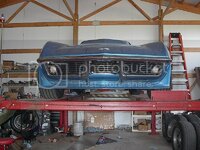
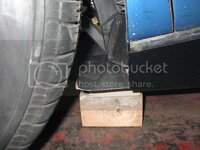
Well, I put the everyday tires back on the car, and I have 5" of clearance under the rockers. Worked well with the jack and a 2x4. The Hoosier tires are about the same height as the Goodrich tires, while the Nittos are about a half inch (radius) less.

IM001997.jpg


I've had the front outer grilles blocked off for the last year to reduce the amount of air getting shoved into the engine compartment. Two of the recent track days have been 98*F (Topeka) and 95*F (MAM-Iowa) and no overheating. I recently blocked off most of the center grill to reduce the air a bit more. We'll see if that will be an issue at the next track day. Fortunately it only takes about five minutes and a philips screwdriver to take it out.

IM001998.jpg

I'm also kicking around an airdam/tubing arrangement mounted under the (differential pinion bracket) crossmember to catch some of the air hitting it, and then directing the air out the rear wheelwell or caliper area to cut down on the amount of air that gets caught in the taillight area. It would take a lot of work to (aerodynamically) clean up the spare tire bucket area, so this is just something to bandaid the issue for the short term.
 
I made a set of side skirts for mine out of a plyable rubber that will bend up enough to let you get a low profile jack under it.
 
69427,

When are you going to be able to get the car out and see if your mods are an improvement? How are you going to measure or validate any change in performance? Seems like on many road courses, you'd spend little time at speeds that might use this approach to your benifit, but I could be way wrong. What kind of higher speeds to you see and for how long? How fast do you think you need to be going to get the benefit from your mods?

I understand aerodynamics just enough to be dangerous, but I'm an avid F1 fan and understand how much a small aero change can make on those cars, but that's about as far from our C3's as you can get and still have wheels. I'm very curious to see what improvements you see and to know if you have any temp issues from restricting the air flow through the engine compartment.

Thanks for sharing!!
 
69427,

When are you going to be able to get the car out and see if your mods are an improvement? How are you going to measure or validate any change in performance? Seems like on many road courses, you'd spend little time at speeds that might use this approach to your benifit, but I could be way wrong. What kind of higher speeds to you see and for how long? How fast do you think you need to be going to get the benefit from your mods?

I understand aerodynamics just enough to be dangerous, but I'm an avid F1 fan and understand how much a small aero change can make on those cars, but that's about as far from our C3's as you can get and still have wheels. I'm very curious to see what improvements you see and to know if you have any temp issues from restricting the air flow through the engine compartment.

Thanks for sharing!!

I'm hoping to get another track day done sometime in the next couple weeks.
I don't have any timing equipment or time to do any A-B comparisons, so it's just going to be some delta pressure measurements with my gauge, and some SOTP impressions.
Regarding "when" this should be beneficial, I expect that it should pay off during braking and cornering. Obviously it will be unnoticable on the slower sections, but hopefully it will incrementally improve the braking and cornering performance as speed goes up by reducing the front end lift. I don't expect actual downforce from such simple modifications, but even reduced lift at speed will be an improvement over the stock configuration.
I've only made one change (blocking the majority of the center grill opening) that might have an effect on cooling. If cooling is an issue I can remove the blockoff material in just a couple minutes.
 
You might check out a couple of the phone aps - for Droids at least.
I just bought a Galaxy Tab (7) and am looking at TRACKMASTER for the car/track day app. [I'm a bit late to the whole handheld phone/stuck in your face all day thing, but am willing to play on the edges for utility.]

It integrates Google Earth, apparently has a bunch of tracks loaded - and cheap at under 10 bucks.

Cheers - Jim
 
Coastdown/Decel data logging?

I'd like to figure out a handy/inexpensive way to measure/log decel speeds/g's during coastdowns (120-40 mph perhaps) to give me some indication of aero drag changes. (I've got some accelerometers and other parts in a box somewhere, so I could probably build something, but these days I just prefer to spend my time driving the car rather than sniffing solder fumes.) Any suggestions?

Thanks,
Mike
 
I'd like to figure out a handy/inexpensive way to measure/log decel speeds/g's during coastdowns (120-40 mph perhaps) to give me some indication of aero drag changes. (I've got some accelerometers and other parts in a box somewhere, so I could probably build something, but these days I just prefer to spend my time driving the car rather than sniffing solder fumes.) Any suggestions?

Thanks,
Mike

Get a copy of the sae coast down standard. All you do is log speed during coast down on a level road and run the data through a program they give you.
 
This guy used a wiimote and even dumped the data to Excel. We tried this at work a few years back and it worked great. You could also plot a graph

http://www.engadget.com/2007/07/31/car-modder-repurposes-wiimote-as-accelerometer/

iPhone got a pretty accurate accelerometer too, there's tons of Apps.
http://gizmodo.com/5030749/iphone-apps-we-like-dynolicious-car-performance-meter

Some are ever free :
http://reviews.cnet.com/8301-13746_7-10424432-48.html

If it's just about logging the Gs, a couple of hours is all it take to code such application.
 
This guy used a wiimote and even dumped the data to Excel. We tried this at work a few years back and it worked great. You could also plot a graph

http://www.engadget.com/2007/07/31/car-modder-repurposes-wiimote-as-accelerometer/

I checked our favorite auction site and it looks like those Wiimotes are available pretty cheaply. Now I just have to figure out the details of operating the thing and the interface issues.

Thanks for the suggestion. :thumbs:

Wooden you have to have a WII game console for the thing to talk to??

:skeptic:
 
Wooden you have to have a WII game console for the thing to talk to??

:skeptic:

No, you don't need the game console. There is tons of stuff on the internet using a wiimote for just about anything.

Hardware Requirements

You don't need much in the way of hardware to get your toes wet. Just a Wii Remote and a computer with a Bluetooth interface are required, but the Nunchuk, Classic Controller, and Sensor Bar are also supported


http://www.joystiq.com/2007/06/12/revolutionary-introducing-glovepie/
 
Aren't there apps that let you log data from the cars data bus? Just log speed, it would have to be way more accurate than a kids arcade game.

There is lots of info in the SAE standard that should be followed. Some local gov'ts make road survey data available, making finding a level road easier. SAE says to run two ways and average to remove grade effects, but less grade is better.
 
Kicking around another item to play with. Looks like it would be easy to get some delta pressure measurements also. For years I've seen some ("frame level") flat plates in front of the rear wheels of formula cars, and it strikes me as an effort to get some downforce from the air that strikes the rear tires (and possibly gets trapped a bit as the tire rotates). It looks like I could install some quasi-similar plates and easily hook up some tubing to my pressure gauge. Here's a mocked up setup.

IM002004.jpg

I don't know if this will be productive, but the material requirements are minimal, and it won't take much time to install a couple pieces of aluminum sheet onto the frame bottom in that location. If it doesn't work I'll just reuse the aluminum pieces for other projects, and the frame will be a dozen grams lighter due to the bolt holes (so it looks like I win either way :amused: ).
 
I have a question about inner genders and air flow control. I have converted the front end so it comes off with a few pins. Right now the inner fenders are off but not sure if to refit with dzus fastners. Car is street and track day with more focus on track.
 
I don't know the range of pressure you're supposed to measure, but let's take this sensor :
http://www.sparkfun.com/products/9602
Hooking them to an Arduino nano (15$) and hook the nano to a laptop could be pretty easy and cheap to do.
I've been tickling with micro-controllers and sensors, I can help.
 
Back
Top