Side Gill Aero Q's

VetteMod - Corvette Restoration, Modding & Performance Forum

Help Support VetteMod Forum:

vette427sbc

Well-known member
Joined
Sep 25, 2008
Messages
1,036
Reaction score
23
City & State/Province
Jersey Shore
Im looking for a place to mount an oil cooler, and was thinking the side gills would be ideal (lots of room, and short oil lines), but I am unsure of how much airflow they actually get. In stock form I would think not enough for an oil cooler, but maybe with the addition of a small Gurney flap, it would pull enough air to work. Thoughts?
 
In actual fact I have no idea what blows out the side scoops, but I know that with the stock radiator angle, and electric fans mounted on a similar plane as the radiator...ie angled down on the airflow, NOT back toward the front of the engine.....there is NO air pressure under the hood behind the radiator/hinges....

the pressure point is in front of the hinges, forward of the radiator....
 
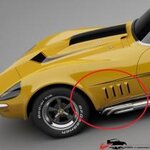
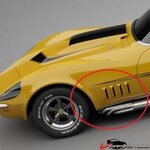
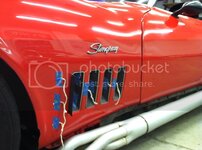
Cut them out - flip them around - like the BALDWIN C3 models and each has a "Gurney Flap!"

thum_12694f5400919db77.jpg

And - looks really Cool. They are available as an insert too - so the finish is ready to install.

Cheers - Jim
 
Cut them out - flip them around - like the BALDWIN C3 models and each has a "Gurney Flap!"

thum_12694f5400919db77.jpg

And - looks really Cool. They are available as an insert too - so the finish is ready to install.

Cheers - Jim

Jim, my car being a old custom '72 has always had open side scoops and no grills...just a ~4x6 open hole faired into the slot...look inside and see guts...

so when I did my pressure tests, that's what was then...I used yarn taped over the hood on back edge and open BB hood scoop, no movement at 100 mph....or anything less.... no rear hood seal gasket ...never had one....

:crylol:
 
I have seen the B/M gills... I prefer the stock style from a looks standpoint. Depending on how big the first Gurney flap is, I dont think you would need one on each gill like the B/M setup. The flap should create a low pressure area, so all of the gills (the open ones) should be affected. I may have to break out the yarn and tape for this one
 
I have seen the B/M gills... I prefer the stock style from a looks standpoint. Depending on how big the first Gurney flap is, I dont think you would need one on each gill like the B/M setup. The flap should create a low pressure area, so all of the gills (the open ones) should be affected. I may have to break out the yarn and tape for this one

I guess use a computer cam to see the yarn?? I didn't have one then, don't now....curious to know what you find...and about your hood and openings like I had.....:nuts:
 
As an Amazon Associate we earn from qualifying purchases. Product prices and availability are accurate as of the date/time indicated and are subject to change.
I guess use a computer cam to see the yarn?? I didn't have one then, don't now....curious to know what you find...and about your hood and openings like I had.....:nuts:

Ill do a bunch of aero tests when I do it... Hood vents, rear parachute, gills and anything else you think would be interesting to see.
If I cant get anyone to follow me with a camera, Ill just duct tape my iphone to the side of the car and get a video :hunter: :crylol:
 
I guess use a computer cam to see the yarn?? I didn't have one then, don't now....curious to know what you find...and about your hood and openings like I had.....:nuts:

Ill do a bunch of aero tests when I do it... Hood vents, rear parachute, gills and anything else you think would be interesting to see.
If I cant get anyone to follow me with a camera, Ill just duct tape my iphone to the side of the car and get a video :hunter: :crylol:

Well, whatever you can send along would be curious to see, as I can't for the life of me visualize just what makes a shark such a brick, compared to a C5+

even a early shark like mine....would be interesting to see one with a holey rear and the yarn in the holes...pressure relief or not??

:huh:
 
I've been curious about the efficiency of the side louvers too. I'm kicking around putting some aluminum sheet between the louvers and the headers to try to dam off some of the air that dumps under the floor pan, and direct it to (and out) the louvers. I'm going to try some wool tufts on the outside of the louvers, and a low pressure gauge plumbed to the engine bay and under the floor pan to give me a very rough idea if the concept works.
 
Should be placed in higher pressure area like the front of radiator. While the side vents to some venting adding a cooler there will restrict air flow and cause the air to stall. Plus you're trying to cool with hot air that's already been through rad and picked up additional compartment heat.
 
It would have been either about 85 or 110 MPH.
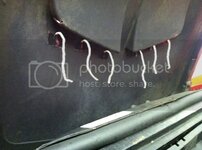
Note that there are two yarns in the gill, you can't see the tape on the one in front, but they are both blowing out, to the rear.
 
I did a yarn test today with a ~1" wicker... Im not sure if the wicker helped or not because the amount of airflow was pretty minimal at regular speeds. Ill try it without the wicker just to get a comparison, but I dont think it will be much different. The yarn in the gills was taped backwards to see if air was truly being drawn out. I took some video from inside the fender too... Ill post it when its done uploading
88f75412.jpg

whats wrong with in front of the radiator?

If the gills pulled enough air it would have been a short and clean run with the oil lines. To the front it is...
 
I have a huge question that has never been answered AFAIK, with a stock mechanical fan/equivalent electric fan setup in it's place, directed back at front of the engine, airflow directed over the front, stock rad placement, it don't matter they bought the room for more rad capacity by tilting it back...

and so with airflow redirected to engine I would think it would be much more pressure to the rear of the hood/scoop.....than the gills....

but with the way I mounted my Spal fans/parallel to the radiator, blowing down under the engine, I wonder if maybe I missing something and so missing additional airflow/cooling over and out the gills.....

hope that was 1/2 way clear in my meaning....:clobbered:
 
Heres the video link, I dont think its completely uploaded to youtube yet though...
[ame]http://www.youtube.com/watch?v=rfiBbZDlaOc[/ame]

I dont have a video editor so skip ahead a few minutes to get to the highway driving (lots of traffic unfortunately) 11:00 shows the high speed run up to 110 or so. Picture quality isnt great, but you get the idea... Not too bad considering its just my iPhone zip tied to my brake master cylinder :3rd:

I also tested the BB/LT-1 hood vents. (no pics or vid though) Seems to pull a little air out during regular driving (enough to pull 2 of the strings out), and a good amount more at 100+. So its not a totally useless mod :tomato:

e20d4d26.jpg

And for Gene- Speeds were recorded with an accurate AutoMeter electronic speedo :friends:
 
Last edited:
I have a huge question that has never been answered AFAIK, with a stock mechanical fan/equivalent electric fan setup in it's place, directed back at front of the engine, airflow directed over the front, stock rad placement, it don't matter they bought the room for more rad capacity by tilting it back...

and so with airflow redirected to engine I would think it would be much more pressure to the rear of the hood/scoop.....than the gills....

but with the way I mounted my Spal fans/parallel to the radiator, blowing down under the engine, I wonder if maybe I missing something and so missing additional airflow/cooling over and out the gills.....

hope that was 1/2 way clear in my meaning....:clobbered:

If you watch the last minute or so of the video, it is sitting with the fans on (electric, parallel to the rad). You can see the string in the lower left corner is still moving a bit. Shows that there is still some exit air flow from the rad to the gills even with the electric fans
 
I have a huge question that has never been answered AFAIK, with a stock mechanical fan/equivalent electric fan setup in it's place, directed back at front of the engine, airflow directed over the front, stock rad placement, it don't matter they bought the room for more rad capacity by tilting it back...

and so with airflow redirected to engine I would think it would be much more pressure to the rear of the hood/scoop.....than the gills....

but with the way I mounted my Spal fans/parallel to the radiator, blowing down under the engine, I wonder if maybe I missing something and so missing additional airflow/cooling over and out the gills.....

hope that was 1/2 way clear in my meaning....:clobbered:

If you watch the last minute or so of the video, it is sitting with the fans on (electric, parallel to the rad). You can see the string in the lower left corner is still moving a bit. Shows that there is still some exit air flow from the rad to the gills even with the electric fans

Your video was removed on my screen here, they said it was too long...??

I seen vids over a hour on YT...odd...
 
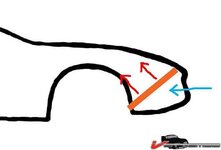
Well this brings up something I noticed when I pulled the hood to pull the motor. On my radiator, all the fuzz & leaves were in a shallow V on the top third of the radiator. Indicating to me that that is where the airflow is. Looking at the big-ass vacuum tank across the frame horns ('73 model) & the lower splashguard & the headlight vacuum buckets, I could see how the airflow would be directed this way. I long ago removed the front license plate & mount and put a grill there for straight-in airflow, but those items still interrupt the airflow.
Made me wonder about a curved sheetmetal vane over the vac tank to direct more air to the lower portion of the radiator. (And a 1/8" mesh screen in front of the rad to catch leaves & etc.)
 
Last edited:
I guess Ill have to find a video editor and shorten it before I try to upload it to youtube again...
 
Take a look at the pictures I have in my 'album'. I did a yarn run a few years ago and the gills do vent out.

Do you remember the speed in this picture?
66481b586f2e722.jpg

This reminds me of something I've been thinking about for a long time. We all can agree that the bottom of our antiques is not a low drag/pressure area. My question is where is the majority of undercar air coming from? Is it all from the engine compartment, or is a lot of it flowing from the sides of the car and making its way under the car? I'm planning on trying to divert a portion of the underhood air out to the side louvers, but if the air is still going to come in from the sides that defeats much of the purpose of blocking air from flowing from the engine compartment to under the floor. It looks like the "under door trim piece" (I'm having a mental block of what that's called at the moment) could be sectioned lengthwise and made a couple inches deeper/lower to block off some of the air that might try to enter from the sides. But, if the air is trying to exit from the underbody area I certainly don't want to trap it there. My car is still disassembled (and with expired plates) so it will be a bit until I could make some measurements. Anyone have any data on this issue?

Thanks,
Mike
 
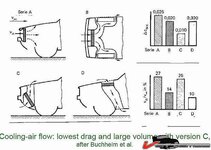
As I see it, much of the air comes in under the car---it's a wedge, some going over the top, some forced down under, some into the engine bay. That creates low pressure above the car, high pressure under the car, and turbulence inside the engine bay which is open to the underneath. There is also lots of resistance & turbulance under the car due to the mechanical equipment.
An air dam in front to divert air from going under the car will help lower the the undercar pressure and thus reduce uplift. But of course, air 'dam' also creates resistance in it's own right, but the benefits are worth it. The only way to reduce engine bay turbulence and resulting undercar turbulence is to vent the the grill airflow (radiator cooling flow) out the top of the hood or out the sides, into lower pressure airstream. Panning of the undercarriage is the only way to smooth undercar airflow.
You are also packing air into & behind the wheel wells from the spinning tires. It creates turbulence which adds to drag & ill handling.That's the reason for top fender vents & wheel skirts on Bonneville cars.

 
Last edited:
As I see it, much of the air comes in under the car---it's a wedge, some going over the top, some forced down under, some into the engine bay. That creates low pressure above the car, high pressure under the car, and turbulence inside the engine bay which is open to the underneath. There is also lots of resistance & turbulance under the car due to the mechanical equipment.
An air dam in front to divert air from going under the car will help lower the the undercar pressure and thus reduce uplift. But of course, air 'dam' also creates resistance in it's own right, but the benefits are worth it. The only way to reduce engine bay turbulence and resulting undercar turbulence is to vent the the grill airflow (radiator cooling flow) out the top of the hood or out the sides, into lower pressure airstream. Panning of the undercarriage is the only way to smooth undercar airflow.
You are also packing air into & behind the wheel wells from the spinning tires. It creates turbulence which adds to drag & ill handling.That's the reason for top fender vents & wheel skirts on Bonneville cars.

AYou really don't wanna know how this got demonstrated to my dumb ass, but....:hissyfit::crylol::censored: on a shark, the air pressure exerted on a hood is all from in front of the radiator, on my car with Spals in parallel to the radiator ...so blowing down on the airflow, toward the balancer....but being as I had to add a air dam above top of the rad support to block up and over airflow, it makes sense air pressure is in front of the rad, and on that portion of the hood,

I proved there is no air pressure under the major part of the hood with yarn some years ago....at least on MY car, witch is not really all THAT far from stock, in general airflow/body design....if it is, I sure as hell can't see it...

my curiosity is about that 'bucket effect' in the rear, so I need find some easy do inserts I can drill the body for to fit clean, just for cool looks and not to bother if they are ********...

:nuts:
 
Back
Top