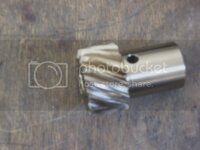
I can't see the picture.
The thing is. All these guys think they need 80 psi of oil pressure hot. That takes probably double digit horsepower and that gear is just too small and soft for that kind of torque.
What does the cam gear look like?
Will the melonized gear eat the billet cam gear?
Nope. It's the only gear I use. The brass/bronze/fiber gears are all hyped up crap.
I have a Lunati Voodoo hydraulic roller. I believe it's a billet cam with a pressed on gear. I know...it's been a while since the dyno. What gears should I not use on my distributor. Now you guys have me thinking.
Look at the effort that goes into a ring-and-pinion installation, yet no one thinks twice about the distributor gear/cam gear relationship unless performance starts to suffer.
Distributor gears are designed to be sacrificial. They’re easier to replace than cam gears, so they’re engineered to go first in the event of failure. Properly chosen, your distributor gear and cam gear will differ in hardness. But since a flat-tappet cam is made to a different hardness than a roller cam, you have to do your homework and pick a compatible distributor gear. We spoke with MSD engineer John Clark to get the lowdown on distributor gear science. Properly set up, these gears will give you one less thing to worry about.
Gear Science
Stock flat-tappet cammed engines usually use a ductile iron distributor gear. A standard iron gear usually works well with a flat-tappet cam grind, but remember that stock gears were designed around a stock cam. Because most modern performance flat-tappet cams are ground on better quality (harder) cores, MSD’s iron distributor gears are surface-hardened a few points higher than stock.
Softer bronze gears are typically used when running a billet steel roller cam, because the roller cam cores aren’t as hard as those on flat tappet cams. Bronze gears have a bad rap for wearing very quickly, but that’s in part due to inferior yellow-brass gears sold by some companies. Quality nickel/bronze alloy gears like MSD’s are made from a tough alloy, so they should live for years provided you don’t beat on the motor before the oil’s hot. Sometimes your first bronze gear may wear out quickly as it massages the cam gear. John mentioned that if the cam gear is poorly made, the first bronze gear may destroy itself deburring and reshaping the cam gear, but the second bronze gear should wear in faster, work more smoothly, and live longer. Bronze gears wear more predictably since they’re the same hardness all the way through, whereas iron gears are only hardened on their outer layer (0.0005- to 0.0015-inch deep). Remember to check ignition timing; as the distributor gear wears, the timing will retard.
Ford developed mild steel distributor gears for use with factory hydraulic-roller-cammed engines. This steel is softer than the ductile iron gears, but harder than bronze, designed for longer life necessary on a factory engine. Relatively harder Chevy hydraulic rollers use a standard iron distributor gear, but at the expense of shortened gear life. The Ford gears, though, are pretty tricky to install since they’re both press-fit and pinned to the shaft.
The metal’s only part of the story, though. How the distributor and cam gears mesh is just as important. The pitch diameter is a measurement of how closely the cam gear and distributor gear mesh. Excessive clearance between the gear teeth shouldn’t be fixed by shoving the distributor farther into the hole; this screws up the proper wear pattern. The right way to take care of excessive backlash is with an oversized distributor gear. Currently, there’s no practical tool for measuring pitch diameter, but John told us a 0.006-inch oversize works great in 99 percent of small-block and big-block Chevys. For the “other guys,” MSD is working on a tool to correctly measure pitch diameter so a proper oversize gear can be chosen.
Autotronic Controls (MSD)
1490 Henry Brennan Dr
El Paso
TX 79936
Will the melonized gear eat the billet cam gear?
Nope. It's the only gear I use. The brass/bronze/fiber gears are all hyped up crap.
Pop the distrubutor, paint the gear with some blue dykem (machinists' blue) or even better, some gear marking paint, drop the dizzy back in, clamo it down and crank it over. Pull it back out and look at the gear pattern. That will tell you right quick fast and in a hurry how it mates with the cam.
Wish I had your good fortune Gene.
For all practical purposes, I think what Bird said holds true.....hyped up crap!
I took a better look down into the intake to get a better look at the cam gear. I can only see a small part of it, but it is dark looking and dull....not shiney like the cam. I am trying to find someone locally with an boroscope I can borrow to get a better look in there before I get a new gear.
Wish I had your good fortune Gene.
For all practical purposes, I think what Bird said holds true.....hyped up crap!
I took a better look down into the intake to get a better look at the cam gear. I can only see a small part of it, but it is dark looking and dull....not shiney like the cam. I am trying to find someone locally with an boroscope I can borrow to get a better look in there before I get a new gear.
And then what? Pull the cam? Just install a melonised gear, and run it.
Wish I had your good fortune Gene.
For all practical purposes, I think what Bird said holds true.....hyped up crap!
I took a better look down into the intake to get a better look at the cam gear. I can only see a small part of it, but it is dark looking and dull....not shiney like the cam. I am trying to find someone locally with an boroscope I can borrow to get a better look in there before I get a new gear.
And then what? Pull the cam? Just install a melonised gear, and run it.
If it is the iron pressed on gear, wouldn't it be better to run the iron dist gear rather than the melonized? Or, no difference?
Wish I had your good fortune Gene.
For all practical purposes, I think what Bird said holds true.....hyped up crap!
I took a better look down into the intake to get a better look at the cam gear. I can only see a small part of it, but it is dark looking and dull....not shiney like the cam. I am trying to find someone locally with an boroscope I can borrow to get a better look in there before I get a new gear.
And then what? Pull the cam? Just install a melonised gear, and run it.
If it is the iron pressed on gear, wouldn't it be better to run the iron dist gear rather than the melonized? Or, no difference?
The melonised gear works well with any cam.
What IS melonised?? and what metal is it made of??
"Melonite™ and Melonite QPQ™ are thermochemical processes intended for the case hardening of iron based metals. These processes are categorized as molten salt bath ferritic nitrocarburizing. During these processes, nitrogen, carbon, and small amounts of oxygen are diffused into the surface of the steel, creating an epsilon iron nitride layer (e - FexN).
A degraded form of this nitride layer (gamma prime: g' - Fe4N) is obtained during plasma or gas nitriding. The nitride layer is composed of two principle zones. Zone 1, called the compound or "white" layer, extends to a case depth of ~0.0004" to 0.0008". The compound layer is porous, which lends to the lubricity of the finish, and hard (~700HV to 1600HV). Zone 2, called the diffusion zone, extends to a case depth of ~.004" to 0.008".
In addition, small quantities of substrate carbon are pulled from deeper within the substrate toward the surface. The diffusion zone demonstrates a decreasing gradient concentration of carbon and particularly nitrogen as the gradient extends deeper into the surface of the substrate. This property yields a tough outer surface or shell, yet alloys the material to retain ductility, thereby lending to the overall strength of the material.
Resulting properties from these chemical and structural composition changes are increased surface hardness, lower coefficient of friction, enhanced surface lubricity, improved running wear performance, increased sliding wear resistance, and enhanced corrosion resistance. Naturally, the alloy of the substrate will influence which properties are principally affected and to what extent they are affected."

What IS melonised?? and what metal is it made of??
Yeh, right, copy paste, and so only a Chem E can understand....
so I just figger it's tough steel, and get over with it....
The gear is just "case hardened".
Melonizing is a trademark name for a case hardening process using cyanide.
In the early 70's I did a stint with, of all people, a "Dutch tool and dye maker" schooled and from Europe. He taught me how to case harden sewing machine parts and using cyanide was one of the methods. Another was using bone meal. I remember asking my dad, who was also a tool and dye maker, about the process, and he said they had been using it ever since he first apprenticed in the 40's.
I guess back then, no one was bright enough to come up with a fancy name for it and trademark it.