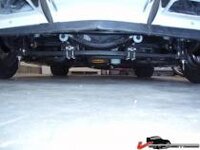
VB&P suspension - after the install

VetteMod - Corvette Restoration, Modding & Performance Forum

Help Support VetteMod Forum:

cascotty

Well-known member
Joined
Mar 24, 2008
Messages
63
Reaction score
0
City & State/Province
Corona - California
After installation of the dual mount rear spring set-up and the transverse mounted front spring I knew that there would be lots of adjustment options to obtain the suspension I wanted. What I'm finding so far is that this trial and error process that may be really time consuming. I haven't found any adjustment manual in the VB&P stuff

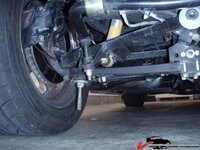
Initially during installation the front was set-up with the springs mounts on the next to softest setting. Softer settings are the inboard holes. The front remains in this setting and it seem okay to me.
39491cb757ada4a.jpg


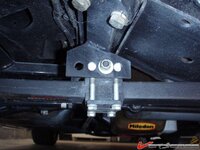
During installation the rear was set up in the softest setting ( see the wear mark on the attached photo). I was hitting the bump stop hard in the rear and my first adjustment was to change it to the next to firmest setting.
39491cb757498f2.jpg

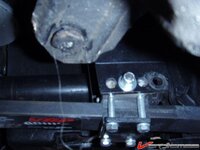
The rear spring adjustment was a lot better. After the adjustments discussed further along I think that it was over done and I need to back it down a notch.

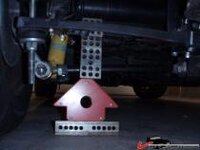
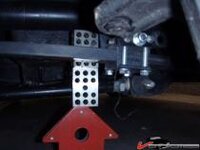
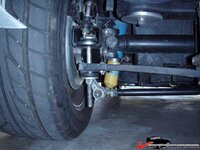
Next I decided to adjust the ride height up to get some more suspension travel. Initial set-up was 27 1/4 to 27 1/2 inches from the floor to the top of the fender at the wheel opening. I raised it to 28 1/2 inches all around. Note my wheels are 27.1 diameter so about stock. This felt like a big improvement. I had to tighten the adjusting nut about 2 inches to get 1 inch lift. Clearly this added a lot of pre-load on the spring. Hmm maybe too much?
39491cb756cd5e8.jpg

39491cb756534bf.jpg

I was also concerned about the length of threads showing, but there is no min./max adjustment indicated in any of the installation material.

Next up, tire pressures. I spent sometime trying to find a recommendation for tire pressures, but mostly the available info. is for stock cars. I wanted something for my Nitto 555's but there is nothing other than a max of 44 psi. I did find this rule of thumb :
(Vehicle Weight in lb/100) + 2 psi at heavier end + 2 psi all around if suspension and alignment are stock.
Example: Stock 911, 3,000 lb. 
(3000/100) = 30 psi
Add 2 psi all around = 32 psi
Add 2 psi to heavy end = 34 psi at rear
With modified suspension, the result is 30 psi front, 32 psi rear.

I checked my pressures cold (not so much in California) and found them at 25 to 27 psi. I thought I must of lost some pressure over the last 6 mos. wow. So based on the above rule of thumb - sort of - I put 36 psi in the fronts and 35 psi in the rear. This made a dramatic change, the ride was a lot rougher. It also made the slow speed turning a lot easier. After about a 20 min. ride and 45 minute cool down I checked pressures and they were up 3 psi in the front and 2 psi in the rear.

So next I took the pressures down to 33 psi all around and went for a drive. It is now a lot closer to feeling like I think it should. I also check pressures with out a cool down and the fronts were up 2 psi and 1 psi in the rear.

I'm thinking that the next adjustment is to take the rear spring adjustment down one notch. Also, maybe lower the car to 28 1/4 to reduce some of the preload. I think I can still play with tire pressure too. A good long drive to get a better feel for what to do next could help too.
 
I have not installed this dual mount spring setup myself so I don't have first hand experience...but: something is wrong, the spring should not be bend upwards at all and the nut on that bolt is way too high....
 
I spoke with VB&P tech. support today. They were very helpful and took their time in reviewing my options down to the detail of spring manufacturing. I suggest calling them when doing the adjustments because they can give you more infor on your specific springs. My question was is it sitting too high? Note the reason I adjusted the lift in was to get more travel out of the suspension in the hope of staying off of the bump stops. Simply the answer was yes, this ride height will negatively affect the geometry in the rear, there is no negative to it being higher in the front. They advised that they typically see around27 to 27 1/2 inches from the floor to the top of the fender arch (This means the car is lowered around 1/2 to 1 inch from stock (Per my measurements). My next question was can I shave the rubber bump stops down to get some more suspension travel. They indicated that customers frequently do that. My other options are to set the spring postion to a stiffer setting or exchange the spring for a stiffer one. However, my spring is a middle weight and I would be going to a really stiff spring.

I'm not inclinded to go that route, as the ride is really rough now. I don't think I have any illusion as to expectations for the ride quality. I've taken every oportunity I've gotten to ride in other C3's to get a sense of their ride quality. Kevin obliged me with a ride where he really worked over the gymka suspension in his car. It was surprisingly comfortable and worked really well. So knowing that my ride will be stiffer than that, I'm looking for some benifit in the trade off in terms of handling.

So as an update to my last post, the plan for further adjustments is now:
1. lower the car to 28 in. floor to fender arch. ( this is still a little high but I want to maximize spring pre-load and suspension travel).
2. take an inch off of the rubber bump stops. If anyone has done this, I'd appreciate advice on the best way to cut them down and if 1 inch sounds like a good number.
 
Rear spring:
If you run that nut down to where it normally is (1/2" from end of bolt) - is the spring still bent upwards like the second picture shows ? The reason I'm asking is that the load on the spring never changes when you adjust ride height, you only "pull" the trailing arm down, closer to the spring.
When you take a look from behind the car and the car is parked on level ground, are the half shafts almost parallel to the floor or slightly sloping down towards the wheels ? If the angle of the half shaft is too steep the U-joints will wear much faster.
 
With the nut run down to 1/2 inch from the bottom, I'm guessing that it would lower the car to 26 1/2 floor to top of wheel wheel. I'd probably have an inch and half of suspension travel. I wish I could get a good photo of the whole rear spring, but the spare is in the way. The spring is arched so the arc is nearest the ground in the center. So it is opposite to the stock center mounted spring.

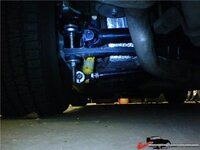
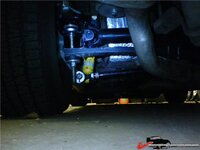
I took a couple of photos of me checking the 1/2 shaft. There is 1/4 inch difference in the clearance in the two positions (more clearance in board). When I lower the car the planned 1/2 inch there will still be a 1/4 difference but it will be in the opposite direction, right.

thum_39491ddbad8cddc.jpg


thum_39491ddbae4a9d7.jpg

I've talked about pre-load obtained when tightening the nut because the relationship between movement of the nut and raising or lowering/raising the car is not direct. I have to move the nut 2 inches to get a 1 inch adjustment to ride height.

BTW, I think the length of the bolt is dictated by providing an allowance for assembly without requiring you to compress the spring to start the nut on the bolt. This is important because if you want to change the spring stiffness you have to change the mounting hole you, and to do that you first take the tension off of the spring. It would be a real PIA, not to mention dangerous with a shorter bolt.
 
Perhaps it's the pictures, but it looks like the halfshafts are between parallel and slighlty angled up? Ie, the halfshaft is higher at the wheel than it is at the differential.
 
As an Amazon Associate we earn from qualifying purchases. Product prices and availability are accurate as of the date/time indicated and are subject to change.
Did they say anything about running the swaybars? I only have the rear double-mount with coils in front and found VBP was correct when they told me to disconnect the rear swaybar. The dual-mount spring reacts like a swaybar so it becomes overkill to have both.
 
No need for the rear sway bar indeed, and you can use a thinner one at the front also.

fiberglass_spring.gif

Why do you have those bolts tightened up that much? Are you shooting for a 4x4 look? I have installed this system and the bolt never had to be turned up that much and the car still sits relatively high (easily clears a 70s ratio 15" tire)
 
Perhaps it's the pictures, but it looks like the halfshafts are between parallel and slighlty angled up? Ie, the halfshaft is higher at the wheel than it is at the differential.

I think it is just the photo. It is really hard to get underneath the car while its on the ground and be able to show the 1/2 to 1/4 inch gap between the blocks and half shafts.
 
Did they say anything about running the swaybars? I only have the rear double-mount with coils in front and found VBP was correct when they told me to disconnect the rear swaybar. The dual-mount spring reacts like a swaybar so it becomes overkill to have both.

That is interesting? The suspension that I have in the car is the Performance Plus package. This is the whole suspension system, dual mount rear spring, shocks, sway bar and smart strut for the rear, plus transverse spring, shocks, sway bar, A-arms. There has got to be a reason for the difference in the recommendation that they gave you and the kit they sold me. But if I knew the answer I probably couldn't explain it properly.
 
OK, just got home & looked.
I have about 2" of thread showing below the bolts & 28" to fender lip with 225/70 15 BFG TAs (27.75 tire diameter). I am on the 3rd of 4th stiffest setting on my dual-mount rear spring. I've been running like this for 2 or 3 years no problem, unless I hit the railroad tracks too fast with a male passenger (it happens) but I hit the pipes, which are about 3" or maybe a tad more above the street (nobody in car). I have not trimmed my bump blocks, they are the "emergency dampers" of the rear suspension and not to be ignored, but I may be using them more than I know, I don't know-but I do know I can tell they get used.
(sorry, the picture is flashlight & cellphone)


66491e2e9f3c2c0.jpg
 
They sent me the sway bar with the package. I installed it and after losing the rear end on a tight corner, I called & Tony told me it should not have been sent, to take it off. He was right!
I got some performance package ("Grand Touring" I think) which came with the single mount spring & sway bar, but I ordered the dual mount instead of the single mount. This was several years ago. I trust VBP to know their ****, but all parts pullers & salesmen are not necessarilly performance 'techs'. And I do not know--perhaps with front & rear dual mounts you can run swaybars at each end to balance it as well since your spring actions are the same. Go find a big empty parking lot and try it! You will have to dial it in further yet anyway.
 
It would be relatively easy to disconnect the four sway bar links, ty-wrap the bars up, and try it out.
Go try a parking lot course, drop the links, and retry the same course.(Be carefull of course)
 
"Ty-wrap"??? Ain't you got any scraps of 12g or 14g wire laying around? Worked for me to tie up the ends of the sway bar for over a year till I got around to removing it!

--TurtlePhil

:lol:
 
Last edited:
No need for the rear sway bar indeed, and you can use a thinner one at the front also.

fiberglass_spring.gif

Why do you have those bolts tightened up that much? Are you shooting for a 4x4 look? I have installed this system and the bolt never had to be turned up that much and the car still sits relatively high (easily clears a 70s ratio 15" tire)

The first reason was because it felt to me like I was hitting the limit of suspension travel when I would hit a bump or dip on the freeway at 70 or 80 miles an hour. So I wanted to see if adding suspension travel would fix it/ validate what I thought I was feeling. It did fix it and therefore I think validate what I'm feeling.

The second reason is this suspension system is advertised as being very adjustable "fully adjustable spring rate, wedge & lowers ride height by 2 inches" " 8 point adjustable dual-mount spring rear mono-spring" " special spring bolts adjust ride height from stock to (2+) inches lower. So I want to tune the suspension for the optimum compromise between handling and ride comfort. But I lean strongly to tuning it for maximum street/touring handling.

Note that the 1 inch additional height didn't "4X4" it out, if this was the best setting for performance, I'd leave it there and the car still would look lower than stock. I'll be back in a bit with another post and picture of the cars ride height so you can see it yourself.

If you set up a car with the nuts only threaded 1/2 inch on the bolt that indicates that you took 2 or more inches of suspension travel out of it according to VB&P's catalog, I'd be surprised if that wasn't noticeable. Unless ?? you removed or cut down the rubber bump stops to gain back the lost travel.

This brings me around to the direction I'm now headed with the adjustments. Since the rear spring is at the next to stiffest setting, I'm looking to lower the car 1/2 inch to 28 inches (ground to the top of wheel arch) and take an inch off of the rubber bump stop. We will see what next from there.

If anyone else has modded these bump stops, I'd like to know how you did it and how much you elected to take off.


It would be relatively easy to disconnect the four sway bar links, ty-wrap the bars up, and try it out.
Go try a parking lot course, drop the links, and retry the same course.(Be carefull of course)

:confused2::confused2: If I do that you're going with me and then if proven true that I didn't need them, you're going to have to bail me out of jail after I beat the people at VB&P with them, for selling useless parts.

This is a complete suspension system guys. I can't believe VB&P chucked sway bars in the kit cause people think that there cool.:smash::smash:
 
Scott,
I have the "Grand touring package" on the 81, and installed it some 3? years ago or so. It uses 460 coils in front with an 1 1/8" sway, and the 360lb spring and 1" sway in back.(Memory, don't hold me to it) The larger sway in front works pretty good, but as I have learned from Howard and TT and many others, plus my own experience, too stiff a rear sway on these goofy rears tend to cause fishtail. Howard has told me to try a 3/4" rear, and I just may soon.($$$)
As for the dual mount units, yours is the first I have toyed with, and I claim ignorance. TT and some others have way more time tuning one than me. IF we could fly Howard out of the first snow, I know we could tune our cars in a day, but that might cost some more $$. (Although a "Chasis tuning for IN AND OUT tour" might be a good idea):D
My GUESS would be with super soft Hoosiers, and flat out racing, the stiffer the better. BUT<, when compromising for "real street" spirited driving with pot holes, swales, and other obstacles like harder street compounds, it's just whatever works with what you have to work with. (Double talk):sweat:
John and I made the same suggestion at the same time. Unless we hear better, I think we are all on the same page.
 
"Ty-wrap"??? Ain't you got any scraps of 12g or 14g wire laying around? Worked for me to tie up the ends of the sway bar for over a year till I got around to removing it!

--TurtlePhil

:lol:

I do trade shows no John. Less headaches. No wire laying around. Ty-wraps up the wazoo.;)
 
OK, just got home & looked.
I have about 2" of thread showing below the bolts & 28" to fender lip with 225/70 15 BFG TAs (27.75 tire diameter). I am on the 3rd of 4th stiffest setting on my dual-mount rear spring. I've been running like this for 2 or 3 years no problem, unless I hit the railroad tracks too fast with a male passenger (it happens) but I hit the pipes, which are about 3" or maybe a tad more above the street (nobody in car). I have not trimmed my bump blocks, they are the "emergency dampers" of the rear suspension and not to be ignored, but I may be using them more than I know, I don't know-but I do know I can tell they get used.
(sorry, the picture is flashlight & cellphone)


66491e2e9f3c2c0.jpg

Thanks, this is good info. It appears that you are 1/2 higher than where I started at 27 1/4 and where I noticed I was hitting the bump blocks (the wheel size accounts for the other 1/4 inch). I would also think that your tires are going to absorb a lot more impact than mine since you have a lot more sidewall, I'm running 255/50 17 Nitto 555's.
 
You will need to be patient & work with it to dial it in, all our cars & situations are unique. I envy you your wheels & tires, that's on my list of things to come. I know mine are mushmasters.
For whatever it's worth, I run 550# coils & 1 1/8" sway bar up front, but have not done a 4-wheel alignment since I installed them & replaced the t-arms so I have not done any parking lot tuning runs.
 
Last edited:
Scott,
I have the "Grand touring package" on the 81, and installed it some 3? years ago or so. It uses 460 coils in front with an 1 1/8" sway, and the 360lb spring and 1" sway in back.(Memory, don't hold me to it) The larger sway in front works pretty good, but as I have learned from Howard and TT and many others, plus my own experience, too stiff a rear sway on these goofy rears tend to cause fishtail. Howard has told me to try a 3/4" rear, and I just may soon.($$$)
As for the dual mount units, yours is the first I have toyed with, and I claim ignorance. TT and some others have way more time tuning one than me. IF we could fly Howard out of the first snow, I know we could tune our cars in a day, but that might cost some more $$. (Although a "Chasis tuning for IN AND OUT tour" might be a good idea):D
My GUESS would be with super soft Hoosiers, and flat out racing, the stiffer the better. BUT<, when compromising for "real street" spirited driving with pot holes, swales, and other obstacles like harder street compounds, it's just whatever works with what you have to work with. (Double talk):sweat:
John and I made the same suggestion at the same time. Unless we hear better, I think we are all on the same page.

I think the disconnect the rear sway bar idea is a couple of steps ahead of me. I haven't played in, or near, that realm. Also, I'm no Dan Gurney so I know that I'm fallible when interpretting the feedback the car is giving me, but, I'm not clueless either. Rather I think I need to focus the discussion a little. Let's talk about freeway driving in So. Cal. where there is a sharp transition and more often than not, an inch or two drop across and perpindicular to the lane, if I hit that at 70 to 80 miles an hour, I was feeling a bump and then a sharp hit. The car feels slightly unstable to me when it hits like that, but it doesn't step out, twitch or anything like that, thank god! If both rear wheels are moving up simultanously to soak up the same transition the sway bar has no effect. So I raised the car and gained some suspension travel and the hit goes away. I think okay, I need that much travel but the question is how best to get it. Leave the ride height, lower/trim the rubber bumper blocks or some of both. So far I've got VB&P saying a lot of people trim them and also I should lower the car some. Or, I can go to the stiffest spring setting or swap for a stiffer spring. This makes perfect sense to me. Since the latter suggestion amounts to make the suspension really stiff to compensate for the loss of travel I'm not in favor of that for the street. I'd rather gain a little travel and lower the car some.

Around town hitting potholes or if in my case running over 3" high swales in asphalt caused by stone pines roots on one side of the car doesn't cause the any twitching or other unsettling issues that I've noticed. But this is going around gentle curves at 30-40 miles an hour, so it is not really being pushed to hard either. However, if I had noticed that problem I'd be saying hey maybe I got a problem with sway bars.
 
You will need to be patient & work with it to dial it in, all our cars & situations are unique. I envy you your wheels & tires, that's on my list of things to come. I know mine are mushmasters.
For whatever it's worth, I run 550# coils & 1 1/8" sway bar up front, but have not done a 4-wheel alignment since I installed them & replaced the t-arms so I have not done any parking lot tuning runs.

Exactly. I'm not planning on doing anything in a rush just one small step at a time. I'll give my impressions of the change, but it is just my honest opinion as to how it feels. It will be here so if anyone else is going to tune this type of suspension in the future they may have some decent ideas on what to do, or not to do. Also, I am open to suggestions/input as I go through it.
 
I don't know anything about these new fiber glass springs and VB&P suspension parts,but after reading alot of these post about trying to set them up :flash:
makes me glad that my car came with the Gymkhana suspension,so far it has never given me a reason to swap it over,or change any part of it,and especially after the Ca trip,what a blast that was :D
Hope you get it figured out Scott before the next trip,i'm looking forward to seeing your car.
 
So I went with lowering the rear 28 inches floor to fender. I took all kinds of measurements but in the end I've decided to key in on the measuring the distance from the rubber bump stop to the pad on the TA and to keep it even side to side. I'm at 1 1/4 inches on each side which wound up being 28 floor to fender.

In the front, I lowered it to about 27 1/2 floor to fender.

I went for a drive over some bad freeway and also some bad roads. I didn't feel any of the hit from impacting the bump stop in the rear that I described earlier.:D It actually felt good overall.

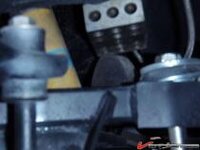
Checking bump stop measure after the drive, in the rear it was a nice equal 1 1/4 on each side, so I'm leaving it there for now. The half shafts are pretty close to being level on each side as it sits now too. Checking the bump stop clearance in the front is more difficult, I just can't get my little 4 inch rule, flashlight and eyeballs lined up. So I wound up using my 1-2-3 block as a fat feeler gage. thum_39491f54482947f.jpg
On the Drivers side it was a snug fit while on the other it was really loose. I readjusted the Pass. side to lower it down so that it was snug too. I'm at 27 5/16 inches to the fender lip on the Pass. side and 27 7/16 inches on the Drivers side.

Someday I'm going to disconnect the front spring and see what that 1 inch clearance translates to in total vertical wheel movement.

I'm toying with the idea of lowering the front a little bit more. I'm also trying to think of a way to create a tell-tale mark if the bump stop hits the frame or TA. Then decide wether or not I want to cut some down and/or if they can be purchased in a lower size.

By the way, the bolts wound up extending 1 3/4 inches from the nut pretty evenly all the way around. thum_39491f5448a3012.jpg
 
Hi

What I don't understand is :

I had to tighten the adjusting nut about 2 inches to get 1 inch lift. Clearly this added a lot of pre-load on the spring. Hmm maybe too much?

The weight of the car always stays the same. Why will the car only move 1 " up when you tighten the nuts up 2 " ? No preload can be added or removed from the spring. The load is purely the weight of the car.

Something is binding here.

Rgds. Günther
 
The weight of the car always stays the same. Why will the car only move 1 " up when you tighten the nuts up 2 " ? No preload can be added or removed from the spring. The load is purely the weight of the car.

Something is binding here.

Rgds. Günther


I agree. Running the nut "up" pulls the trailing arm "down", closer to the spring, nothing else... the arc of the spring should be the same no matter if the nut is high or low....

That's why I asked about the arc in reply #4:
Rear spring:
If you run that nut down to where it normally is (1/2" from end of bolt) - is the spring still bent upwards like the second picture shows ? The reason I'm asking is that the load on the spring never changes when you adjust ride height, you only "pull" the trailing arm down, closer to the spring.
 
I bet if he disconnects the sway bar links, the bind will go away.:idea:
 
I just loosed up the sway bar bolts and nuts. There are rubber washers on each side of the top and bottom of the bar and top and bottom of the connection to the TA. There was no crush to indicate compression of the rubber. Loosened up the nuts and there was no indication of any bind. I also loosened up the the bolts holding the spring to the dual mounts and noticed no movement. I wondered about the smart strut causing bind but this is in both the front and rear. If you all think of something I should look at or do to test the binding idea let me know.

I measured the sway bars to make sure they are the same as advertised - they are - 1.125 front and .750 rear.

After Sundays drive, it still feels much improved. I think I can make a significant difference in what is still a rough ride with air pressure. I read what I could find on tire pressures for C4's and C5's which would be similar to my tires and they are between 30 psi and 35 psi. So I'm thinking I will drop 2 psi out of the tires to 31 PSI cold.

I also want to try dropping the rear spring rate setting one notch ( it is at the next to stiffest setting now). There is work being done on a freeway onramp that I use which has a big drop near the end of the ramp, and the rebound off of that bounced my head of the roof (about a 2 inch gap). But I did not feel it bottoming out. Maybe it is becoming clear in this thread that the roads in my town are pretty crappy. In particular the above is an extreme road condition, and it tosses my CTS too.
 
Back
Top