What benefits do slotted & drilled rotors offer?

VetteMod - Corvette Restoration, Modding & Performance Forum

Help Support VetteMod Forum:

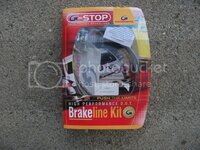
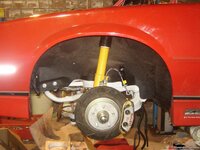
:clap: Want good brakes on a shark?? O ring stainless lines calipers, eliminate that brake light switch, and do a Hydroboost conversion....

stop on a dime with 9 cents change....

:shocking::shocking::beer:

Of course it will. That boat anchor weighs so much, you can't even go fast.
Hydroboost is for trucks and Winnebagos. Rip it off, and install it on that Clamper.
(The dual rears too). :hissyfit:

Clamper has it's own HB setup, it too actually stops....I put a aluminum m/cyl on the vette because that large dia. truck m/cyl I tried with the old sucky 'booster' was WAY too much ....so I went aluminum aftermarket OEM diameter again...and sure enuff, It's fine....MY vette stops good with about 2" of pedal deflection, the way GOD intended, not some 4+" and to the floor, damn nearly....all I can do is post my observations guys....

:hissyfit::gurney::drink:
 
....all I can do is post my observations guys....
:hissyfit::gurney::drink:

I probably have no business lecturing you since i'm a hair from being banned.....but, the guys get weary of every brake related thread and some not related to brakes becoming about your hydroboost, over and over and over and over and over and over..... They all get taken off topic.

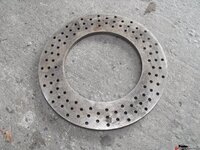
The question is "What benefits do slotted and drilled rotors offer?"

Street pads still outgas in my opinon so there is a very good reason to use drilled/slotted rotors. Racing pads don't outgas but they're so hard they wear a rotor out as fast as the pad wears.

The guys cracking rotors are getting them red hot. They're cracking rotors that are not drilled too.
 
Back in the mid eighties I used a "paint" product called Steel It to put a stainless steel coating on some motorcycle parts. It was magniciently bullet prrof looking as good as new for years. I don't recall now but it may have been heat set. Do a Google to see if it is still around as it may be the solution for those calipers.

What kind of paint can be used on the hat area to keep them from rusting?

Also how hard is it to rebuild these calipers with o-rings or whatever they use?

Best way to bleed all brake fluid out of the entire system? Best fluid to use with (has ABS) I have heard you can't use silicone brake fluid with this system, is this true or false?

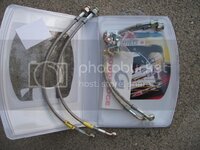
Good or bad stainless lines?

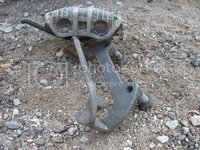
DSCF0423.jpg
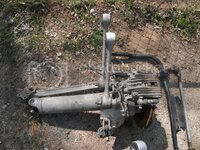
DSCF0424.jpg

these are calipers I will be using but I would like to make them nice again, not interest in red/pink/black paint hahaha ... however getting a nice aluminum color back and then clear coating would be nice if clear can stand up to and heat that is present on the calipers.

DSCF0412.jpg
DSCF0416.jpg
 
....all I can do is post my observations guys....
:hissyfit::gurney::drink:

I probably have no business lecturing you since i'm a hair from being banned.....but, the guys get weary of every brake related thread and some not related to brakes becoming about your hydroboost, over and over and over and over and over and over..... They all get taken off topic.

The question is "What benefits do slotted and drilled rotors offer?"

I have to agree here.:suicide: Gene, save it for a hydroboost thread, and since no one will ever start one here, it will quietly recede from brainwashing.
 
Back in the mid eighties I used a "paint" product called Steel It to put a stainless steel coating on some motorcycle parts. It was magniciently bullet prrof looking as good as new for years. I don't recall now but it may have been heat set. Do a Google to see if it is still around as it may be the solution for those calipers.

Interesting

http://steel-it.com/
 
It's not the first time this subject comes up.
I remember Norval drilling his rotors and claiming they were braking fine.

and heres an interesting answer I copied at ******** forum from one of our own member before he was banned there.


These are visual improvements, modern pads (street type stuff) don't outgas any meaningful amount, the holes and slots are purely visual. What they do affect however is rotor mass, the rotor mass is the heat storage buffer when braking (and the heat gets dissipated by air pumping through rotor from inside out, hence the vanes) so a rotor with less mass will run at a higher temperature under severe braking. More mass in the rotor is a good thing to lower the running temp. furthermore drilled holes may crack under severe braking (temperatureS) the expensive holed rotors have the holes cast into them. So if you want it for looks, go with slots but if you want brake performance I'd say go with plain rotors.

And I agree with him...
 
It's not the first time this subject comes up.
I remember Norval drilling his rotors and claiming they were braking fine.

Norval also used organic brake pads and set-up his car so it would ride like a Cadillac...his words not mine.
 
I did some searching. There is a SAE paper on it where engineers did some testing.

http://papers.sae.org/2006-01-0691/

Below is someone providing a summary of the findings.

There are many claims as to the benefits of drilled vs slotted rotors on stopping power. This guide is intended to provide some facts about drilled and slotted rotors. As a member of the SAE (Society of Automotive Engineers), I was pleased to see a paper "The Effect of Rotor Crossdrilling on Brake Performance" by two GM engineers published in 2006. They examined three vehicle platforms with cross-drilled rotors vs standard rotors to measure convection cooling capability, fade characteristics, wet braking, pedal feel and lining wear. The result is summarized as follows:

1.For the sports sedan, the coefficient of friction was 21% higher for drilled rotors than standard front rotors at 340F and higher using 15 brake snubs at 62mph. The track simulated 124 mph fade test showed 37% better brake output for drilled rotors. The drilled rotor brake temperature was about 150 degrees cooler.
2.For the performance car, the coefficient of friction was significantly higher for drilled rotors especially at high temperature.
3.Wet braking at high pedal pressure was the same for drilled or standard rotors. Wet braking is not significantly improved by drilled rotors.
4.Pedal force was much more consistent with drilled rotors over the brake temperature range. That is, to stop at the same deceleration rate, the driver does not need to modulate pedal pressure based on different brake temperatures. This reduces driver fatigue and improves brake response.
The authors also reported that drilled rotors prevent pad resin glazing on the rotor. So we now have solid evidence that drilled rotors have benefits over standard rotors. However, I have not found any published paper to show how slots affect brake output. So I reviewed inertial dynamometer tests using ISO NWI 26867 from Link Testing in Detroit with slotted rotors vs standard rotors. The results showed no significant difference in the coefficient of friction during the fade sections, hot stop section or pedal sensitivity portion of the test. My hypothesis is that slotted rotors do not contribute to rotor cooling whereas drilled rotors improve convection heat transfer to cool rotors and reduce brake fade. I should also point out that the pad lining wear for the slotted rotor was very severe during the test, i.e. the pad was chewed up over 20% more than the lining with stock rotors. While I believe that slots will help remove gas and debri from under the pad, I am not sure that this has a significant effect on brake torque for normal street driving. Perhaps the effect of slotted rotors is more significant on the race track, and conversely, I believe that drilled rotors are better for street and highway driving. For most drivers, I recommend drilled rotors over slotted rotors, and this conclusion is supported by the fact that Corvette, Ford GT, Porsche, Mercedes and BMW come with OEM drilled rotors. Brakemotive store

 
OK, so lets suppose I want to drill my rotors, how to do?? drill size? countersunk? where on the surface? one per fin? every other fin??

:crutches:
 
OK, so lets suppose I want to drill my rotors, how to do?? drill size? countersunk? where on the surface? one per fin? every other fin??

:crutches:

Buy them then. You'll never get a good balance on doing them with a drill press.

Hold the fort. You have hydroboost. You could use wooden pads and stop.
 
OK, so lets suppose I want to drill my rotors, how to do?? drill size? countersunk? where on the surface? one per fin? every other fin??

:crutches:

Buy them then. You'll never get a good balance on doing them with a drill press.

Hold the fort. You have hydroboost. You could use wooden pads and stop.

THAT is true, so to leave well enuff alone....

:smash::fishing::hunter:
 
I did some searching. There is a SAE paper on it where engineers did some testing.

http://papers.sae.org/2006-01-0691/

Below is someone providing a summary of the findings.

There to provide some facts about drilled and slotted rotors. As a member of the SAE (Society of Automotive Engineers), I was pleased to see a paper "The Effect of Rotor Crossdrilling on Brake Performance" by two GM store

Turtle, good article, I seem to remember reading the slots act as a uniform cutter to condition the pads and prevent glazing. The directions for installation tell you to orient the slots a particular way, so there must be a reason.


Wilwood sells drilled rotors for circle track and drag racing and advertise faster acceleration due to lower inertia, but you can see they have a lot of holes.


All my cars have drilled rotors, two with the slots as well and I would not go back to solid disks. The difference was very noticeable on my old c5z.
 
I thought I'd seen somewhere that the slots were for cleaning action. Here was the first mention I found today:

SRP Drilled Performance Rotor & Hat
For custom, show, and high performance sport driving, SRP rotors offer the high tech look and improved performance of a directional cross-drill and face slot pattern. In addition to the aesthetic appeal, the venting and cleaning action of the hole and slot pattern helps to reduce pad glaze and minimize irregular pad build-up on the rotor faces. The results are a smoother engagement feel at the pedal and consistent response from the pads. Each rotor is precision machined to less than .001" tolerance for overall flatness, parallelism, and radial run-out on long grain carbon iron castings. The rotors are finished with a black electro coat to provide corrosion resistance.


Here's the rotational inertia reference:

Ulltralite 32 Vane Rotor Drilled
When it comes to rotors, racers are constantly searching for the ultimate balance between the lowest weight and the ability to effectively manage heat. Decreased rotating weight in the drive line provides quicker deceleration under braking and quicker acceleration out of the corners. Lower weight also benefits handling with improved spring and shock control over the unsprung suspension mass. Wilwood's ULD-32 drilled iron rotors provides effective lightweight options for sprints, late models, modifieds, and other competition applications that race in low to medium temperature ranges.
 
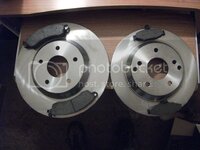
I just got my rotors and brake pads. I'm actually disappointed in the pads though. If they are truly for J55 they are anemic looking at best. I would have thought they would have been larger then they are and are considerably smaller then the fronts on my 97 Camaro. The difference between my stock 12 inch front rotor and these 13" ones is very noticeable. But I am thinking about a C5 conversion after seening these pads that look like they belong on a motorcycle and not a car.
 
I just got my rotors and brake pads. I'm actually disappointed in the pads though. If they are truly for J55 they are anemic looking at best. I would have thought they would have been larger then they are and are considerably smaller then the fronts on my 97 Camaro. The difference between my stock 12 inch front rotor and these 13" ones is very noticeable. But I am thinking about a C5 conversion after seening these pads that look like they belong on a motorcycle and not a car.

What kind of pads did you get? Modern friction materials require more unit area pressure (PSI) to work effectively than the materials they had in the 60's. So, I wouldn't be alarmed at the size of the pads.
 
I just got my rotors and brake pads. I'm actually disappointed in the pads though. If they are truly for J55 they are anemic looking at best. I would have thought they would have been larger then they are and are considerably smaller then the fronts on my 97 Camaro. The difference between my stock 12 inch front rotor and these 13" ones is very noticeable. But I am thinking about a C5 conversion after seening these pads that look like they belong on a motorcycle and not a car.

What kind of pads did you get? Modern friction materials require more unit area pressure (PSI) to work effectively than the materials they had in the 60's. So, I wouldn't be alarmed at the size of the pads.


when swapping from my '87 to this '72 one of the first things I noted was the change in the brakes, entire '72 setup seemed thicker and heavier from calipers through rotors, much less pads....that is my recollection, anyway....

to I wonder if the modern replacement pads were needing/requiring more pressure than the stock vac booser could muster?? hence the pedal going to the floor when stopping good/on time??

but that still don't say anything to the huge disparity of brake booster opinions....

:goodevil::clobbered:
 
What benefits do slotted & drilled rotors offer?

My understanding is the drilled holes increase cooling. The slots give an exit for gasses built up between the pad and rotor.
 
when swapping from my '87 to this '72 one of the first things I noted was the change in the brakes, entire '72 setup seemed thicker and heavier from calipers through rotors, much less pads....that is my recollection, anyway....

to I wonder if the modern replacement pads were needing/requiring more pressure than the stock vac booser could muster?? hence the pedal going to the floor when stopping good/on time??

but that still don't say anything to the huge disparity of brake booster opinions....

:goodevil::clobbered:

I don't understand why a power brake booster would be the heart of the problem. My 82 vette stops very good, much better then my friends 90 vette and my 97 camaro leaves them both feeling pre-historic. Only reason hydro-boost was implemented was due to a diesel not being able to make vacuum. Even my windstar feels better in the braking department then my friends 90 vette.

However the only complaints I ever hear about are 84-96 base 12 inch brakes being a pain in the butt. Never heard of a ZR1 owner really complain. The front 12 inch brake rotors are only by looks marginally better then the rear rotors. Perhaps the company sent me the wrong brake pads who knows.
 
Last edited by a moderator:
Based just on that picture I would agree there is an issue there. On the larger rotor, there isn't enough sweep of those pads to fully utilize the rotor's surface area. I would think that the height of that pad should be about 1/8" off the hat all the way up to about 1/8" from the outer edge of the disc.
Looks to me like the pads you have on the larger disc go to the smaller disc and the pads on the smaller disc go to something else entirely.
 
That's normal that the pads don't sweep the entire rotor, not a problem at all. He has the pads correct, the larger ones arae for a front PBR caliper, JL9, J55 or 1LE. The rears are for the pbr rear parking brake combo calipers for the same brake options.
Front rotors are 13x1.1 rears are 12x.83

24b508cdc06b67.jpg

24bc236b718065.jpg
 
The wife's Volvo factory pads did not sweep all the way to the outer diameter. After maybe 30,000 miles a grinding noise began. Once looking at the car the pads were still good. The pads had worn enough into the rotor that it the rotor, had begun to rub on the caliper. The way the caliper is designed there is very little clearance. That is the only issue I ever saw with smaller pads. By the way since then I have replaced her pads. They now reach the OD of the rotors.
 
The wife's Volvo factory pads did not sweep all the way to the outer diameter. After maybe 30,000 miles a grinding noise began. Once looking at the car the pads were still good. The pads had worn enough into the rotor that it the rotor, had begun to rub on the caliper. The way the caliper is designed there is very little clearance. That is the only issue I ever saw with smaller pads. By the way since then I have replaced her pads. They now reach the OD of the rotors.

Race pads will eat the rotor. They're not meant to be cold stoppers.
 
Back
Top