oil pressure dropping over 5000 rpm

VetteMod - Corvette Restoration, Modding & Performance Forum

Help Support VetteMod Forum:

Belgian1979vette

Well-known member
Joined
Apr 4, 2008
Messages
1,707
Reaction score
0
City & State/Province
Koersel/Belgium
I already asked on another forum but no final solution yet. The thing is I'm running a HV pump with 75 psi spring and anti-cavitation slots. I have a oiling system including Canton 15-240t pan, thermostat, B&M Hi Tek oil cooler (stacked plate), accusump (with epc valve), remote oil filter.

The thermostat normally bypasses (up to a %) as long as the oil is not fully warmed up.

Getting around 75 psi when cold. No problem there.

Last weekend, with +30°C outside temps, engine got to 210°F. As soon as it was getting warm, I had around 55-60 psi oil pressure below 5000, around 25-30 hot. But going over 5000, made oil pressure go down...I saw it go untill 45-50 psi.

There is some debate about the accusump having a tendency of overfilling the pan, but I somehow have the impression that the oil cooler is causing the restriction.

Anyone ever run into this same problem with the B&M ?

PS : I know there is debate about the HV pump, but I run a pretty large system and spring oilers. There is no way on earth the pan gets sucked dry as all excess oil normally gets routed back to the intake side of the pump.
 
are you pumping the pan dry? how many quarts are you running in the motor?

It's hard to see how the drains are working, but did you deburr the drains when you did the motor? With high-volume/high-pressure pumps you can literally pull so much oil from the pan that you'll start sucking air because it can't drain back fast enough.

This might be as well:

Depending on the design of the oil cooler and oil filter base - you could simply be bypassing the cooler and filter under high pressure thus still getting too much oil up top.
 
are you pumping the pan dry? how many quarts are you running in the motor?

It's hard to see how the drains are working, but did you deburr the drains when you did the motor? With high-volume/high-pressure pumps you can literally pull so much oil from the pan that you'll start sucking air because it can't drain back fast enough.

This might be as well:

Depending on the design of the oil cooler and oil filter base - you could simply be bypassing the cooler and filter under high pressure thus still getting too much oil up top.

I have a hard time seeing how it can pull the pan dry. If it starts pumping too much oil, it still has to get through all the passages. That will normally cause the pressure to rise and hit the set point of the spring in the pump, which is what i'm seeing at idle. If I check the volume of oil in the pan after it ran up to 75 psi cold, I'm still above the add mark. (to note is that the accusump draws some oilvolume as well which is variable based on pressure, but that aside).

The oil on top can only get there throught the pushrods, which allow the same amount of oil on top.

It will bleed off somewhat more since I have normally got a 70-75 psi spring in it. IMO it will not be enough to draw the pan dry.

The pan has 7 quarts actual oil content (without taking into account the filled filter, oil cooler and everything). If the total 7 quarts would end up on top, it would simply run out of my breather which is not the case.

It almost looks as if the pump cannot keep up.

BTW : to be sure I just changed the oil filter and cut the old one open. No metal scrapings in there.

The pump is of the type with the anti-cavitation slot in it.
The drains were deburred.
 
Last edited:
are you pumping the pan dry? how many quarts are you running in the motor?

It's hard to see how the drains are working, but did you deburr the drains when you did the motor? With high-volume/high-pressure pumps you can literally pull so much oil from the pan that you'll start sucking air because it can't drain back fast enough.

This might be as well:

Depending on the design of the oil cooler and oil filter base - you could simply be bypassing the cooler and filter under high pressure thus still getting too much oil up top.

I have a hard time seeing how it can pull the pan dry. If it starts pumping too much oil, it still has to get through all the passages. That will normally cause the pressure to rise and hit the set point of the spring in the pump, which is what i'm seeing at idle. If I check the volume of oil in the pan after it ran up to 75 psi cold, I'm still above the add mark. (to note is that the accusump draws some oilvolume as well which is variable based on pressure, but that aside).

The oil on top can only get there throught the pushrods, which allow the same amount of oil on top.

It will bleed off somewhat more since I have normally got a 70-75 psi spring in it. IMO it will not be enough to draw the pan dry.

The pan has 7 quarts actual oil content (without taking into account the filled filter, oil cooler and everything). If the total 7 quarts would end up on top, it would simply run out of my breather which is not the case.

It almost looks as if the pump cannot keep up.

BTW : to be sure I just changed the oil filter and cut the old one open. No metal scrapings in there.

The pump is of the type with the anti-cavitation slot in it.
The drains were deburred.

pressurized to the top, gravity to the pan - and it's not theoretical, the filling the top of the motor and starving the bottom; I've seen it happen. The issue is the high volume pump, unless you have a turbo or something that requires extra oil flow; they're just not worth it. (IMO 75 psi is a lot, and a waste of hp - 50 max, 25-30 psi warm would be about perfect).

it also might be that your pump is cavitating - the oil has to go somewhere, and if you push too much into the oil galleys; it could be sucking air or aerating the oil (cavitation) .... here's a wiki on the situation.
https://en.wikipedia.org/wiki/Cavitation
 
read up on Grumpy's reply in this old thread :

http://forums.hybridz.org/topic/3012-oil-pressurehow-low-is-too-low/

I have had my covers off immediatly after stopping the engine to set valve lash on 1 cyl. There was the normal amount of oil in there. This whole : sucking the pan dry is a bogus idea.

When hot it turns usually around 25-30 psi idle and 55-60 untill 5000. After 5000 i'm seeing it drop.

I'm going to assume pumped volume is high enough, so this leaves restrictions in the circuit and these can be :
- oil filter (non bypass filter AC Delco PF2)
- oil cooler
- the 90° bends I had to use
 
Last edited:
dont know how it come up but my dad told me about jaguar 6cyl development, reckons they had main bearing starvation problem. Turns out the oil passages to bigend were to big and at revs centifigal force would force oil out of bigend faster than main gallery could supply it. so fix was to reduce drilling in crank,problem solved apparently. just something to ponder.:D
 
New testing I did with the filter I replace yesterday and disconnecting power to the accusump suggest both a combination of the oil filter and oil level in the crankcase to be part of the problem.

Going to look further into this and try another brand filter among a reduction in oil level. The latter is especially problematic since the amount of oil the accusump stores and dumps into the pan is dependant on oil pressure which changes with temperature of the oil.

With regards to the last statement on oil channel diameter. I know about the discussion relating to crossdrilled cranks (which mine is btw and unfortunatly I knew about this only after I bought it). What I find strange is that if centrifugal force prevents oil to flow out of the oil channels in the crank I would suspect the pressure to rise rather than drop. I'm no engineer so I could be wrong though.
Anyway I only saw the subject come up with engine running at or above 8000 rpm. I'm below that level.
 
In my previous engine configuration I was experiencing the same problem and after any kind of test, 3 different oil pan and 3 different oil pump...... the problem was in the high part of the engine!!!!!

My Worldcasting block was partially incompatible with my TrickFlow heads !
The oil drain hole in the heads was too little and partially blocked by the block shape..... basically, after few seconds at high rpm, all my oil was under the valve covers !!! :twitch:

Then, after some grinding in the heads and the block, the problem was solved.

Now, same block but Dart Pro1 227cc full CNC heads.... no problems!
 
In my previous engine configuration I was experiencing the same problem and after any kind of test, 3 different oil pan and 3 different oil pump...... the problem was in the high part of the engine!!!!!

My Worldcasting block was partially incompatible with my TrickFlow heads !
The oil drain hole in the heads was too little and partially blocked by the block shape..... basically, after few seconds at high rpm, all my oil was under the valve covers !!! :twitch:

Then, after some grinding in the heads and the block, the problem was solved.

Now, same block but Dart Pro1 227cc full CNC heads.... no problems!

Correct, but I found this out when doing trial assembly. The block was already grinded before it was put together, so this is not the issue.

Meantime, I pinned it down to 2 possible causes : oil filter and pan overfill (possible promoted because of the accusump dumping partially its content in the pan during operation when pressure drops)
 
An update to this. A lot of tests later I ruled out some possible causes.
The filter was not one of them nor was a high oil level (so it seems).

I got better results running a 5W30 and currently due to what I'm seeing I'm inclined to believe it was oil pump cavitation. (BTW I checked oil levels while in running condition and hot at elevated oil pressure but oil level in the pan was correct)
 
This continued and for those who have the same issues : I still experienced a drop in pressure with the 5W30 and 6qrts, although less. I thought it was an oil drainage problem in the block and at first added about 700 ml. That made it worse, so it was pretty clear it was windage related. I drained some oil out of it with the oil level ending slightly below 6qrts and after that I had a solid pressure again at rpm.
 
This is very strange situation because these engines have the tendency to keep oil in the upper area of the block (lifter walley and valve covers).

Really looks windage related, but with tray and scraper....... mha!

There is allways something new to see.....
 
Well the story continues. Although I saw less of a drop with the 5W30 it wouldn't go up to the bypass relief valve setting which is strange since the volume produce by the pump goes up. It either has something to do with the bypass or cavitation.

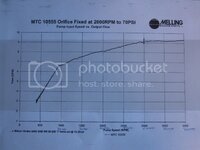
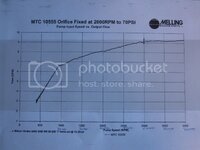
I got a pump graph from Melling and what i'm seeing on my engine irl seems to be confirmed by the graph. There is a lot of debate on what could have caused this.

The thing is that people running below 5500 will probably never see this problem.

I'm still searching for a solution. It might end up with a dry sump, although on our cars that's a lot of hassle.

IMG_0233_zps605fa6b8.jpg
 
Last edited:
the pressure section of a dry sump is a gerotor pump unlike the simple gear pump you have now. Cavitation, surge ..whatever it is, it's inherent to the simple 2 gear design

Titan makes a gerotor pump for SBC


There once was a setup that had a hybrid pump. A barnes in pan dry sump pump. They are very very ahrd to find but easy to use as it only requires the pan (not available anymore) or mods to your existing pan and 2 lines from the side of the pan.
 
the pressure section of a dry sump is a gerotor pump unlike the simple gear pump you have now. Cavitation, surge ..whatever it is, it's inherent to the simple 2 gear design

Titan makes a gerotor pump for SBC


There once was a setup that had a hybrid pump. A barnes in pan dry sump pump. They are very very ahrd to find but easy to use as it only requires the pan (not available anymore) or mods to your existing pan and 2 lines from the side of the pan.

yes, but the Titan pumps are wider in the back, necessitating a change in the pan apparently. Even then, cavitation originates from the inlet side and the drop in pressure, so it all depend on the inlet.

I know there has been talk about the barnes in sump dry sump, but quite frankly I've never even seen a picture of one. But even then it would still need an external tank.
 
read up on Grumpy's reply in this old thread :

I'm going to assume pumped volume is high enough, so this leaves restrictions in the circuit and these can be :
- oil filter (non bypass filter AC Delco PF2)
- oil cooler
- the 90° bends I had to use


Well the story continues. Although I saw less of a drop with the 5W30 it wouldn't go up to the bypass relief valve setting which is strange since the volume produce by the pump goes up. It either has something to do with the bypass or cavitation.

I got a pump graph from Melling and what i'm seeing on my engine irl seems to be confirmed by the graph. There is a lot of debate on what could have caused this.

The thing is that people running below 5500 will probably never see this problem.

I'm still searching for a solution. It might end up with a dry sump, although on our cars that's a lot of hassle.

IMG_0233_zps605fa6b8.jpg

That filter does have an internal bypass, not that it matters at all.

The graph is not for the anti cavitation pump from Melling.
The proper pump is a 10555C, hope you are aware of that and have it.

Really not much debate, the loss of oil pressure above 5k with sbc HV wet pumps is well documented with cavitation being the root. It's no surprise that the thinner oil helped a lot.
You seem to have eliminated the other common causes, aeration and oil supply starvation.

Lots of testing has been done Melling, Moroso and others and the pickup is the problem. In fact most of the aftermarket hipo pickups flow substantially less than the oem. Screen size, suction vortexes.

Might want to try and mod yours for less restriction.

Call this guy, he has a dual pickup hv pump that may be of interest. Might be the easiest cure. Treasure chest of info.

http://www.schumannsdynamicperformance.com/dual-feed-oil-pump-small-block-chevy-race.html
 
Thanks, I never knew a dual inlet even existed.

An answer I got from someone else. Something to think about :

This chart illustrates my point regarding the operation of the bypass. The test is performed with the required fixed orifice size to achieve 70psi at 4000 engine RPM (given that the pump itself is driven 2:1) on 5w30- at what I can only assume is to operating temperature? 70@4000rpm on the suggested viscosity is a pretty standard condition, nothing outrageous. You'll notice pump output is completely linear before about 1900 crankshaft RPM. That line corresponds perfectly to the pump's displacement output at those RPMs. The bypass valve is on it's seat. Over 1900RPM, the bypass begins to operate. Yes, nineteen-hundred RPM. Flow at the output of the pump begins to plateau, until 6000RPM where FLOW finally reaches it. You'll notice a blip on the graph at exactly 6000RPM. The bypass valve is being effected to it's specified fully-open point (not considering the secondary bypass design, which can open up even more, but without a progressive bleed control). At this RPM,6000, with the standard viscosity and clearances, is where given "bypass pressure specification" seen in manuals should match the PSIG. You'll notice 6000RPM is a far cry from where this graph clearly shows the bypass begin to function.

Belgian, with regard to the "sudden drop" of PSI using higher viscosity oil, which is not seen using a lower viscosity oil, is something a few people are noticing and it's not vehicle specific. Cavitation is one possibility, though it real cavitation is rare IMO. There should be no reason a pickup tube and screen can't flow 10GPM of 40grade, unless there is contamination or a severe design flaw. I've mentioned this to another recent poster with nearly identical concern. I pointed the finger to the bypass design, which is the culprit IMO, but not a flaw. Given that the bypass is a dynamic, progressive orifice, and that it's bleed rate is proportional to its position in the bore, which is determined by the spring rate x backpressure, it regulates pressure but only relative to the fluid's viscosity. Some pump designs use what I'd call a secondary bypass channel, beyond the linear, progressive increase of leakage used in normal bypass operation. When the valve cylinder get's pushed beyond the normal 'primary' range, a second orifice with a much larger, 'uncontrolled' leakage capacity opens up. This is a smart thing to do IMO as it allows wrecklessly high RPMs on cold and/or viscous oil without excessive internal pressure spikes that can lead to damage. I hypothesize that you're entering the secondary bypass range (where leakage is much less controlled, a true bypass mode) when using the 10W40. This is exactly an appropriate time where CATERHAM could tell you that your oil (10w40) is too thick and he would be absolutely right.
 
Thanks, I never knew a dual inlet even existed.

An answer I got from someone else. Something to think about :.....

Not really at all.
Don't know the rest of the correspondence, but this sounds like a lot of mumbo jumbo.
First, that chart is flow not pressure, it simply shows that the bypass opened at 70psi within the confines of the restrictions they setup and with continued rpm increase, the flow rate dropped off proportionally until the relief spring was fully compressed. No hydraulic manufacturer would state false pressure. If you buy a 100 psi relief valve, it opens at 100 psi. That guy is probably thinking thermostats.


Don't know what this secondary bypass thing he's talking about, but all hydraulic components have a certain amount of acceptable leakage, a necessity for operation , but it governs their efficiency.
In a gear pump, it's usually around 85%. This leakage behind the gears etc, in the anti cavitation pumps is directed thru the extra slots to feed oil to equalize the suction pressure and eliminate the vapor, thus cavitation.
Nothing at all to do with relief or bypass pressure.

Going over relief DOES NOT result in lower oil pressure.
You said you had a 75 psi relief spring and other than cold startup, your pressures are never over 60 psi, so hot, you are never going over relief, no more complicated than that.

I assume you have this pressure losss on high rpm acceleration. If so, take a look at the oil climbing up the back wall of the pan and leaving the pickup. If it's under normal high sustained rpm, forget that. Miloden makes a baffle to prevent the climbing I think. Or you can construct the pickup to the side or rear of the pan instead of the normal front.

Definitely take the time to call or email the link in Iowa I posted. Think his name is Vern, but he know his oiling and especially cavitation.
 
It's doing the same under constant high rpm as well.

I already sent them an email. They suggest the pump exiting to the pan. I find that kind of odd since that would put the pump at more risk of cavitation I would think.

So what you're basically saying is that the pump doesn't produce enough flow at high rpm, even though this is a HV pump ? I would have assumed if this is the case the pressure drop would have been higher with a lower viscosity oil.
 
Last edited:
It's doing the same under constant high rpm as well.

I already sent them an email. They suggest the pump exiting to the pan. I find that kind of odd since that would put the pump at more risk of cavitation I would think.

So what you're basically saying is that the pump doesn't produce enough flow at high rpm, even though this is a HV pump ? I would have assumed if this is the case the pressure drop would have been higher with a lower viscosity oil.

I don't know what you mean by that.

I'm saying that you most likely have cavitation and therefore the pump is losing flow output at a higher rpm. Lower flow = lower pressure.
 
The situation is this (numbers are purely for the purpose of this and not correct): if the pump puts out 40 gpm at high rpm and the engine only uses 10 gpm, 30 gpm have to go through the bypass and be recycled. The pickup only has to flow 10 gpm....if you exit to the pan you make the pump pull the full flow, 30 gpm through the pickup. This causes a pressure drop and can induce cavitation.

I specifically asked them this and Schumann's reasoning is that the bypass at this amount backs up into the pickup tube, in effect hindering the engine to pull enough oil.
 
Last edited:
Your train of thought is confusing a flow control valve with a pressure relief valve. Two different animals.
The Melling pump only has a pressure relief valve.
Anything less, in your case, 75psi and the flow is being circulated completely and properly.

What happens on the pressure side of the pump (including or excluding the relief) is irrelevant to the suction side if the demand exceeds the suction restriction.

No matter how you shake it, it leaves cavitation, as long as you have oil covering the pickup and the oil is not aerated.

So anyway, what did he say about the dual inlet pump?
 
Your train of thought is confusing a flow control valve with a pressure relief valve. Two different animals.
The Melling pump only has a pressure relief valve.
Anything less, in your case, 75psi and the flow is being circulated completely and properly.

What happens on the pressure side of the pump (including or excluding the relief) is irrelevant to the suction side if the demand exceeds the suction restriction.

No matter how you shake it, it leaves cavitation, as long as you have oil covering the pickup and the oil is not aerated.

So anyway, what did he say about the dual inlet pump?

The description was something about extra holes in the cover for the inlet side. Apparently on the side....I didn't quite understand that one, aside that it's aimed at an additional oil flow into the pump. But the pump he suggested doesn't have that feature, just the external bypass.

Piece about bypassing althoug in dry sumps. Same principle though.

http://nutterracingengines.com/racing_oil_pumps/about_dry_sump_oil_pumps.html

Some pump manufacturers like to claim that recirculating the bypassed oil back to the inlet of the pressure pump causes the oil temperature to increase. Well, technically that is true. The problem is that the temperature increase due to recirculation is so small that it is difficult to measure accurately.

Those manufacturers who criticize recirculation claim their products are superior because, instead of recirculating the bypass oil back into the pressure pump inlet, they pump it back to the oil tank (or to the sump).

HOWEVER, sending the bypassed oil back to the tank (or the sump) creates an even bigger problem: The output of the pump at high RPM can be 30 GPM or more, while the engine requires only 8 - 12 GPM. That means that the pump will be bypassing at least 18 GPM through the relief valve to maintain the set oil pressure. If the bypass oil does not recirculate to the pump inlet, then the full pump volume (30 GPM or more) must flow from the tank to the pump inlet through the dash-12 inlet line, with only atmospheric pressure (at best) to move it. The reality is that it can't be done without reducing the inlet pressure below the vapor-pressure of the oil, causing pump cavitation, line collapse, aerated lube oil, and all the engine problems that follow those problems.

NRC pumps provide optimal pumping efficiency by recirculating the bypassed oil back to the inlet side of the pump.
 
Last edited:
Back
Top