
You are using an out of date browser. It may not display this or other websites correctly.
You should upgrade or use an alternative browser.
You should upgrade or use an alternative browser.
Internal Body Aerodynamics
- Thread starter vette427sbc
- Start date

Help Support VetteMod Forum:


![Pampers Sensitive Baby Wipes, Clinically Proven, Fragrance Free, Unscented, Water Based, Hypoallergenic, Multi-Use, Hand Wipes 336 Wipes Total (6X Flip-Top Packs) [Packaging May Vary]](https://m.media-amazon.com/images/I/41KLBHu9CAL._SL500_.jpg)






As an Amazon Associate we earn from qualifying purchases. Product prices and availability are accurate as of the date/time indicated and are subject to change.

So all the phase change materials (and other theories) talk was wrong and front and rear tire temperatures are controlled by flexing the front wing? I think the budget for a top F1 team is $500 million per year. This is why.

phantomjock
Well-known member
Interesting to see the Brake Ducts come into focus. I am currently working (in collaboration with an off-shore aero engineer) on brake cooling and overall drag reduction.
Old fighter sq saying; Don't ya' just love it when a plan comes together?
One of the challenges F-1 doesn't have is the wheel well (or wheelhouse). Once you get the air in - you gotta' get it out or loose time due to drag.
Added bonus - if you can get it out efficiently, you might just reduce wake drag too.
I've been "messing" around with CAD for a number of years (self-taught) and now have added CFD to my study efforts.
It's a natural fit to my aero background and may just help point some of my build in a better direction.
[SIDE NOTE: I am back to work on the 'vette and will be finishing up the front suspension - steering this week. Then onto floors and wiring.]
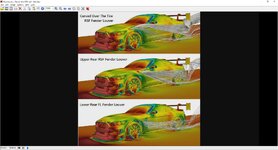
OK - back to CFD. Here is an interesting snapshot from a video selling fender louvers:

Not a fan of the platform, but the information is very useful. If I can find some time, I'll try and replicate in CFD on a C3 platform.
BTW, we all "know" the early models (pre 78) with the flying butress is dirty, and can be improved with a mod similar to the Baldwin Motion Corvettes.
And I'll bring the receipts - as I have time. I've done some rough work, but not yet ready for presentation. Yes, I tease.
LINK to the Louvers Video (sorry - you'll have to click - won't embed):
and another
For hood vents:
It is really great to see Race Louvers using real Wind Tunnel time to prove their products. Do the initial work with CFD, then follow up. Very effective. Not cheap, but shows the product works!
Old fighter sq saying; Don't ya' just love it when a plan comes together?
One of the challenges F-1 doesn't have is the wheel well (or wheelhouse). Once you get the air in - you gotta' get it out or loose time due to drag.
Added bonus - if you can get it out efficiently, you might just reduce wake drag too.
I've been "messing" around with CAD for a number of years (self-taught) and now have added CFD to my study efforts.
It's a natural fit to my aero background and may just help point some of my build in a better direction.
[SIDE NOTE: I am back to work on the 'vette and will be finishing up the front suspension - steering this week. Then onto floors and wiring.]
OK - back to CFD. Here is an interesting snapshot from a video selling fender louvers:
Not a fan of the platform, but the information is very useful. If I can find some time, I'll try and replicate in CFD on a C3 platform.
BTW, we all "know" the early models (pre 78) with the flying butress is dirty, and can be improved with a mod similar to the Baldwin Motion Corvettes.
And I'll bring the receipts - as I have time. I've done some rough work, but not yet ready for presentation. Yes, I tease.
LINK to the Louvers Video (sorry - you'll have to click - won't embed):
and another
For hood vents:
It is really great to see Race Louvers using real Wind Tunnel time to prove their products. Do the initial work with CFD, then follow up. Very effective. Not cheap, but shows the product works!
Attachments
Last edited:

rtj
Well-known member
- Joined
- Nov 5, 2011
- Messages
- 3,598
- Reaction score
- 211
Those vents really help underhood temps.
This is a bit pricey, but cheaper than the entire rear clip, and easier to install. I grabbed a second hand aci convertible rear clip off FB a while ago, so going that route.
Cd a bit lower for the vert, not as good as big back window if I remember correctly, but I prefer the look.
This is a bit pricey, but cheaper than the entire rear clip, and easier to install. I grabbed a second hand aci convertible rear clip off FB a while ago, so going that route.
Cd a bit lower for the vert, not as good as big back window if I remember correctly, but I prefer the look.
I've been looking at the long hood for 68-72 but its $1500 plus freight. Can't imagine what the freight for that would be.
rtj
Well-known member
- Joined
- Nov 5, 2011
- Messages
- 3,598
- Reaction score
- 211
Isn’t ACI close to you? I always thought their prices were as good as any. Dynamic Corvettes makes nice stuff, but is probably the most expensive out there.
Or, grab a late model c3 hood cheap and graft on a big hood scoop. . Yes I’m cheap.
Or, grab a late model c3 hood cheap and graft on a big hood scoop.
. Yes I’m cheap.
ACI is 200 miles from me. I do have a collection of hoods to do what I want. I should be working on that now so that I can get the car to paint.
I've been working on this car so long all the painters I had in mind are dead!
I've been working on this car so long all the painters I had in mind are dead!
Thanks, I had one of those. The fit was awful. It would be easier to modify a stock 68 hood.

phantomjock
Well-known member
A LOT to be said about Anti-Dive and Anti-Squat too (touched on in the video).
As I recall the SpeedLab Corvette - has Zero Anti-dive/Zero Anti-Squat.
I like the idea of the forces through the CG. It would be an interesting ride.
Cheers - Jim
As I recall the SpeedLab Corvette - has Zero Anti-dive/Zero Anti-Squat.
I like the idea of the forces through the CG. It would be an interesting ride.
Cheers - Jim
I can see where removing what little dive there is under braking/on turn in would make it somewhat more difficult for the driver. But I'm not sure how that relates to tire front tire wear.
Is most front tire wear is due to braking into corners or going through the corner? Also, must of what I was seeing in these YT videos about McLaren, was related to brake temperatures. How do the deceleration forces change unless you are proportioning more braking to the rear tires (probably not a great idea).
Is most front tire wear is due to braking into corners or going through the corner? Also, must of what I was seeing in these YT videos about McLaren, was related to brake temperatures. How do the deceleration forces change unless you are proportioning more braking to the rear tires (probably not a great idea).
rtj
Well-known member
- Joined
- Nov 5, 2011
- Messages
- 3,598
- Reaction score
- 211
I think he mentions the reason why keeping downforce constant from the underbody wing helps keep tires cooler.
When the downforce changes suddenly, the traction forces change rapidly, loading and unloading tires. The sudden changes in load is responsible for wear and heat, I believe is what he reasoned.
Pretty amazing that so many people are studying this to try and figure out their secret.
When the downforce changes suddenly, the traction forces change rapidly, loading and unloading tires. The sudden changes in load is responsible for wear and heat, I believe is what he reasoned.
Pretty amazing that so many people are studying this to try and figure out their secret.
I don't understand how the brakes run cooler because of anti dive. The total (all 4 wheels) of rotational/frictional forces acting on the brakes that slow a mass of X from 200mph to 100mph are the same regardless of weight transfer. The only way to deploy and incredible amount of drag (think a parachute)b or transfer braking forces from front to back. That sounds like a very bad idea.
rtj
Well-known member
- Joined
- Nov 5, 2011
- Messages
- 3,598
- Reaction score
- 211
If you have less downforce your wheels have less traction, I’m thinking more pedal pressure (clamping force) to achieve the same braking force.
Second, if you have lots of traction, you are less likely to need brakes.
Third, unloading and loading the tires suddenly due to big changes in downforce, would also translate to big brake force changes. Those big spikes would cause temps to spike.
Just throwing out some guesses. Probably other factors.
Second, if you have lots of traction, you are less likely to need brakes.
Third, unloading and loading the tires suddenly due to big changes in downforce, would also translate to big brake force changes. Those big spikes would cause temps to spike.
Just throwing out some guesses. Probably other factors.
rtj
Well-known member
- Joined
- Nov 5, 2011
- Messages
- 3,598
- Reaction score
- 211
Hey BBShark, I asked google AI. Here is the answer it gave:
In F1, changes in tire downforce can indeed affect brake heating due to the interconnectedness of aerodynamics, tire grip, and braking systems. Increased downforce leads to greater grip, which in turn allows for more aggressive braking and higher deceleration rates. This, in turn, increases the heat generated by the brakes as they convert the car's kinetic energy into thermal energy.
Here's a more detailed explanation:
In F1, changes in tire downforce can indeed affect brake heating due to the interconnectedness of aerodynamics, tire grip, and braking systems. Increased downforce leads to greater grip, which in turn allows for more aggressive braking and higher deceleration rates. This, in turn, increases the heat generated by the brakes as they convert the car's kinetic energy into thermal energy.
Here's a more detailed explanation:
- Downforce and Grip:
Downforce, generated by the car's aerodynamics (particularly wings and the underbody), increases the force pressing the tires onto the track. This translates to more grip, allowing the tires to handle higher cornering speeds and, significantly, more braking force.
- Braking Performance:
When a car brakes, the brake pads or calipers apply pressure to the brake rotors, converting the car's kinetic energy into heat through friction. More downforce allows for more braking force to be applied without the wheels locking up, resulting in a higher deceleration rate and thus, more heat generated.
- Weight Transfer:
During braking, weight shifts from the rear to the front of the car. This weight transfer is influenced by downforce. With more downforce, the weight transfer is more pronounced, potentially leading to more heat being transferred to the front brakes.
- Brake Cooling:
F1 cars have sophisticated brake cooling systems, including ducts and vents, to manage the extreme heat generated during braking. However, the effectiveness of these systems can be influenced by the aerodynamic setup and the amount of heat generated, which is directly impacted by downforce changes.
- Brake Balance:
F1 teams adjust the brake balance (the distribution of braking force between the front and rear wheels) based on various factors, including downforce levels and track conditions. More downforce can necessitate a shift in brake balance to ensure optimal braking performance and prevent overheating.
- Tire Temperature:
Brakes can also affect tire temperature, as heat from the brakes can be transferred to the wheels and tires. This is why F1 teams carefully manage tire temperatures to optimize grip and performance.
- Tire Wear:
Excessive heat can lead to tire degradation, potentially causing blistering or other issues. Therefore, teams must carefully balance braking performance with tire management.
AI's ability to analyze complex systems is not good. This is one example:
The problem statement is, why do McLarens brakes run cooler that everyone else? If the answer is that they have greater down force under braking, this AI analysis would indicate the opposite:
In F1, changes in tire downforce can indeed affect brake heating due to the interconnectedness of aerodynamics, tire grip, and braking systems. Increased downforce leads to greater grip, which in turn allows for more aggressive braking and higher deceleration rates. This, in turn, increases the heat generated by the brakes as they convert the car's kinetic energy into thermal energy.
I agree with this statement, however it is directly opposite the premise that the video presents.
The problem statement is, why do McLarens brakes run cooler that everyone else? If the answer is that they have greater down force under braking, this AI analysis would indicate the opposite:
In F1, changes in tire downforce can indeed affect brake heating due to the interconnectedness of aerodynamics, tire grip, and braking systems. Increased downforce leads to greater grip, which in turn allows for more aggressive braking and higher deceleration rates. This, in turn, increases the heat generated by the brakes as they convert the car's kinetic energy into thermal energy.
I agree with this statement, however it is directly opposite the premise that the video presents.
phantomjock
Well-known member
I haven't run any numbers. I see this:
Two Car Thought Experiment: (Simplistic Assumptions: - no weight transfer, same weights, brakes, cooling -delta T at the rotors, etc..)
More Downforce yields more Grip.
More Grip yields higher Cornering Speed.
Higher Cornering Speed means there is less speed to loose before entry.
Less speed to loose generates less braking heat.
Two Car Thought Experiment: (Simplistic Assumptions: - no weight transfer, same weights, brakes, cooling -delta T at the rotors, etc..)
Both cars will approach the same corner at the same speed - Pick a number.
They will both brake as required to make the turn. (May not be the same position!)
Car #1 (with more DF) will take the turn at higher speed due to more Grip available.
Car #2 will brake harder to reach a lower cornering speed to make the turn, generating more heat in the calipers and rotors.
Car #1 retains more kinetic energy, and converts less to heat, faster exit speed. Car #2 finishes as the first looser, all other things being equal. (YEAH RIGHT as if they ever are...)
I might be able to run something on CarTest2K, but gotta work steering arms today first.
Cheers - Jim
Similar threads


- Replies
- 3
- Views
- 1K

- Replies
- 93
- Views
- 22K
- Replies
- 31
- Views
- 10K

