Brake "failure" oddity that has me scratching my head.

VetteMod - Corvette Restoration, Modding & Performance Forum

Help Support VetteMod Forum:

69427

The Artist formerly known as Turbo84
Joined
Mar 30, 2008
Messages
3,080
Reaction score
42
City & State/Province
Clinging to my guns and religion in KCMO.
At the track day last week the brakes were fantastic when first applied coming up to the corner. If I did a quick second application of the brakes there seemed to be little to no deceleration going on. The pedal was high and firm at both the first and second application. It just felt like a typical power brake system that has no vacuum to the booster. The throttle was closed through all this, so the booster should be getting vacuum to the front side of the diaphram. So, I'm confused on what's going on here. Booster is an '84 C4 unit.

Another possibility I was trying to figure out if the master cylinder was the culprit. It was hot to to the touch, and slightly overfilled. I drained out some fluid to reduce the vertical pressure column under braking, just in case the cylinder "ram" couldn't release the fluid quick enough under braking. (Far fetched, but I was really scratching my head trying to figure out the cause). I also tie strapped a length of foam tubing insulation onto the master cylinder to reduce the heat conduction, but didn't see any improvements. The master cylinder is a C5 aluminum part.

Another item I'm addressing is the vacuum tubing between the booster and the carb. I changed the vacuum plumbing over the winter, and for all I know I might have possibly caused this problem. I have two sources of vacuum (the carb base at the secondaries, and a manifold fitting right at the #8 cylinder runner). I also have two main requirements for vacuum: The brake booster and the PCV vailve. I used to plumb them to the two vacuum ports I mentioned, but I always hated that the port above #8 runner either injested oily fumes from the PCV valve, or injested raw air from the booster that leaned out #8 cylinder. So, over the winter I hooked the booster hose and the PCV hose together at a tee about 1.5" behind the carb base fitting. I figured that I shouldn't get a noticeable pressure rise (vacuum loss) over that short of a distance. But, I can be wrong, and maybe that was the cause of the vacuum booster acting odd. I don't know. Either way, I am now making a way to pull vacuum straight from the manifold plenum, and I will hook the PCV hose to that, and the card vacuum post will hook to the booster.

That;s where I'm at. I welcome comments and advice on this issue.
 
Another item I'm addressing is the vacuum tubing between the booster and the carb. I changed the vacuum plumbing over the winter, and for all I know I might have possibly caused this problem. I have two sources of vacuum (the carb base at the secondaries, and a manifold fitting right at the #8 cylinder runner). I also have two main requirements for vacuum: The brake booster and the PCV vailve. I used to plumb them to the two vacuum ports I mentioned, but I always hated that the port above #8 runner either injested oily fumes from the PCV valve, or injested raw air from the booster that leaned out #8 cylinder. So, over the winter I hooked the booster hose and the PCV hose together at a tee about 1.5" behind the carb base fitting. I figured that I shouldn't get a noticeable pressure rise (vacuum loss) over that short of a distance. But, I can be wrong, and maybe that was the cause of the vacuum booster acting odd. I don't know. Either way, I am now making a way to pull vacuum straight from the manifold plenum, and I will hook the PCV hose to that, and the card vacuum post will hook to the booster.
I'm just now chasing Vacuum Leaks in the engine bay on the 2008 Chevy 2500 (tow) Van-Camper [6.0L LS uhuhuh ].

There is a Check Valve (apparently -- yet to disassemble) in that hose from the vacuum source to the brake booster. Once I reassemble everything, I can check my booster for the leaks.

The method I see is starting the engine, pressing the brake pedal to the floor, then turn off, and hold down 30 seconds. If the pedal rises (with light pressure still on it - its the booster. - So says YT. Then I'll check the gasket between the MC and the booster.

Again, my problem is slightly different - but in the same "neck of the woods." If the check valve is bad - could that be creating your problem? - Can't say.
LINK if helpful:

Good Luck,

Cheers - Jim
 
I have never checked but is it normal for the brake cylinder to be hot to the touch?

Sounds like the crankcase vapor is getting into the booster (somehow)? Maybe consider plumbing the PCV into the air filter housing like older GM cars?
 
Boiling your brake fluid?

I put a vacuum reservoir on my car and it helped when car went to idle.
 
I have never checked but is it normal for the brake cylinder to be hot to the touch?

Sounds like the crankcase vapor is getting into the booster (somehow)? Maybe consider plumbing the PCV into the air filter housing like older GM cars?

I'll confess I've never had any cause to put my hand on the master cylinder before, so I don't know if it's a common occurrence or not with my car. It was an 80* day, and I had spent about 15 minutes out on the track, so the engine and coolant temps were about 210*. I have some aluminum sheets at the frame level to dissuade air from exiting the engine compartment via the bottom of the car, and instead entice it to leave via the side gills. I suspect that the master cylinder in enveloped in hot air during all this.

I'm trying to figure out if there's some way that I'm getting some "crosstalk" between the contents of the two vacuum lines, but I haven't arrived at an answer yet. Part of the unknown is if the checkvalve at the booster ends up allowing slight pressure back into the line once the checkvalve closes. I just don't know.

So for now, I'm shotgunning things. I replumbed the line from the booster to be the only line attached to the carburetor rear vacuum nipple, so there can't be any interaction with any other vacuum line. I'm also working on being able to hook the pcv valve line to the intake plenum, so that any oil fumes or combustion blowby will be equally distributed/diluted to the cylinders, rather than it all ending up going into the vacuum nipple right in the port feeding cylinder #8. And lastly, I'll be flushing the system with new brake fluid just to reduce the list of possible contributing factors.

If it hadn't been for this odd brake issue, it would have been an absolutely perfect track day.
 
As an Amazon Associate we earn from qualifying purchases. Product prices and availability are accurate as of the date/time indicated and are subject to change.
Boiling your brake fluid?

I put a vacuum reservoir on my car and it helped when car went to idle.

I don't believe the fluid was boiling, as I had a firm high pedal throughout all this, but I'm putting fresh fluid in it this week anyway just to give me a bit more peace of mind.

I'll keep the vacuum reservoir option in mind.
 
I'm just now chasing Vacuum Leaks in the engine bay on the 2008 Chevy 2500 (tow) Van-Camper [6.0L LS uhuhuh ].

There is a Check Valve (apparently -- yet to disassemble) in that hose from the vacuum source to the brake booster. Once I reassemble everything, I can check my booster for the leaks.

.........................

Again, my problem is slightly different - but in the same "neck of the woods." If the check valve is bad - could that be creating your problem? - Can't say.
.....................

Good Luck,

Cheers - Jim
I am definitely going to look at the checkvalve. My booster is an '84 Corvette unit (small and light).
 
I would try the air filter housing vent filter for the PCV. Not like you have to have a good vacuum source to vent the PCV.

1716144254153.png
 
I would try the air filter housing vent filter for the PCV. Not like you have to have a good vacuum source to vent the PCV.

View attachment 56884
The factory setup on my car has that large size hose going from the right side valve cover up to the air filter base, and the PCV valve draws out of the drivers side valve cover. I've reworked/relocated the PCV valve vacuum source to a couple threaded holes that enter the plenum of the (Edelbrock C396) manifold. Also, the power brake booster is now getting its (unshared) vacuum signal from the nipple under the carburetor rear fuel bowl. The booster should be getting a guaranteed clean high flow vacuum now. The only thing I haven't tested yet is the booster vacuum check valve. I'm still trying to figure out how I'm going to do that.
 
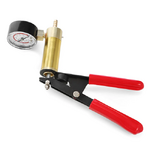
One of these?
1716196933739.png
Mine does pressure or vacuum. Pull the hose (PITA) then just use one end - suck/blow. Then you'll know.
My problem - can't see th ehose on the booster to pull it off!
Best of Luck..

Cheers - Jim
 
One of these?
View attachment 56886
Mine does pressure or vacuum. Pull the hose (PITA) then just use one end - suck/blow. Then you'll know.
My problem - can't see th ehose on the booster to pull it off!
Best of Luck..

Cheers - Jim
Thanks, yes I recently bought one of those. (y) I spent some time today thinking about the booster operation, and I have a couple ideas on how to check a few aspects of the high and low pressure sides of the booster. I'll be trying to get that done this week.
 
I'm with 'boiling the fluid' camp. My FJ40 initially would have this problem. The hydraulic clutch would work great when cool but because of where it was at, the cylinder got very hot - and made pushing the clutch quite hard. Also, a dragging brake or brakes will do this. what fluid is in it? the worst part about a dragging brake is the problem just gets worse - the more it drags, the more the fluid expands, the more the fluid expands, the less braking you have available.

vacuum systems either work of they don't - the only exception to that rule is if there isn't a check valve. From what you describe, the issue would be more pronounced at idle.
 
I like your idea if re-routing the vacuum lines; you changed 'em this winter....now you have the symptom. I agree boiling brake fluid isn't the problem. I agree getting a gauge on it should help you see what's going on. A well functioning booster should give you about three brake pumps with full power assist.....so even if your vacuum source were marginal, I'd think that it'd give you two good brake applications for each brake event. I guess I'd vacuum test the booster itself and see if it's leaking.

That IS an odd one....I'm looking forward to hearing more about this as you dig into it.
 
Dual Brake Gauges with video capture of the "event" would be useful post session. Might indicate a loss at either end - if both drop then the booster.
No indication of fluid anywhere?
Getting close to sounding like the master cylinder...

Cheers - Jim
 
Next track day is in a week, so I'm trying to take the car for a test drive around the neighborhood and up the interstate, but can't move the car until I get a stinking cotter pin to hold the RF caliper pads in. The Wilwood calipers use a three and a half inch long skinny cotter pin that seems to be unavailable from any source other than Wilwood and their dealers, and my order seems to be taking the long scenic route getting to me. In the meantime I'm trying to figure out a safe substitute for that pin so I can at least drive the car a short bit to see if I've made progress on this issue.
 
Amazon shows the available overnight.

But, if they are truly 1/8 in, steel tig rod would probably work. 1/8 bolt, etc.
 
Amazon shows the available overnight.

But, if they are truly 1/8 in, steel tig rod would probably work. 1/8 bolt, etc.

Thanks, I will check Amazon. (y)

We're on a similar wavelength with your tig rod suggestion. While all my tig filler rods are for aluminum welding, I could go pick up some steel rods. And this morning I was looking at a dust covered pack of 308 stainless stick-weld rods that I considered repurposing if possible.
 
Well, I took the car out for a test drive just to see if the vacuum line connection rework fixed the problem. It didn't. I had mixed feelings about that. I felt relieved that my change of the hose setup last winter apparently wasn't the cause of the problem. I also felt lousy, because the problem isn't resolved, and the next track day is this coming Friday, so I'm running out of time. So, time to dig further into the vacuum line and the booster. The first thing I checked was the inline filter that's in the vacuum line. There wasn't a filter in the circuit with the stock booster, but my present booster is an '84 Corvette piece (half the weight of the C3 booster), and there's a filter in C4s, so I just duplicated that setup. i pulled the filter off and shook it to see if it made any rattling noise, and a whole bunch of ultrafine black plastic beads/dust came out. More came out as I continued to shake it. I thought, well that explains the dead second pedal application: the restriction in the filter wouldn't allow enough airflow to quickly work the air/vacuum in the booster. I then looked at the vacuum nipple at the booster, and it was full of those same beads. More flow restriction obviously. I cut the filter (plastic housing) apart, but couldn't really see if it was just the trap for the beads, or the source of the beads/dust. I hooked my shop vac to the booster nipple to vacuum out what I could, and also pumped the brake pedal during that to induce some air flow through the circuit.

So, that's where I am. Long term I need to figure out if I need to replace the booster, but for this week I'm hoping I can bandaid things. I'm going to go buy a new filter for the vacuum line, and if the old filter was the culprit due to age (I bought it new at the parts store, but it did look like it had been on the shelf for quite a while) then the system should work okay this Friday. If the problem is internal to the booster, then hopefully the plastic dust production is slow enough to allow a few hours of track time, and any dust will be caught by the filter. I can always pull the filter between sessions and blow into it in reverse to see if anything comes out.

Again, that's where I'm at.
 
I just got to thinking. I wonder if one of those clear plastic fuel line filters would work as a vacuum line filter short term, just to see if any crap is being sucked out of the booster.

The pressure vectors are in the opposite direction, but I might buy one this week to try out anyway.
 
The rest of the story: I did a bunch of searching on the web, and found out the story behind the vacuum line filter. Apparently GM had a bunch of brake booster warranty issues and failed parts problems in the early and mid seventies. It seems gasoline fumes were gassing off from the intake manifold and getting into the brake booster, damaging the booster diaphragm, causing brake assist problems. GM's "cure" for this was a charcoal infused filter between the manifold and the brake booster. The charcoal was to absorb the gas fumes until the next engine operation when the fumes would be pulled back into the engine. From a few peoples' comments, GM recommended that this charcoal filter be replaced every year. I doubt if many people did that, but I do wonder if the filter would disintegrate with age and vibration, resulting in a filter and hose filled with charcoal dust (see where I'm going here?). My earlier observation that my booster hose was full of plastic powder was most likely charcoal from the disintegrating filter internals. From other info it appears that this filter was used from 1978 to 1984 model years. (I'm using a 1984 design booster, so I had copied the vacuum details.) So, while I still have the '84 design booster on my car, it's not an '84 vintage piece, so I'm wondering/hoping this ten year old unit is built with whatever improved material is in later boosters that are not vulnerable to gas fume damage. I think I'm going to forgo purchasing another charcoal filter, and just see how things go.

If I had heard about this issue thirty years ago it would have surely saved me time and aggravation this past month.
 
It sounds like you may be on to solving the issue. I've never seen one of these booster filters before, just your usual check valve and typical issues were always leaking vacuum lines or a bad check valve. This could very well be the smoking gun as the clogged filter could create a restriction that would effectively extend the amount if time it takes to build the vacuum back up in the booster, just like if you were feeding the booster with the same size line on the vacuum advance can on the distributor. Looking forward to hearing the results at your upcoming track day.
 
The rest of the story: I did a bunch of searching on the web, and found out the story behind the vacuum line filter. Apparently GM had a bunch of brake booster warranty issues and failed parts problems in the early and mid seventies. It seems gasoline fumes were gassing off from the intake manifold and getting into the brake booster, damaging the booster diaphragm, causing brake assist problems. GM's "cure" for this was a charcoal infused filter between the manifold and the brake booster. The charcoal was to absorb the gas fumes until the next engine operation when the fumes would be pulled back into the engine. From a few peoples' comments, GM recommended that this charcoal filter be replaced every year. I doubt if many people did that, but I do wonder if the filter would disintegrate with age and vibration, resulting in a filter and hose filled with charcoal dust (see where I'm going here?). My earlier observation that my booster hose was full of plastic powder was most likely charcoal from the disintegrating filter internals. From other info it appears that this filter was used from 1978 to 1984 model years. (I'm using a 1984 design booster, so I had copied the vacuum details.) So, while I still have the '84 design booster on my car, it's not an '84 vintage piece, so I'm wondering/hoping this ten year old unit is built with whatever improved material is in later boosters that are not vulnerable to gas fume damage. I think I'm going to forgo purchasing another charcoal filter, and just see how things go.

If I had heard about this issue thirty years ago it would have surely saved me time and aggravation this past month.

So the purpose of the filter was to filter the fumes from the booster that re-entered the engine at shutdown? Wouldn't the vacuum in the booster pull in some small amount of engine air/fumes (when the engine was shut down)?
 
So the purpose of the filter was to filter the fumes from the booster that re-entered the engine at shutdown? Wouldn't the vacuum in the booster pull in some small amount of engine air/fumes (when the engine was shut down)?

I'm not entirely clear on what you mean in your first sentence, so I'll just respond to the second sentence.
I think we agree on the second sentence. In a perfect world the checkvalve in the booster wouldn't allow any (ambient pressure) air from the intake manifold to leak into the evacuated booster. I suspect that the checkvalves were imperfect (like most things on a Chevrolet), and the booster vacuum level gradually pulled air and gasoline vapors into the booster interior, damaging the diaphragm. The charcoal in the filter was there to soak up the gas vapor in the hose to prevent or reduce the amount of fuel vapor entering the booster after shutdown.

Given that Chevrolet stopped equipping Corvettes in 1985 with this filter, I'm assuming there was a material change in the diaphragm that no longer required this protection/bandaid.
 
Update: I went to a track day yesterday. Recall that I found the previous brake problem was the charcoal filter in the booster vacuum line had disintegrated and filled the vacuum line full of charcoal dust, restricting the manifold vacuum flow from the booster. A few weeks ago I vacuumed as much of the charcoal out of the line and booster checkvalve as I could, and then installed a clear plastic fuel filter in the line to catch any of the remainder before it got into the engine. To my relief the brakes worked perfect all day yesterday. I was happily surprised that the fuel filter wasn't restrictive enough to cause any noticeable loss of assist. Looking at the filter I did see about a half dozen small pieces of debris, so I'll probably keep this filter hooked up for the remainder of the season.
 
Back
Top