Weight reduction: Running out of ideas.

VetteMod - Corvette Restoration, Modding & Performance Forum

Help Support VetteMod Forum:

Shipping weight for a 1976 Corvette was 3445, curb weight was 3541. Add 200 lbs for a/c, th400, telescoping steering wheel, power windows, power steering, am/fm radio (18lbs for the radio!)
I'm just under 3200 lbs (3160) with a full tank of fuel (I'm supposed to be 3200 for the class I run in) - with 3 gallons it'd be roughly 3060... which makes your weight even more impressive.
That said, my weight bias is almost exactly 50/50 (within 5 lbs)
One of my scales died, so weighing hasn't happened recently - but once resolved I'll see where I'm at now. I suspect I weigh more

*link https://corvettestory.com/specs/1976-Corvette-specs-options.php
 
Had a spa/mental-health day today, roaming my favorite junkyard. Looked around for parts for a few project cars. Was surprised to find another C4 (an '85) in the yard. Last time I was there I pulled some parts off an '89 C4. I checked dozens of GM intermediate size cars looking for 11.5" solid rear rotors, but kept striking out. Close to closing time I stumbled upon an '11 Buick Regal with 11.5" rotors. The quick measurements I made (and comparing them to the rear rotors on the '85 C4) indicate a good possibility of trying them on my car. The only measurement that looks to be a concern is the center hole. The Buick rotor "looks" like it's maybe .100-.150" smaller. Right now the plan is to stop in there again next week, pull the rear calipers off the Buick and the C4 , and see if the rotors are interchangeable on the spindle/hub or not. I'll also bring my portable scale to measure the weight difference between these two rotors to see if the swap is worth the expense of new rotors and a machining fee.
 
Well, scratch the rotor swap idea for reduced weight. Went to the junkyard today and pulled rear rotors off an '11 Buick Regal and an '85 Corvette. The Corvette had drilled aftermarket rotors, and some wear, but the Buick rotors had similar wear. I weighed them both with my HF hanging scale, and the Corvette rotors were about two ounces LIGHTER (.12#). Weighed them three times, and the results were repeatable. So, this economical option isn't going to work.

While wandering around looking at radiator sizes and shapes for my street rod truck project, I saw some small radiators that might package in the rear of my '69. In addition to trying to reduce mass in my car, I keep looking for ideas on how to move some of the remaining mass either to the right or to the rear. I keep entertaining ideas on how to reduce the radiator size and weight (and airflow) up front, and move some of the weight and work rearward. Would definitely take some duct work and plumbing to direct the fluids, pretty sure that's doable, but I have no experience on what it takes to pump the coolant in that long of a round trip. I suspect the overall weight of the cooling system would increase slightly, but possibly a better f/r weight balance (currently about 1400/1300 pounds) might net a better handling car. As I heard someone once say, you can only go around a corner as fast as the slowest axle/half of your car.

Just trying to figure out a next move.
 
Well, my parsimony paid off. Got my "pre-owned and generically priced" 26mm hollow front swaybar (off an '89 C4) finally installed. Went online to buy some poly bushings for it, and for some damn reason 26mm generic poly kits are noticeably more expensive than other kits of similar size range. Surfing the web I found some 26mm poly bushings for a Honda Accord for a pretty cheap price. Bought them, and last week scoured the junkyard for some brackets. No luck finding an Accord of the correct vintage, but did find a late model Jeep IIRC with the correct sized brackets. Got them (and a similar size pair off an Isuzu) for a very acceptable price. I welded short extensions on them to give additional fore and aft adjustment, and I was in business. Total cost for the bushings and brackets was about half compared to buying the generic kit (my labor is free, and the mental health benefit of wandering a junkyard on a nice sunny day is substantial).

Oh, and the weight of this mongrel kit turned out to be four ounces lighter than a generic kit of similar size. Win, Win.
 
A productive day at the junkyard is a good day. Especially when you are able to piece together exactly what you wanted.
 
Enjoyed a track day last week. The rear suspension geometry changes and the front sway bar reduction really helped the car rotate in the corners, and to be noticeably more steady during heavy braking. The car just seemed to go where I aimed the steering wheel. With a big block this car previously always seemed reluctant to flick the front end each way. This was a rare moment of owning this car when changes to it exceeded my hopes. Another item that made all the weight reduction work worth it was the braking into the corners. The car slowed down noticeably quicker than I was used to, and I found myself letting off the brakes into the corners, rather than trail braking. Not a big deal, it was a track day, not a race, so there's more opportunities ahead to adjust my braking points. One thing that did scare me was the brake booster seemed to have only one good application per corner. When I let off the brake, and then reapplied the brake a half or full second later, the pedal felt like I had no boost at all. Firm hard pedal, but seemingly no noticeable deceleration. I'm still trying to figure this out, and I'll be starting a thread in the Brake section shortly to discuss it in more detail.
 
As an Amazon Associate we earn from qualifying purchases. Product prices and availability are accurate as of the date/time indicated and are subject to change.
Enjoyed a track day last week. The rear suspension geometry changes and the front sway bar reduction really helped the car rotate in the corners, and to be noticeably more steady during heavy braking. The car just seemed to go where I aimed the steering wheel. With a big block this car previously always seemed reluctant to flick the front end each way. This was a rare moment of owning this car when changes to it exceeded my hopes. Another item that made all the weight reduction work worth it was the braking into the corners. The car slowed down noticeably quicker than I was used to, and I found myself letting off the brakes into the corners, rather than trail braking. Not a big deal, it was a track day, not a race, so there's more opportunities ahead to adjust my braking points. One thing that did scare me was the brake booster seemed to have only one good application per corner. When I let off the brake, and then reapplied the brake a half or full second later, the pedal felt like I had no boost at all. Firm hard pedal, but seemingly no noticeable deceleration. I'm still trying to figure this out, and I'll be starting a thread in the Brake section shortly to discuss it in more detail.
big camshafts don`t make vacuum, you might want to try the C-6 (maybe) aluminum master with no booster, you might just kill two birds with one stone, better brakes and a weight reduction, on my racer I ran a stock cast iron manual 1" master cylinder...
 
Enjoyed a track day last week. The rear suspension geometry changes and the front sway bar reduction really helped the car rotate in the corners, and to be noticeably more steady during heavy braking. The car just seemed to go where I aimed the steering wheel. With a big block this car previously always seemed reluctant to flick the front end each way. This was a rare moment of owning this car when changes to it exceeded my hopes. Another item that made all the weight reduction work worth it was the braking into the corners. The car slowed down noticeably quicker than I was used to, and I found myself letting off the brakes into the corners, rather than trail braking. Not a big deal, it was a track day, not a race, so there's more opportunities ahead to adjust my braking points. One thing that did scare me was the brake booster seemed to have only one good application per corner. When I let off the brake, and then reapplied the brake a half or full second later, the pedal felt like I had no boost at all. Firm hard pedal, but seemingly no noticeable deceleration. I'm still trying to figure this out, and I'll be starting a thread in the Brake section shortly to discuss it in more detail.
you also might consider a triple disc clutch you can ditch your heavy scattershield, the triple disc has much less rotating mass allowing you to go into corners deeper (braking later) and come out quicker due to less rotating weight...
 
big camshafts don`t make vacuum, you might want to try the C-6 (maybe) aluminum master with no booster, you might just kill two birds with one stone, better brakes and a weight reduction, on my racer I ran a stock cast iron manual 1" master cylinder...

My current setup is an '84 C4 booster (smallest OD of the C4 boosters, needed to clear my valve cover, and half the weight of a C3 booster), and a C5 aluminum m/c (about 1# with a 1" piston). My current engine combination idles at about 12" of vacuum, as it's also a licensed street car. This setup worked perfectly for the past ten years up 'til the other week.

I'll admit my possible ignorance on the next item. Regarding manual brake C3 Corvettes, I was/am under the impression that the 1" manual master cylinders have a deeper rear conical bore in the rear of the piston to better deal with the brake pedal pushrod, compared to the conical bore depth in the 1.125" PB master cylinders. Is this correct, or have I been fed incorrect information?
 
you also might consider a triple disc clutch you can ditch your heavy scattershield, the triple disc has much less rotating mass allowing you to go into corners deeper (braking later) and come out quicker due to less rotating weight...
I've looked at those small diameter setups. They're fantastic in every way, except when taking off from a standstill. As I mentioned earlier, my car is still a licensed street car, and dealing with stop signs and traffic is still a concern. I presently have the 10.5" 14# L88 flywheel, a 13# pressure plate (the lightest I could find), and a pretty light 6.5" front damper. Given the M21 and 3.08 rear gear I have, my setup is already threatening to stall the engine whenever I take off from a stop.
 
Just an update from a change quite a while back. I experimented/installed a radiator out of a 2001 Cavalier 2.2L into the car, taking about ten pounds of material and coolant off of ahead of the front axle centerline compared to the previous aluminum radiator I had. The reason for this radiator choice was it has almost identical frontal area as the stock radiator, but just one row thick. Yesterday was the first track day in quite a while where the ambient temps were hot enough (90*) that I was concerned about the capability of this radiator to keep the engine "cool" (it usually ran 210* on hot track days with the previous name-brand aluminum radiator). For less aero drag/lift I have had both the headlight grills blocked off and most of the two underchin holes blocked as well. The majority of cooling air comes in the center grille, as I'm not running a front plate. To my great relief the coolant temps were at the same 210* as before.

Just dreaming right now, but I would like to put a smaller yet radiator up front (biased to the right), and then add a second radiator/fan in the back between the two mufflers. This dual system would most probably be a net weight increase for the car, but may pay off in better front cornering grip and more weight on the rear axle during accels and braking. I have most of the details worked out, other than a clean way to plumb the lines above/around the rear batwing and halfshafts.
 
Glad it worked out. Maybe take a look at motorcycle radiators for your remote application. You may be able to find something that fits size and weight constraints if you shop some wrecked sportbikes. One concern will be it may take longer to burp all the air out of the cooling system, but once fully filled and pressurized, you'll be in good shape.
 
Red77: One concern will be it may take longer to burp all the air out of the cooling system, but once fully filled and pressurized, you'll be in good shape.
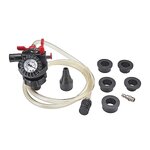
I've been doing a MAJOR cooling System review/rehab on the "Tow-Van." Found a unique tool at HF that helps make the whole "burping" process a piece of cake.
1722388535538.jpeg

It uses your air compressor to create a vacuum in the system (venturi-effect). Then, you fill and get a nearly full and burp-free fill. I've been using it as a fill and flush (4 times over) and tomorrow will do the final fill. The van hasn't had any service on the coolant system by the PO in the last 16 years - so I don't think I'm going overboard! Tool is right at 80 bucks - but requires a source of shop air.

Cheers - Jim
 
you also might consider a triple disc clutch you can ditch your heavy scattershield, the triple disc has much less rotating mass allowing you to go into corners deeper (braking later) and come out quicker due to less rotating weight...
Both my son and I run manual brakes in dedicated C3 roadracers with VARA and SVRA without any issues. Much easier to modulate braking and no issues related to vacuum dropping under acceleration. I am running a Tilton 5.5" diameter clutch with an automatic flex plate. You will find this takes weight off the car as well as rotating inertia. A 7.25" setup is also available. Have to spin the tires to launch but that is part of racing or track day. Using a QuickTime scattershield which also reduces weight as it is smaller in diameter than those designed for larger diameter flywheels. Be sure to center any new scattershield. I learned that hard way by welding the input shaft to the throwout bearing at AutoClub Speedway.
 
Both my son and I run manual brakes in dedicated C3 roadracers with VARA and SVRA without any issues. Much easier to modulate braking and no issues related to vacuum dropping under acceleration. I am running a Tilton 5.5" diameter clutch with an automatic flex plate. You will find this takes weight off the car as well as rotating inertia. A 7.25" setup is also available. Have to spin the tires to launch but that is part of racing or track day. Using a QuickTime scattershield which also reduces weight as it is smaller in diameter than those designed for larger diameter flywheels. Be sure to center any new scattershield. I learned that hard way by welding the input shaft to the throwout bearing at AutoClub Speedway.
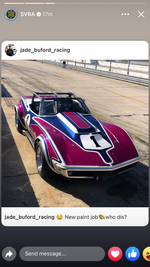
you do NOT need a scatter shield with a triple disc clutch, the QMI and Tilton bell housings are aluminum, I ran the QMI 5.5 with a reverse mount starter reducing my moment of inertia even further...you race SVRA? know this car??image0.png
 
An item I fabricated a couple years ago was an aluminum cross shaft (bellcrank) for the clutch linkage. It's not NCRS compliant, as a couple of the physical dimensions differ from the stock steel piece, but it bolts in the same as the stock piece, and has (thankfully) worked at track days the past two summers as well as the stock piece, even with the damn stiff pressure plate I'm using. Not much mass to lose off the stock piece, but I'll gladly take this one pound reduction off the left front of the car.
 
Glad it worked out. Maybe take a look at motorcycle radiators for your remote application. You may be able to find something that fits size and weight constraints if you shop some wrecked sportbikes. One concern will be it may take longer to burp all the air out of the cooling system, but once fully filled and pressurized, you'll be in good shape.

Excellent suggestion. (y) Until I figure out a satisfactory way to route coolant lines past/rearward of the halfshafts, I might look into trying to package a small radiator into the passenger fender, near the louvers (moving weight rearward and to the right), and then finding a narrower than current front radiator that I can bias to the right of the radiator bracket to reduce weight at the left front.

Just pondering, with the coolant expansion tank at the passenger fender, half of the coolant routing and radiator burping might go pretty easily.
 
If I find myself with excess free time I might think about making a pair of aluminum glasspacks for track days. The current aluminum mufflers weigh 10# each (compared to 16# each for the previous steel turbo mufflers), and the glasspacks might be in the 6# each range. For all the effort I'd rather the weight come off the front, but I can't think of any 8# savings I could currently do to the front.
 
Mike, you are using aluminum pipes also, correct? I assume your entire system (pipes, mufflers) is welded together, no clamps?
 
Mike, you are using aluminum pipes also, correct? I assume your entire system (pipes, mufflers) is welded together, no clamps?

Yeah, everything from the transmission crossmember back is aluminum, with stock looking polished aluminum tips. (The S bend hotter pipes from the header collectors to the trans crossmember area are still steel.) They're slip fits at the crossmember area, but the mufflers are attached to the rear piping behind the spring with aluminum band straps and light weight hose clamps to tighten those band straps (light and cheap).

Oh, and the heavy nasty looking exhaust support at the transmission mount is replaced by a modest aluminum bracket and hose clamps for a few more ounces reduced.
 
IIRC the stock fuel tank in my car is 16 gallon capacity (and twenty something pounds empty IIRC). I've been kicking around for a while the possibility of fitting an 8 to 10 gallon tank from a junk car somewhere and adapting it to mine. The smaller tank should be lighter and smaller in size, which would hopefully allow mounting it on the passenger side of the frame centerline. This would improve L/R weight ratio (but obviously "worsening" F/R weight ratio, but I'll gladly take the hit when reducing total vehicle weight), and reduce lateral weight transfer due to fuel slosh in the corners.
I made a "spa day" at the local Pik-N-Pull today to see what I could find, and pretty much struck out. All the compact cars I could crawl under had pancake shaped tanks, while the Corvette tank is shaped like a big stick of butter. Ideally I was hoping to find a tank that was about 12" by 12" by 15-18" long. I'm not terribly encouraged at the moment, but I'll keep looking.
Another item that may not work out is replacing my aluminum coolant expansion tank with a newer plastic piece. On a slow day sometime I might pull the tank and see what the empty weight of that thing is, and than take my small scale with me on the next trip to the junkyard to compare weights. Until somewhat recently I had a damaged spare aluminum expansion tank, and I had planned on cutting the tank vertically in half at the middle, and then welding a new vertical wall there, reducing the weight and coolant volume. But, it has disappeared during one of my moves the past decade, so scratch that plan.
 
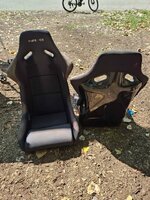
I've been working the floors - drooping them about 2" for seating height. Reg says; a minimum of 2 inches from top of the helmet to top for roll bar/cage. But my "skull bucket" would still "tap" the cage - so I am dropping the floors. [Don't raise the bridge - Lower the Water -obscure movie reference}.

1756516953674.jpeg

The regs don't specifically spec Aluminum seats, so those CF would be a nice addition. Or take lessons from Pappy and DIY!
The regs do spec :
  • One-piece bucket seat: For most events, the driver's seat must be a one-piece, bucket-style race seat that provides strong fore/aft and lateral support.
  • Secure mounting: The seat must be securely mounted to the floor, cage, or transmission tunnel. Bolting through aluminum floor panels is prohibited unless a backing plate of equal or greater thickness is used to distribute the load.
  • Headrest: A system to prevent whiplash and keep the driver's head from striking the roll hoop is required. Racing seats with an integral headrest meet this rule.
  • Harness routing: Aftermarket seats must be installed according to the manufacturer's guidelines and provide appropriate routing for a 5-point (or more) harness.
  • Mounting hardware: All bolts and nuts used for seat mounting must be a minimum of SAE Grade 5 or Metric 8.8.

Rules by racing program
Regulations can differ between SCCA's racing programs (e.g., Solo vs. Time Trials). You should always check the most current rule set for your specific event.
  • For Time Trials and Club Racing: Aftermarket seats are permitted and must meet the general specifications for safety and mounting.
  • For Solo (Autocross): Depending on the specific class, factory original seats may be required. In some cases, a driver's seat may be replaced with a one-piece bucket seat, but stock seats often cannot be modified for harness installation.
  • For Club Spec: In programs like Club Spec, different safety levels dictate what interior modifications are permitted. Upgrading to aftermarket seats and restraints is typically allowed at higher safety levels.
Take that for "what it's worth" its an AI ref, but pretty close to facts. I'll be in Special Production - so some open options - but the safety section [Chapter/Section/Appendix 9] is not a waver-able item.

BTW, all the form cars tend to use the floor pan and rear firewall with a foam insert as the seat. I've considered that too.

Cheers - Jim
 
This probably doesn’t have any cert, but I’m thinking about using it as a passenger seat. Looks like a copy of a Kirkey pro street.

6 lbs, under $450

EDIT. Looks like it sold out.

https://www.amazon.com/Unlimited-Pr...2lkZ2V0TmFtZT1zcF9waG9uZV9zZWFyY2hfYXRm&psc=1

$450 is a bit out of my budget, but I certainly would love to take more weight out of the left side of the car. I'm presently using seats out of a '79 Corvette (Thank you again Karsten!). IIRC they are 12# lighter each compared to the original '69 seats, and heaven knows, have significantly more side bolster than the stock seats. I need to reweigh one of these seats to refresh my memory of the actual weight.
I never think about seat weight while I'm wandering the junkyards. I should start bringing my portable scale with me on future trips. While I concede that racing seats will be lighter, I'm trying to keep my car looking somewhat stock if I can.

Edit: I weighed the '79 seat, and it's 19#. That gives me a baseline for comparison with any junkyard candidates.
 
Last edited:
Just a thought - and across town:
1756680784435.jpeg

On FB. listed as John Chase for $200. Looks like could use some work - but lightweight?
Disregard - weight more than the "79 seat - maybe.
Cheers - and happy hunting!
Jim
 
The '79 seats are very light for a factory seat, I'm not sure that my fibreglass buckets are much lighter at all. I normally leave the bucket in the drivers side and the factory seat in the passenger side so that I can still access the rear, I only bolt both buckets in when running and event that allows passengers or requires a codriver.
 
Running out of better and easier weight reduction ideas, so I'm looking at two items this winter.
1) Going to try to locate a used C3 fuel tank for modification. I believe I mentioned this before, but I'm thinking of cutting off the left half of the tank, and welding in a new sidewall just to the left of the fill port. This should take half a dozen pounds off the tank weight, bias the tank and fuel weight to the right side of the vehicle centerline, and if my thinking is correct, the force vector of the fuel weight and the fuel slosh in a right hand corner might still remain within the rear axle trackwidth. (That vector will be way outside the axle trackwidth in a left turn, but there's enough driver ballast to offset that. :giggle:) I have to still confirm my understanding of the tank empty weight (I believe a helpful member here gave me a weight for the tank previously in this thread), and I also have to confirm that the gas gauge float will still package in there.
2) Just ounces here, but I'm going to drill a few big holes in the P/S pulley. The original composite serpentine pulley on the pump weighed 8 ounces, but the steel vee pulley I'm currently using is 15.5 ounces. It's rotating weight up front, so I'm willing to put in the effort for those few ounces.
 
Tanks are pretty heavy. You car is probably old enough not to have the steel crash protection cover. That thing is heavy. You can mount a small fuel cell pretty easy on the oem brackets. And, the fuel cell can’t be seen from the rear.
 
There used to be an extensive list of part weights in the "Tech Section" but it seems to have disappeared. That's a shame, lots of good information there.

I didn't know modern vehicles with ~10 gallon tanks existed until I filled our CR-V with a little less than 12 gallons. I found this list of newish cars with small tanks:

Smart ForTwo Passion 8.7
Chevrolet Volt 9.3
Fiat 500 Sport 10.5
Fiat 500c Pop 10.5
Honda CR-Z EX 10.6
Honda Fit (base) 10.6
Honda Fit Sport (manual) 10.6
Honda Insight 10.6
Scion xD (base) 11.1
Scion xD (base manual) 11.1
Toyota Yaris LE 11.1
Kia Rio EX hatchback 11.3
Kia Rio EX sedan 11.3
Mazda2 Sport (manual) 11.3
Mazda2 Touring 11.3
Nissan Versa sedan SV 11.3
Hyundai Accent GLS 11.4
Hyundai Accent SE (manual) 11.4
Lexus CT 200h Premium 11.9
Suzuki SX4 Tech hatchback 11.9
Toyota Prius IV 11.9
Toyota Prius V Three 11.9
Chevrolet Sonic LT 12.2
Chevrolet Sonic LTZ (manual) 12.2
Ford Fiesta SES hatchback (manual) 12.4
Ford Fiesta SE sedan 12.4
Ford Focus SEL hatchback 12.4
Ford Focus SE sedan 12.4
Nissan Juke 11.9
 
Back
Top