Antique John Deere tractor got me thinking about C3 aero stuff.

VetteMod - Corvette Restoration, Modding & Performance Forum

Help Support VetteMod Forum:

69427

The Artist formerly known as Turbo84
Joined
Mar 30, 2008
Messages
3,080
Reaction score
42
City & State/Province
Clinging to my guns and religion in KCMO.
My dad had several antique JD tractors (30s and 40s vintage) which he enjoyed as a retirement hobby. The older JD engines didn't have thermostats, but they had a shutter system in front of the radiator so the driver could regulate the airflow into the radiator to set the coolant temps. That got me thinking about a few engine and aero issues relating to our antique C3s when we try to have some high speed fun with them. It seems counterproductive to let great volumes of air into the pre-radiator plenum area, creating lift, and also producing such a great heat exchange out of the radiator that the thermostat ends up restricting the coolant flow to maintain a minimum coolant temp. It seems to me that it would be better to restrict the airflow into the plenum (with the positive side-effect being reduced lift), and causing the thermostat to open wider, allowing higher coolant flow. Higher coolant flow, while still maintaining the same BTU heat exchange with the air, would reduce the temperature drop across the radiator, and as we know, this would also reduce the temperature rise across the engine. Higher coolant flow will scrub away steam bubbles better, and reducing the cross-engine temperature delta should help engine longevity.
My point is, I think I'm going to add another item to my modification list for the '69. I'm thinking about fabricating some blockoff panels to attach to the three underbumper grills to restrict the flow into the plenum (I still have the undergrill openings and a pace car spoiler to obtain air). If I overreach with this, or end up running on a particulary hot track day, I can always remove one of the blockoffs. So far I've had little overheating issues with the stock radiator during track days, and last year I put in a new DeWitts aluminum radiator. The new radiator doesn't have 40 years of internal scaling in it, so it ought to be a more efficient heat exchanger than the "well deserved retirement" original.

Just something I'm kicking around. Any thoughts or comments?

thanks,
Mike
 
I'm thinking about fabricating some block off panels to attach to the three under bumper grills to restrict the flow into the plenum (I still have the undergrill openings and a pace car spoiler to obtain air). If I overreach with this, or end up running on a particularly hot track day, I can always remove one of the block offs.

Not sure of the accuracy of this but when the 68 was introduced, the three under bumper grill openings were not there. I believe that the cars were recalled (or a bulletin was issued) where the three holes were cut into early 68's. I have no idea of this is true or urban legend but, supposedly, the cause was overheating.

It's an interesting concept. I'm amazed at how small the radiator openings are for race cars but I guess a small opening flows a lot of air at 200mph!
 
Not sure of the accuracy of this but when the 68 was introduced, the three under bumper grill openings were not there. I believe that the cars were recalled (or a bulletin was issued) where the three holes were cut into early 68's. I have no idea of this is true or urban legend but, supposedly, the cause was overheating.

This is true...
 
MY heat problems were ABOVE 70 mph- I pulled the front license plate and bracket- end of problem. Never been fast enough with Ol' Red to feel any lift, the 4:11's don't like that too much and I get a little chicken above 6500 rpm.
 
MY heat problems were ABOVE 70 mph- I pulled the front license plate and bracket- end of problem. Never been fast enough with Ol' Red to feel any lift, the 4:11's don't like that too much and I get a little chicken above 6500 rpm.

Come ON dude!!!, we need go for a RIDE, flip it into OVERdrive....

:bounce::bump:
 
Move the radiator to the rear , close off the front. :)

Seriously, I thought about that. If I had side pipes (no mufflers in the tail) I'd be doing some parts moving. A radiator with two or three gallons of water in it is 35-40 pounds of rear weight instead of front weight.
But, I've got (heat radiating) mufflers back there (and I guess I'm still a bit paranoid to drive on the highway without a spare tire back there).
 
I'm thinking about fabricating some block off panels to attach to the three under bumper grills to restrict the flow into the plenum (I still have the undergrill openings and a pace car spoiler to obtain air). If I overreach with this, or end up running on a particularly hot track day, I can always remove one of the block offs.

Not sure of the accuracy of this but when the 68 was introduced, the three under bumper grill openings were not there. I believe that the cars were recalled (or a bulletin was issued) where the three holes were cut into early 68's. I have no idea of this is true or urban legend but, supposedly, the cause was overheating.

It's an interesting concept. I'm amazed at how small the radiator openings are for race cars but I guess a small opening flows a lot of air at 200mph!

It was my impression that it was the two undergrill openings that were a last minute design/manufacturing change.
 
I would suspect the shutter system would work well, but is all at low speed.
Semi trucks use a variant to help in cold weather, as they run cold.
I was at the radiator shop today, and learned some more.
Vette radiators are built at 16 fins to the inch. They cool well at idle, and at speed work fine.
The 19 fin per inch radiator cools better at speed, but tends to overheat at idle, due to low airflow at idle with just a fan. But, with 19 fins oper inch, they are superior at speed.
Don't know if this helps, but is related.
 
Move the radiator to the rear , close off the front. :)

Seriously, I thought about that. If I had side pipes (no mufflers in the tail) I'd be doing some parts moving. A radiator with two or three gallons of water in it is 35-40 pounds of rear weight instead of front weight.
But, I've got (heat radiating) mufflers back there (and I guess I'm still a bit paranoid to drive on the highway without a spare tire back there).

Seems that side pipes would allow for many other options , does HP always suffer with side pipes ?

If one moved things around a bit ,
could you split the radiator with 1/2 on each side in the rear to allow for the spare?
could a minimum diameter and very narrow and light spare and be put in the area between the waterpump and front bumper ?
could you split the fuel tank and mount the radiator in the back wall of the storage area behind the seats and use the cabin air to cool the radiator ( this one allows the driver to bring air inside where he needs it for personal cooling)?
could you split both the radiator and fuel tank and being they are smaller find new places to mount ?
if the radiator is moved to the rear could the conduit to get the coolant to the rear be the type that I've seen on big compressors with fins around the conduit to remove heat ( will the added coolant from going to the rear be a plus ?)
if you would route the coolant to the rear could you mount the tubing to the frame and use the frame to absorb heat requiring less radiator ?

Sorry its early , I've had many cups of coffee , I'll climb back inside the box as soon as the caffeine wears off. :lol:
 
Last edited:
Mike, I'm not an aero guy, but I work around a lot of them. Some of it rubs off:suspicious: Seems to me, that front end lift is related to redirected air through the radiator. The mass of that air redirected down at an angle induces a force upward lifting the front end. On the other hand, any air that travels over the top of the core support induces a force down. Trick is to control air flow such to cancel the forces. Maybe some kind of variable ducted flow at the top of the core support at speed. Of course the air that travels over the top needs a path out of the engine compartment. My old L-88 hood on RamJet, which doesn't have an air chamber provides this.
Just some out of the box thinking?

Bullshark
 
a simple solution but wont work to easily on a C3.

gt40.jpg
 
ACtually it's a lot easier than it seems to do an extractor hood on a C3, all you have to do is reposition the radiator and use a lift off type hood. The blue John Paul race car has an extractor hood
 
I like this idea. Would you have a number of fixed panels to block of air and then "tune" the set up at the track or do you plan on using a lever in-cab to actuate shutters?
 
I like this idea. Would you have a number of fixed panels to block of air and then "tune" the set up at the track or do you plan on using a lever in-cab to actuate shutters?

Ideally I'd love to have something that would automatically regulate the airflow dependent upon coolant temperature so that only the minimum amount of air that provides sufficient cooling is allowed into the underhood area. But, that seems a bit complex (although it could be done reasonably easy with a temperature sensor, some electronics, and some actuators) and might be possibly a bit "heavy" (I hate adding weight to a car). So for now, (it's still the experimental stage) I'm just going to block off the grill areas (relying on the undergrill holes for radiator air) and see what the coolant temps run. The main focus of this is for track days. If the airflow is insufficient for cooling at the higher speeds on the track, my plan was to remove a blockoff plate or reduce the size of the plate(s) to allow more air into the radiator.
I've considered using a cable into the "cab" to manually control some shutters, but I haven't currently figured out a clean way to incorporate them into the grillwork while retaining the stock appearance.
 
Meanwhile toward a better street machine, with less underhood temps...an old thought from last winter,....

the Spals in my car are angled down to the floor, like the rad , so they do not blow any much air over the engine/headers....nor allow any lift under the hood, but I wonder if maybe I loosing some cooling power there, since the a/c seems stressed in summer....

so the thought is, would it make a difference IF the fans were remounted to face straight back toward the engine?? lower underhood temps and therefore making the a/c blow colder?? same sort of thing like maybe the stock fan position, but electric and of course wider....

anyone??

:clobbered::nuts: ?
 
I stopped at a couple places at lunchtime looking for some grill blockoff material, but no luck. I first stopped at a craft type store and struck out, but did find some modeling clay to check my intake valve to cylinder wall clearance later on. Stopped at Blowes hardware, and nothing there either. I'm trying to find something similar to the production plastic sheet material that protects the headlights behind the grills on my '69. Anyone know who might carry something like that? McMaster-Carr probably does, but I'd sure like to find someplace local if I could.

Any suggestions?
 
I like this idea. Would you have a number of fixed panels to block of air and then "tune" the set up at the track or do you plan on using a lever in-cab to actuate shutters?

Ideally I'd love to have something that would automatically regulate the airflow dependent upon coolant temperature so that only the minimum amount of air that provides sufficient cooling is allowed into the underhood area.

It seems to me that would adjust the front lift automatically, perhaps an undesired effect at times.:sweat:
 
.....................It seems to me that would adjust the front lift automatically, perhaps an undesired effect at times.:sweat:

You are absolutely correct. On a cool day, the lift would be minimized. Excellent. On a hot day, however, the flaps/shutters would open fully, resulting in a semi-crappy lift situation identical to what I have to contend with presently. Restricting the air isn't a cure-all, but at least the worst case situation is not worse than the current situation.
 
Last edited by a moderator:
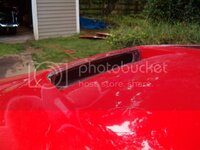
Bringing this thread back to show my small mod to help evacuate some of the air from under the nose. Just cut out the vents in my (real :rolleyes: ) BB hood
I had the bezels out so I could paint them so I snapped a few pics:

Here is the hole behind the bezel. You can barely see the rad support right in front of the hole:
DSCF1109.jpg

And a close up of the rad support as seen through the hole:
DSCF1110.jpg

And an old pic of the bezels installed. I just painted them satin black. Hopefully they look as good in daylight as they do in the dark...
HPIM1672.jpg

If you didnt already notice, I dont run any seals around my rad. The car will run at 195* all day in traffic, freeway and higher speeds. Besides that, I would think that running without the seals around the radiator would help with under-nose pressures since not all of the air has to be forced through the radiator. Ive also been running around with my front license plate mounted (zip tied). Besides keeping the LEO's happy, it should also help keep some more air out of the nose. The zip ties also let it sit on an angle so that it kind of flows with the lower valance.
 
If you didnt already notice, I dont run any seals around my rad. The car will run at 195* all day in traffic, freeway and higher speeds. Besides that, I would think that running without the seals around the radiator would help with under-nose pressures since not all of the air has to be forced through the radiator. Ive also been running around with my front license plate mounted (zip tied). Besides keeping the LEO's happy, it should also help keep some more air out of the nose. The zip ties also let it sit on an angle so that it kind of flows with the lower valance.

James Bond, the zip tied front tag.....I like it, IF I had to run a front tag in Florida, I would have made the front grill to take one with just that concept, that at speed the tag would flip up out of the way via air pressure, it's only aluminum after all, and when stopped, the cops should be happy....

:drink:
 
Back
Top